Sá Gustavo Pilotto D, Vicentine Fernando P P, Salzedas-Netto Alcides A, Matos Carla Adriana Loureiro de, Romero Luiz R, Tejada Dario F P, Massarollo Paulo Celso Bosco, Lopes-Filho Gaspar J, Gonzalez Adriano M
Postgraduation Program in Interdisciplinary Surgical Science, Federal University of São Paulo, São Paulo, SP, Brazil.
; Sector of Liver Transplantation, Discipline of Surgical Gastroenterology, Federal University of São Paulo; São Paulo, SP, Brazil.
Arq Bras Cir Dig. 2016 Nov-Dec;29(4):240-245. doi: 10.1590/0102-6720201600040007.
The criterion of Milan (CM) has been used as standard for indication of liver transplantation (LTx) for hepatocellular carcinoma (HCC) worldwide for nearly 20 years. Several centers have adopted criteria expanded in order to increase the number of patients eligible to liver transplantation, while maintaining good survival rates. In Brazil, since 2006, the criterion of Milan/Brazil (CMB), which disregards nodules <2 cm, is adopted, including patients with a higher number of small nodules.
To evaluate the outcome of liver transplantation within the CMB.
The medical records of patients with HCC undergoing liver transplantation in relation to recurrence and survival by comparing CM and CMB, were analyzed.
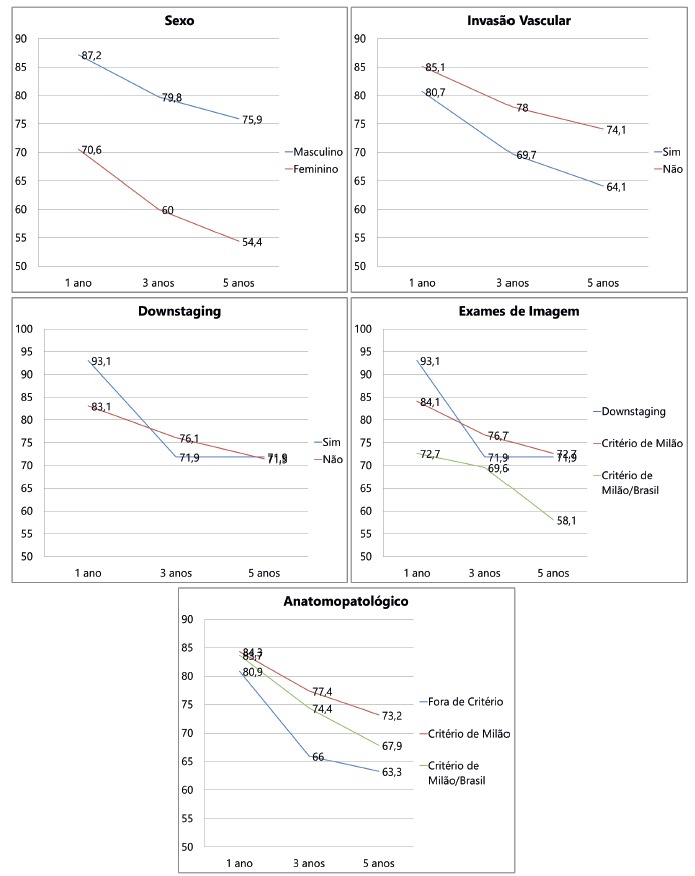
414 LTx for HCC, the survival at 1 and 5 years was 84.1 and 72.7%. Of these, 7% reached the CMB through downstaging, with survival at 1 and 5 years of 93.1 and 71.9%. The CMB patient group that exceeded the CM (8.6%) had a survival rate of 58.1% at five years. There was no statistical difference in survival between the groups CM, CMB and downstaging. Vascular invasion (p<0.001), higher nodule size (p=0.001) and number of nodules >2 cm (p=0.028) were associated with relapse. The age (p=0.001), female (p<0.001), real MELD (p<0.001), vascular invasion (p=0.045) and number of nodes >2 cm (p<0.014) were associated with worse survival.
CMB increased by 8.6% indications of liver transplantation, and showed survival rates similar to CM.
米兰标准(CM)近20年来一直被用作全球肝细胞癌(HCC)肝移植(LTx)的适应症标准。为了增加符合肝移植条件的患者数量,同时保持良好的生存率,一些中心采用了扩展标准。在巴西,自2006年起采用米兰/巴西标准(CMB),该标准忽略直径<2 cm的结节,纳入了更多小结节患者。
评估CMB标准下肝移植的结果。
通过比较CM和CMB,分析HCC患者肝移植的病历,以了解复发和生存情况。
414例HCC患者接受肝移植,1年和5年生存率分别为84.1%和72.7%。其中,7%的患者通过降期达到CMB标准,1年和5年生存率分别为93.1%和71.9%。超过CM标准的CMB患者组(8.6%)5年生存率为58.1%。CM、CMB和降期组之间的生存率无统计学差异。血管侵犯(p<0.001)、较大结节大小(p=0.001)和直径>2 cm的结节数量(p=0.028)与复发相关。年龄(p=0.001)、女性(p<0.001)、实际终末期肝病模型(MELD)评分(p<0.001)、血管侵犯(p=0.045)和直径>2 cm的结节数量(p<0.014)与较差的生存率相关。
CMB标准使肝移植适应症增加了8.6%,且生存率与CM标准相似。