Chaib Eleazar, Massad Eduardo, Varone Bruno Butturi, Bordini Andre Leopoldino, Galvão Flavio Henrique Ferreira, Crescenzi Alessandra, Filho Arnaldo Bernal, D'Albuquerque Luiz Augusto Carneiro
Division of Liver Transplantation, LIM 37, Department of Gastroenterology, São Paulo School of Medicine, Suite 3206, 3rd Foor, 01246-903 São Paulo, SP, Brazil.
Department of Informatics, LIM 01, University of São Paulo School of Medicine, 01246-903 São Paulo, SP, Brazil.
J Transplant. 2014;2014:219789. doi: 10.1155/2014/219789. Epub 2014 Nov 27.
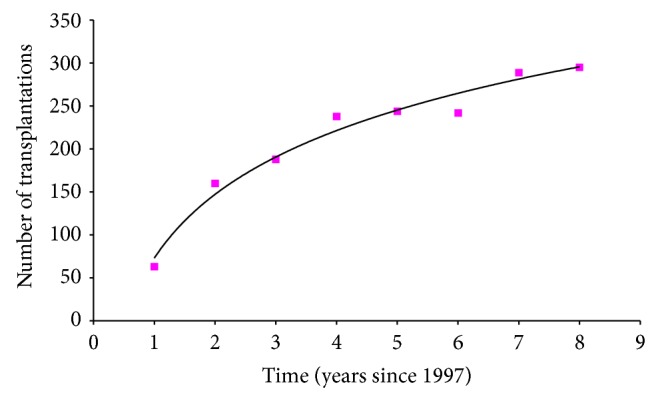
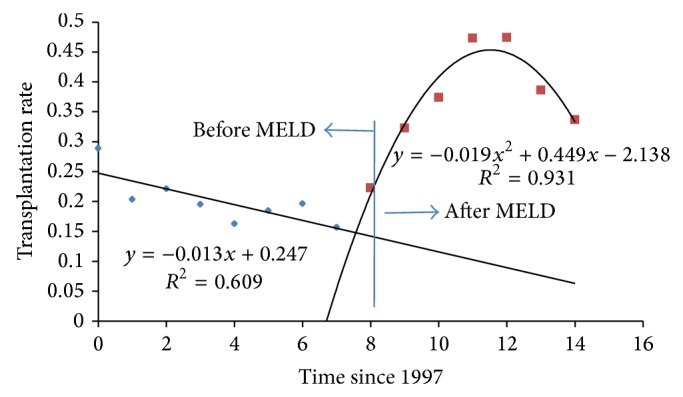
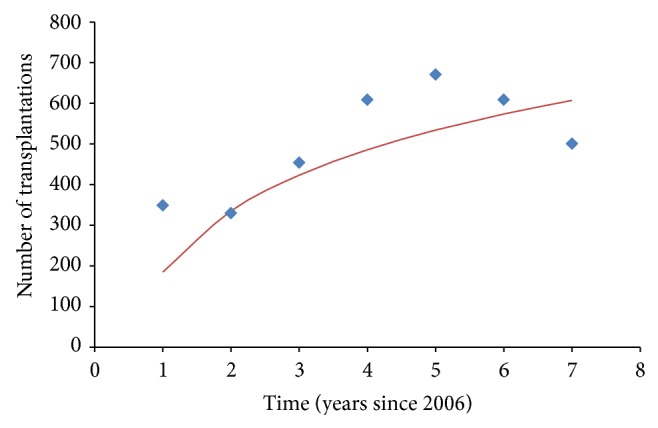
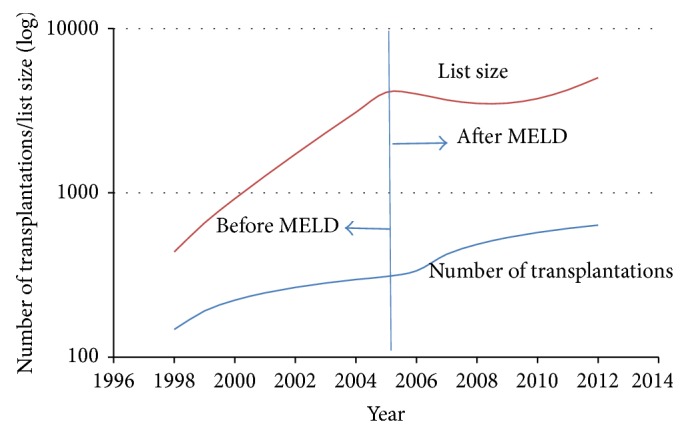
Until July 15, 2006, the time on the waiting list was the main criterion for allocating deceased donor livers in the state of São Paulo, Brazil. After this date, MELD has been the basis for the allocation of deceased donor livers for adult transplantation. Our aim was to compare the waitlist dynamics before MELD (1997-2005) and after MELD (2006-2012) in our state. A retrospective study was conducted including the data from all the liver transplant candidate waiting lists from July 1997 to December 2012. The data were related to the actual number of liver transplantations (Tr), the incidence of new patients on the list (I), and the number of patients who died while being on the waitlist (D) from 1997 to 2005 (the pre-MELD era) and from 2006 to 2012 (the post-MELD era). The number of transplantations from 1997 to 2005 and from 2006 to 2012 increased nonlinearly, with a clear trend to levelling to equilibrium at approximately 350 and 500 cases per year, respectively. The implementation of the MELD score resulted in a shorter waiting time until liver transplantation. Additionally, there was a significant effect on the waitlist dynamics in the first 4 years; however, the curves diverge from there, implying a null long-range effect on the waitlist by the MELD scores.
直到2006年7月15日,在巴西圣保罗州,等待名单上的时间一直是分配已故捐赠者肝脏的主要标准。在此日期之后,终末期肝病模型(MELD)成为成人肝移植中分配已故捐赠者肝脏的依据。我们的目的是比较本州在采用MELD评分之前(1997 - 2005年)和之后(2006 - 2012年)等待名单的动态变化。我们进行了一项回顾性研究,纳入了1997年7月至2012年12月期间所有肝移植候选者等待名单的数据。这些数据涉及实际肝移植手术数量(Tr)、名单上新患者的发生率(I)以及1997年至2005年(MELD评分前时代)和2006年至2012年(MELD评分后时代)等待名单上死亡患者的数量(D)。1997年至2005年以及2006年至2012年的肝移植手术数量呈非线性增长,明显趋势是分别稳定在每年约350例和500例的平衡水平。MELD评分的实施使肝移植前的等待时间缩短。此外,在最初4年对等待名单动态有显著影响;然而,从那时起曲线出现分歧,这意味着MELD评分对等待名单没有长期影响。