Fabiani Emiliano, Falconi Giulia, Fianchi Luana, Criscuolo Marianna, Ottone Tiziana, Cicconi Laura, Hohaus Stefan, Sica Simona, Postorino Massimiliano, Neri Antonino, Lionetti Marta, Leone Giuseppe, Lo-Coco Francesco, Voso Maria Teresa
Department of Biomedicine and Prevention, Universita' Tor Vergata, Rome, Italy.
Department of Hematology, Universita' Cattolica S. Cuore, Rome, Italy.
Oncotarget. 2017 Feb 14;8(7):12031-12040. doi: 10.18632/oncotarget.14509.
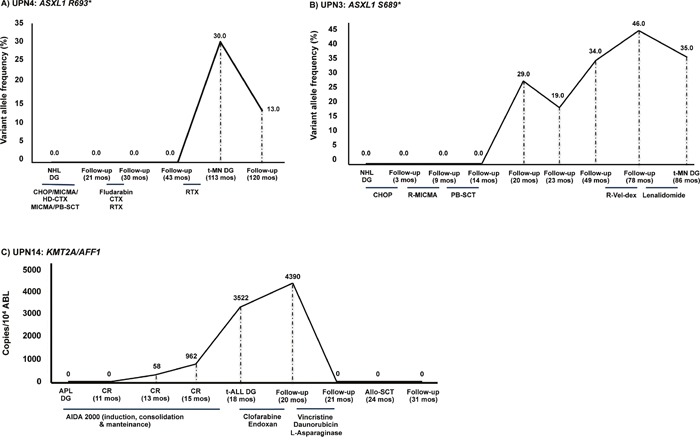
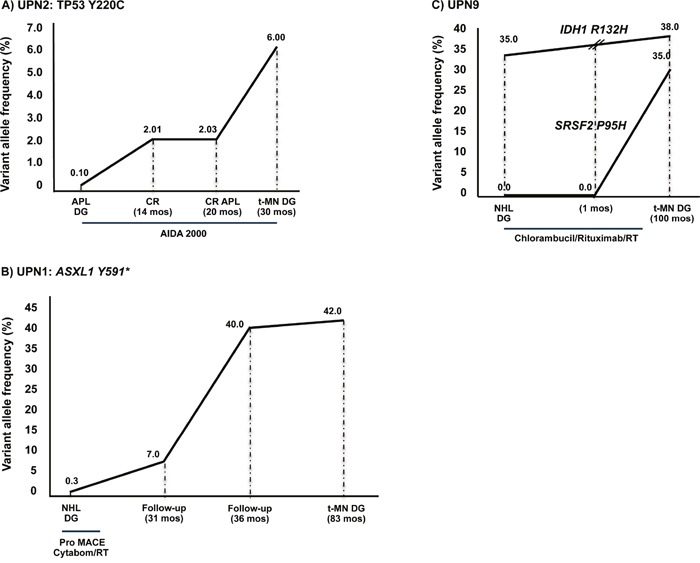
Therapy-related myeloid neoplasms (t-MN) may occur as a late effect of cytotoxic therapy for a primary malignancy or autoimmune diseases in susceptible individuals. We studied the development of somatic mutations in t-MN, using a collection of follow-up samples from 14 patients with a primary hematologic malignancy, who developed a secondary leukemia (13 t-MN and 1 t-acute lymphoblastic leukemia), at a median latency of 73 months (range 18-108) from primary cancer diagnosis.Using Sanger and next generation sequencing (NGS) approaches we identified 8 mutations (IDH1 R132H, ASXL1 Y591*, ASXL1 S689*, ASXL1 R693*, SRSF2 P95H, SF3B1 K700E, SETBP1 G870R and TP53 Y220C) in seven of thirteen t-MN patients (54%), whereas the t-ALL patient had a t(4,11) translocation, resulting in the KMT2A/AFF1 fusion gene. These mutations were then tracked backwards in marrow samples preceding secondary leukemia occurrence, using pyrosequencing and a NGS protocol that allows the detection of low variant allele frequencies (≥0.1%).Somatic mutations were detectable in the BM harvested at the primary diagnosis, prior to any cytotoxic treatment in three patients, while they were not detectable and apparently acquired by the t-MN clone in five patients.These data show that clonal evolution in t-MN is heterogeneous, with some somatic mutations preceding cytotoxic treatment and possibly favoring leukemic development.
治疗相关的髓系肿瘤(t-MN)可能作为细胞毒性治疗对原发性恶性肿瘤或易感个体自身免疫性疾病的晚期效应而出现。我们研究了t-MN中体细胞突变的发生情况,使用了14例原发性血液系统恶性肿瘤患者的随访样本集合,这些患者在原发性癌症诊断后中位潜伏期73个月(范围18 - 108个月)时发生了继发性白血病(13例t-MN和1例t-急性淋巴细胞白血病)。通过桑格测序和新一代测序(NGS)方法,我们在13例t-MN患者中的7例(54%)中鉴定出8种突变(异柠檬酸脱氢酶1(IDH1)R132H、附加体结合蛋白1(ASXL1)Y591*、ASXL1 S689*、ASXL1 R693*、丝氨酸/精氨酸丰富剪接因子2(SRSF2)P95H、剪接因子3b亚基1(SF3B1)K700E、SET结合蛋白1(SETBP1)G870R和肿瘤蛋白p53(TP53)Y220C),而t-ALL患者有t(4;11)易位,导致赖氨酸甲基转移酶2A(KMT2A)/AF4融合基因。然后,使用焦磷酸测序和一种能够检测低变异等位基因频率(≥0.1%)的NGS方案,在继发性白血病发生之前的骨髓样本中追溯这些突变。在3例患者中,在初次诊断时采集的骨髓中可检测到体细胞突变,此时尚未进行任何细胞毒性治疗,而在5例患者中未检测到体细胞突变,这些突变显然是由t-MN克隆获得的。这些数据表明,t-MN中的克隆进化是异质性的,一些体细胞突变在细胞毒性治疗之前就已存在,并可能促进白血病的发生。