Ampuja M, Rantapero T, Rodriguez-Martinez A, Palmroth M, Alarmo E L, Nykter M, Kallioniemi A
BioMediTech, University of Tampere, Tampere, Finland.
Fimlab Laboratories, Tampere, Finland.
BMC Genomics. 2017 Jan 11;18(1):68. doi: 10.1186/s12864-016-3428-1.
Bone morphogenetic protein 4 (BMP4) plays an important role in cancer pathogenesis. In breast cancer, it reduces proliferation and increases migration in a cell line-dependent manner. To characterize the transcriptional mediators of these phenotypes, we performed RNA-seq and DNase-seq analyses after BMP4 treatment in MDA-MB-231 and T-47D breast cancer cells that respond to BMP4 with enhanced migration and decreased cell growth, respectively.
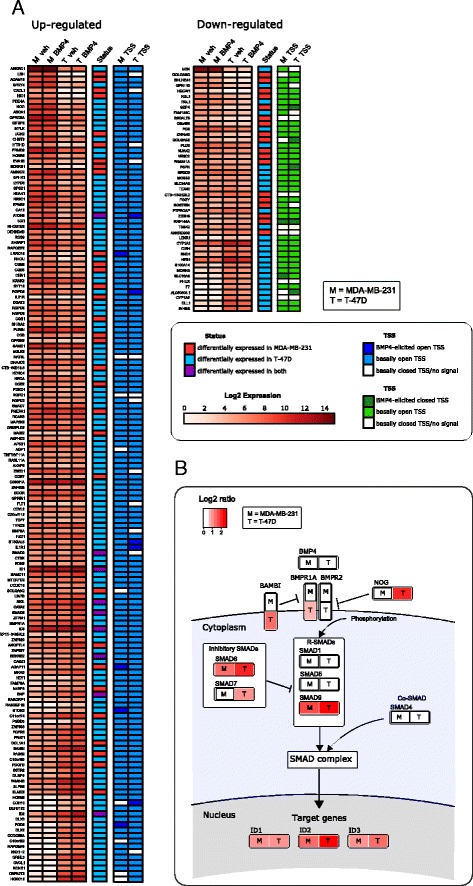
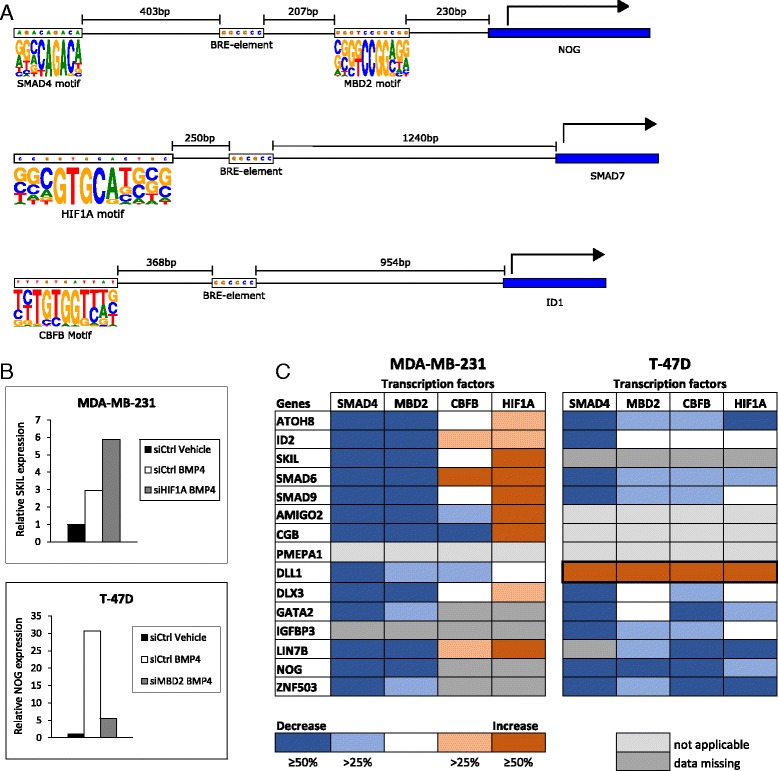
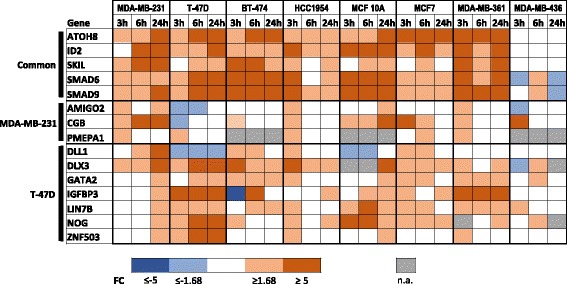
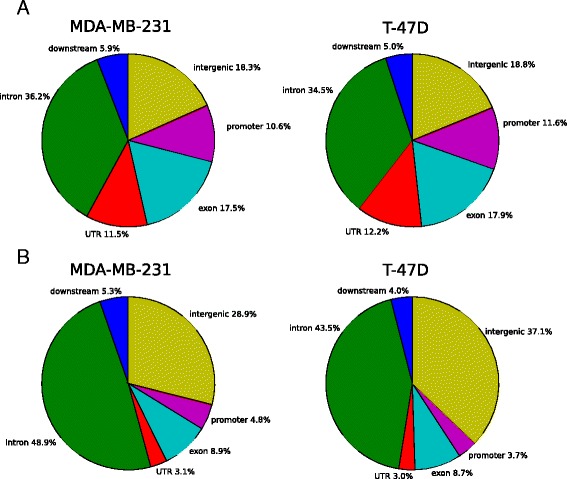
The RNA-seq data revealed gene expression changes that were consistent with the in vitro phenotypes of the cell lines, particularly in MDA-MB-231, where migration-related processes were enriched. These results were confirmed when enrichment of BMP4-induced open chromatin regions was analyzed. Interestingly, the chromatin in transcription start sites of differentially expressed genes was already open in unstimulated cells, thus enabling rapid recruitment of transcription factors to the promoters as a response to stimulation. Further analysis and functional validation identified MBD2, CBFB, and HIF1A as downstream regulators of BMP4 signaling. Silencing of these transcription factors revealed that MBD2 was a consistent activator of target genes in both cell lines, CBFB an activator in cells with reduced proliferation phenotype, and HIF1A a repressor in cells with induced migration phenotype.
Integrating RNA-seq and DNase-seq data showed that the phenotypic responses to BMP4 in breast cancer cell lines are reflected in transcriptomic and chromatin levels. We identified and experimentally validated downstream regulators of BMP4 signaling that relate to the different in vitro phenotypes and thus demonstrate that the downstream BMP4 response is regulated in a cell type-specific manner.
骨形态发生蛋白4(BMP4)在癌症发病机制中起重要作用。在乳腺癌中,它以细胞系依赖的方式降低细胞增殖并增加细胞迁移。为了表征这些表型的转录调节因子,我们在BMP4处理MDA-MB-231和T-47D乳腺癌细胞后进行了RNA测序和DNase测序分析,这两种细胞系分别对BMP4产生迁移增强和细胞生长减少的反应。
RNA测序数据揭示了与细胞系体外表型一致的基因表达变化,特别是在MDA-MB-231中,其中与迁移相关的过程得到富集。当分析BMP4诱导的开放染色质区域的富集情况时,这些结果得到了证实。有趣的是,差异表达基因转录起始位点的染色质在未受刺激的细胞中已经开放,因此能够在刺激后迅速将转录因子募集到启动子上。进一步的分析和功能验证确定MBD2、CBFB和HIF1A为BMP4信号的下游调节因子。对这些转录因子的沉默表明,MBD2在两种细胞系中都是靶基因的一致激活剂,CBFB在增殖表型降低的细胞中是激活剂,而HIF1A在诱导迁移表型的细胞中是抑制剂。
整合RNA测序和DNase测序数据表明,乳腺癌细胞系对BMP4的表型反应反映在转录组和染色质水平上。我们鉴定并通过实验验证了与不同体外表型相关的BMP4信号下游调节因子,从而证明下游BMP4反应是以细胞类型特异性方式调节的。