van Drongelen Alwin, Boot Cécile R L, Hlobil Hynek, van der Beek Allard J, Smid Tjabe
Department of Public and Occupational Health, EMGO Institute for Health and Care Research, VU University Medical Center, PO Box 7057, Amsterdam, 1007 MB, The Netherlands.
KLM Health Services, Schiphol Airport, Schiphol, The Netherlands.
BMC Public Health. 2017 Jan 11;17(1):67. doi: 10.1186/s12889-016-3906-z.
Exposure to shift work has been associated with negative health consequences, although the association between shift work and sickness absence remains unclear. The aim of this study is to investigate associations between cumulative exposure to shift work and sickness absence among ground staff employees of an airline company.
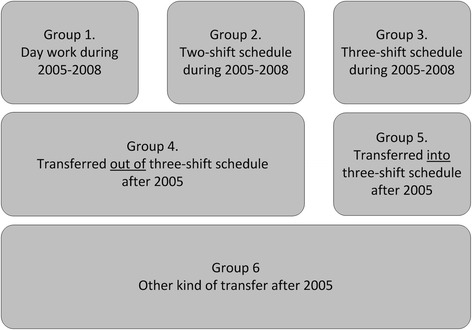
This study used data from the MORE (Monitoring Occupational Health Risks in Employees) cohort, which is a 5-year historic cohort. The population of the present study consisted of 7562 ground staff employees. For each employee, work schedules and sickness absence days between 2005 and 2009 were obtained from company records. For the exposure to different shift schedule types and to the cumulative number of night shifts, the association with long-term sickness absence (>7 consecutive sickness absence days) and the number of sickness absence episodes during 2009, was calculated using logistic and Poisson regression analyses. Socio-demographic variables, work-related variables, job classification variables, and previous sickness absence days were regarded as confounders.
After adjusting for previous sickness absence and job classification variables, only the group of employees that switched into working in a three-shift schedule, showed a significantly increased risk for long-term sickness absence (OR = 1.31, 95%CI 1.02-1.69). Night shift exposure was not significantly associated with long-term sickness absence. Exposure to shift work was negatively associated with more sickness absence episodes. Employees who were exposed to more than 46 night shifts also showed a lower risk for more sickness absence episodes. Subgroup analyses showed that single employees and employees without children had an increased risk for long-term sickness absence when exposed to a three-shift schedule, and when they had changed between shift schedule types.
Cumulative exposure to shift work proved to be negatively associated with more sickness absence episodes, and was not associated with more long-term sickness absence, although selection bias could not be ruled out. Future research should explore the influence of household composition, and take into account both previous sickness absence and psychosocial and physical work factors to obtain a better estimation of the association between shift work and sickness absence.
尽管轮班工作与病假之间的关联尚不清楚,但接触轮班工作已被证明会对健康产生负面影响。本研究旨在调查航空公司地勤人员累积接触轮班工作与病假之间的关联。
本研究使用了MORE(监测员工职业健康风险)队列的数据,这是一个为期5年的历史性队列。本研究的人群包括7562名地勤人员。对于每位员工,从公司记录中获取了2005年至2009年的工作时间表和病假天数。对于不同轮班时间表类型的接触以及夜班累积次数,使用逻辑回归和泊松回归分析计算了与长期病假(连续病假超过7天)以及2009年病假发作次数的关联。社会人口统计学变量、工作相关变量、工作分类变量和既往病假天数被视为混杂因素。
在调整了既往病假和工作分类变量后,只有转为三班制工作的员工组显示长期病假风险显著增加(OR = 1.31,95%CI 1.02 - 1.69)。夜班接触与长期病假无显著关联。轮班工作接触与更多的病假发作呈负相关。接触超过46个夜班的员工也显示出更多病假发作的风险较低。亚组分析表明,单身员工和没有孩子的员工在接触三班制时间表以及在不同轮班时间表类型之间转换时,长期病假风险增加。
尽管不能排除选择偏倚,但累积接触轮班工作被证明与更多的病假发作呈负相关,且与更多的长期病假无关。未来的研究应探讨家庭构成的影响,并考虑既往病假以及心理社会和身体工作因素,以更好地估计轮班工作与病假之间的关联。