Jia Haomiao, Lubetkin Erica I
Department of Biostatistics, Mailman School of Public Health and School of Nursing, Columbia University, 617 West 168th Street, New York, NY, 10032, USA.
Department of Community Health and Social Medicine, CUNY School of Medicine, New York, NY, USA.
Health Qual Life Outcomes. 2017 Jan 11;15(1):9. doi: 10.1186/s12955-016-0582-8.
Quality-adjusted life years (QALY) is a single value index that quantifies the overall burden of disease. It reflects all aspects of heath, including nonfatal illness and mortality outcomes by weighting life-years lived with health-related quality of life (HRQOL) scores. This study examine the burden of disease due to increasing levels of depressive symptoms by examining the association between the 9-item Patient Health Questionnaire (PHQ-9) scores and QALY for U.S. adults aged 65 years and older.
We ascertained respondents' HRQOL scores and mortality status from the 2005-2006, 2007-2008, and 2009-2010 cohorts of the National Health and Nutrition Examination Survey (NHANES) with mortality follow-up data through December 31, 2011. This analysis included respondents aged 65 years and older (n = 3,680). We estimated the mean QALY throughout the remaining lifetime according to participants' depression severity categories: none or minimal (PHQ-9 score 0-4), mild (5-9), moderate (10-14), and moderately severs and severe (15 or higher). We estimated QALY loss due to major depressive disorder (PHQ-9 score 10 or higher) and to mild depression (5-9).
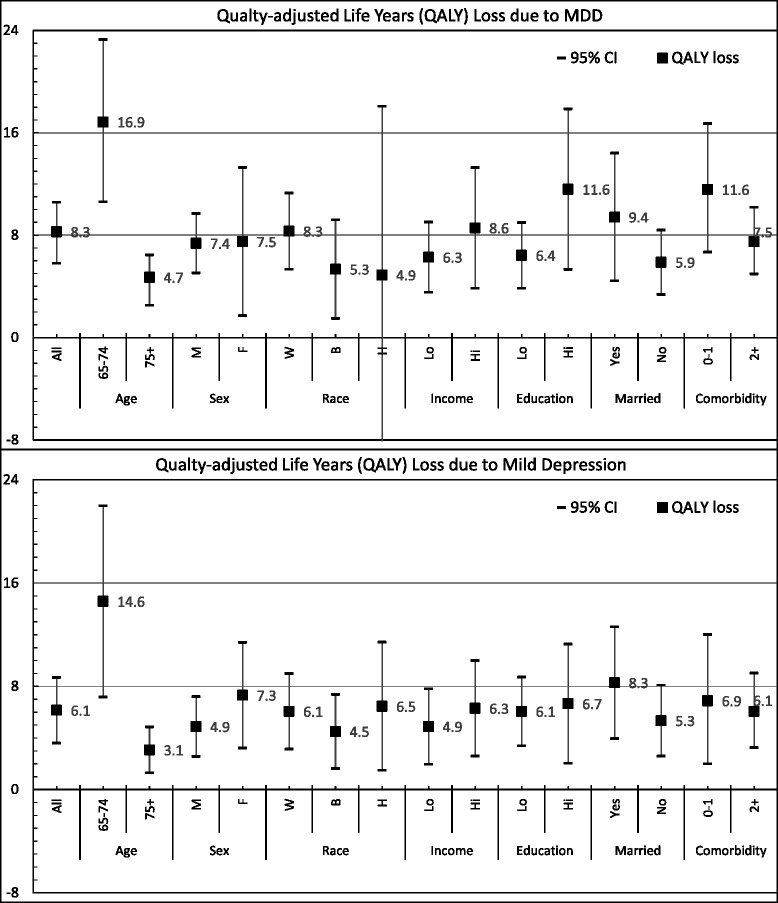
The QALY for persons with none/minimal, mild, moderate, and moderately severe/severe depression were 14.0, 7.8, 4.7, and 3.3 years, respectively. Compared to persons without major depressive disorder, persons with major depressive disorder had 8.3 fewer QALY (12.7 vs. 4.4), or a 65% loss. Compared to persons who reported "none" or minimal depressive symptoms, persons who reported mild depressive symptoms had 6.2 fewer QALY (14.0 vs. 7.8), or a 44% loss. The same patterns were noted in demographic and socioeconomic subgroups and according to number of comorbidities.
This study not only confirmed the significant burden of disease for major depressive disorder among the U.S. elderly, but also showed an incremental decrease in QALY with an increasing severity of depressive symptoms as well as significant QALY loss due to mild depression. Specifically, individuals with higher (or more impaired) PHQ-9 scores had significantly fewer QALYs and our findings of fewer years of QALY for persons with major depressive disorder and mild depression were not only statistically significant but also clinically important.
质量调整生命年(QALY)是一个单一数值指标,用于量化疾病的总体负担。它反映了健康的各个方面,包括非致命性疾病和死亡结果,通过将生存年数与健康相关生活质量(HRQOL)得分进行加权计算。本研究通过考察9项患者健康问卷(PHQ - 9)得分与65岁及以上美国成年人的QALY之间的关联,来研究抑郁症状水平上升所导致的疾病负担。
我们从2005 - 2006年、2007 - 2008年和2009 - 2010年的美国国家健康与营养检查调查(NHANES)队列中确定了受访者的HRQOL得分和死亡状况,并获取了截至2011年12月31日的死亡随访数据。该分析纳入了65岁及以上的受访者(n = 3680)。我们根据参与者的抑郁严重程度类别估计了其余生的平均QALY:无或轻微(PHQ - 9得分0 - 4)、轻度(5 - 9)、中度(10 - 14)以及中度严重和重度(15或更高)。我们估计了因重度抑郁症(PHQ - 9得分10或更高)和轻度抑郁症(5 - 9)导致的QALY损失。
无/轻微、轻度、中度以及中度严重/重度抑郁症患者的QALY分别为14.0年、7.8年、4.7年和3.3年。与没有重度抑郁症的人相比,患有重度抑郁症的人QALY少8.3年(12.7年对4.4年),即损失了65%。与报告“无”或轻微抑郁症状的人相比,报告有轻度抑郁症状的人QALY少6.2年(14.0年对7.8年),即损失了44%。在人口统计学和社会经济亚组以及根据合并症数量方面也观察到了相同的模式。
本研究不仅证实了美国老年人中重度抑郁症的重大疾病负担,还表明随着抑郁症状严重程度的增加,QALY逐渐减少,以及轻度抑郁症导致的显著QALY损失。具体而言,PHQ - 9得分较高(或受损程度更高)的个体QALY显著更少,并且我们关于重度抑郁症和轻度抑郁症患者QALY年数较少的发现不仅具有统计学意义,而且具有临床重要性。