Scott C E H, Eaton M J, Nutton R W, Wade F A, Evans S L, Pankaj P
School of Engineering, University of Edinburgh, Alexander Graham Bell Building, Mayfield Road, Edinburgh EH9 3JL, UK
Cardiff School of Engineering, Cardiff University Institute of Mechanical and Manufacturing Engineering, Queen's Buildings, The Parade, Cardiff CF24 3AA, UK.
Bone Joint Res. 2017 Jan;6(1):22-30. doi: 10.1302/2046-3758.61.BJR-2016-0142.R1.
Up to 40% of unicompartmental knee arthroplasty (UKA) revisions are performed for unexplained pain which may be caused by elevated proximal tibial bone strain. This study investigates the effect of tibial component metal backing and polyethylene thickness on bone strain in a cemented fixed-bearing medial UKA using a finite element model (FEM) validated experimentally by digital image correlation (DIC) and acoustic emission (AE).
A total of ten composite tibias implanted with all-polyethylene (AP) and metal-backed (MB) tibial components were loaded to 2500 N. Cortical strain was measured using DIC and cancellous microdamage using AE. FEMs were created and validated and polyethylene thickness varied from 6 mm to 10 mm. The volume of cancellous bone exposed to < -3000 µε (pathological loading) and < -7000 µε (yield point) minimum principal (compressive) microstrain and > 3000 µε and > 7000 µε maximum principal (tensile) microstrain was computed.
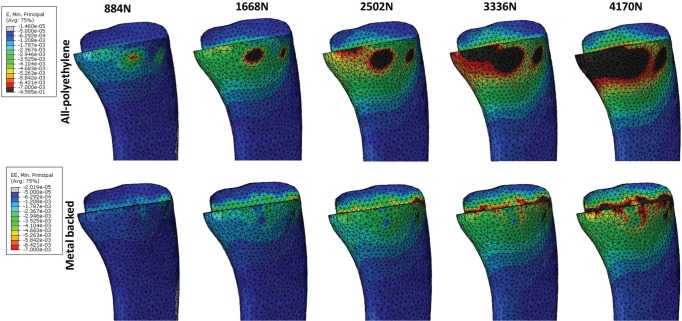
Experimental AE data and the FEM volume of cancellous bone with compressive strain < -3000 µε correlated strongly: R = 0.947, R = 0.847, percentage error 12.5% (p < 0.001). DIC and FEM data correlated: R = 0.838, R = 0.702, percentage error 4.5% (p < 0.001). FEM strain patterns included MB lateral edge concentrations; AP concentrations at keel, peg and at the region of load application. Cancellous strains were higher in AP implants at all loads: 2.2- (10 mm) to 3.2-times (6 mm) the volume of cancellous bone compressively strained < -7000 µε.
AP tibial components display greater volumes of pathologically overstrained cancellous bone than MB implants of the same geometry. Increasing AP thickness does not overcome these pathological forces and comes at the cost of greater bone resection.Cite this article: C. E. H. Scott, M. J. Eaton, R. W. Nutton, F. A. Wade, S. L. Evans, P. Pankaj. Metal-backed versus all-polyethylene unicompartmental knee arthroplasty: Proximal tibial strain in an experimentally validated finite element model. Bone Joint Res 2017;6:22-30. DOI:10.1302/2046-3758.61.BJR-2016-0142.R1.
高达40%的单髁膝关节置换术(UKA)翻修手术是由于不明原因的疼痛而进行的,这种疼痛可能是由胫骨近端骨应变升高引起的。本研究使用通过数字图像相关(DIC)和声发射(AE)进行实验验证的有限元模型(FEM),研究胫骨组件金属背衬和聚乙烯厚度对骨水泥固定承重内侧UKA中骨应变的影响。
总共10个复合胫骨植入全聚乙烯(AP)和金属背衬(MB)胫骨组件,加载至2500 N。使用DIC测量皮质应变,使用AE测量松质骨微损伤。创建并验证有限元模型,聚乙烯厚度从6 mm变化到10 mm。计算暴露于< -3000 με(病理负荷)和< -7000 με(屈服点)最小主(压缩)微应变以及> 3000 με和> 7000 με最大主(拉伸)微应变的松质骨体积。
实验AE数据与压缩应变< -3000 με的松质骨有限元模型体积高度相关:R = 0.947,R = 0.847,百分比误差12.5%(p < 0.001)。DIC和有限元模型数据相关:R = 0.838,R = 0.702,百分比误差4.5%(p < 0.001)。有限元模型应变模式包括MB外侧边缘集中;AP在龙骨、栓钉和载荷施加区域集中。在所有载荷下,AP植入物中的松质骨应变更高:压缩应变< -7000 με的松质骨体积是2.2倍(10 mm)至3.2倍(6 mm)。
与相同几何形状的MB植入物相比,AP胫骨组件显示出更大体积的病理过度应变松质骨。增加AP厚度并不能克服这些病理力,而且是以更大的骨切除为代价。引用本文:C. E. H. Scott, M. J. Eaton, R. W. Nutton, F. A. Wade, S. L. Evans, P. Pankaj。金属背衬与全聚乙烯单髁膝关节置换术:实验验证的有限元模型中的胫骨近端应变。《骨与关节研究》2017;6:22 - 30。DOI:10.1302/2046 - 3758.61.BJR - 2016 - 0142.R1。