Schmidt Fabian, Liegeois Florian, Greenwood Edward J D, LeBreton Matthew, Lester James, Deleplancque Luc, Peeters Martine, Aghokeng Avelin, Tamoufe Ubald, Diffo Joseph L D, Takuo Jean M, Wolfe Nathan D, Leroy Eric, Rouet François, Heeney Jonathan L
Lab of Viral Zoonotics, Department of Veterinary Medicine, University of Cambridge, Cambridge, United Kingdom
UMI233/INSERM1175, IRD, and University of Montpellier, Montpellier, France.
J Virol. 2017 Feb 28;91(6). doi: 10.1128/JVI.01884-16. Print 2017 Mar 15.
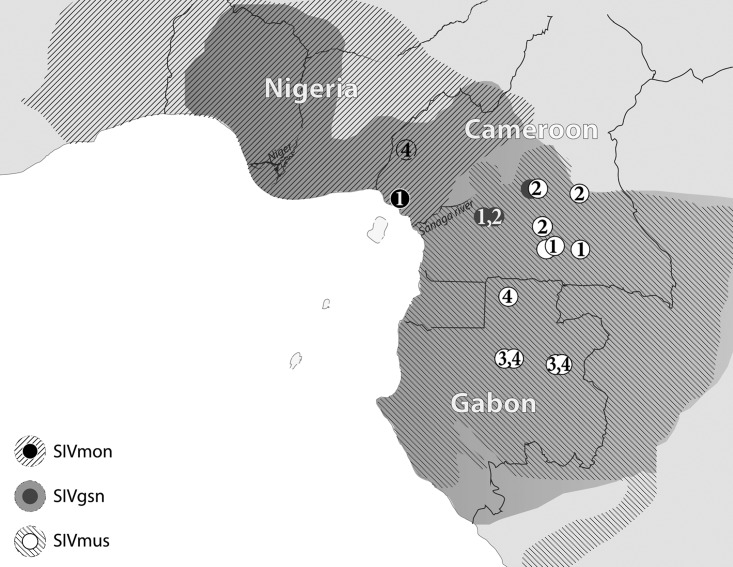
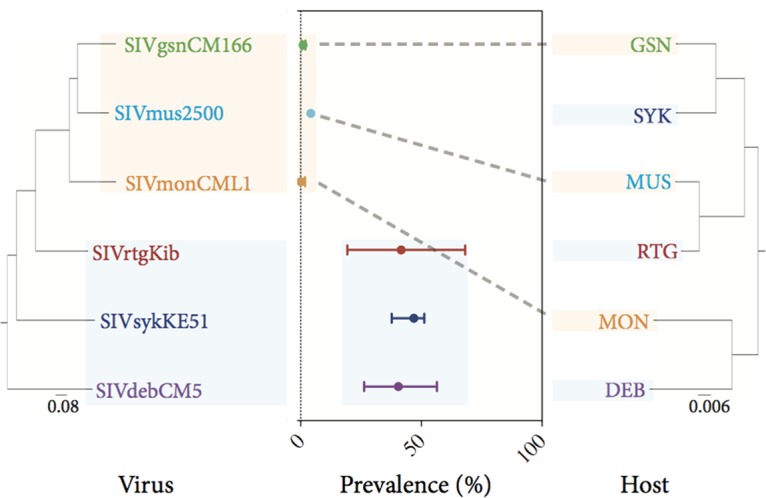
Human immunodeficiency virus type 1 (HIV-1) is the result of cross-species transmission of simian immunodeficiency virus from chimpanzees (SIVcpz). SIVcpz is a chimeric virus which shares common ancestors with viruses infecting red-capped mangabeys and a subset of guenon species. The epidemiology of SIV infection in hominoids is characterized by low prevalences and an uneven geographic distribution. Surveys in Cameroon indicated that two closely related members of the guenon species subset, mustached guenons and greater spot-nosed guenons, infected with SIVmus and SIVgsn, respectively, also have low rates of SIV infections in their populations. Compared to that for other monkeys, including red-capped mangabeys and closely related guenon species, such an epidemiology is unusual. By intensifying sampling of geographically distinct populations of mustached and greater spot-nosed guenons in Gabon and including large sample sets of mona guenons from Cameroon, we add strong support to the hypothesis that the paucity of SIV infections in wild populations is a general feature of this monophyletic group of viruses. Furthermore, comparative phylogenetic analysis reveals that this phenotype is a feature of this group of viruses infecting phylogenetically disparate hosts, suggesting that this epidemiological phenotype results from infection with these HIV-1-related viruses rather than from a common host factor. Thus, these HIV-1-related viruses, i.e., SIVcpz and the guenon viruses which share an ancestor with part of the SIVcpz genome, have an epidemiology distinct from that found for SIVs in other African primate species. Stable virus-host relationships are established over multiple generations. The prevalence of viral infections in any given host is determined by various factors. Stable virus-host relationships of viruses that are able to cause persistent infections and exist with high incidences of infection are generally characterized by a lack of morbidity prior to host reproduction. Such is the case for cytomegalovirus (CMV) and Epstein-Barr virus (EBV) infections of humans. SIV infections of most African primate species also satisfy these criteria, with these infections found at a high prevalence and with rare cases of clinical disease. In contrast, SIVcpz, the ancestor of HIV-1, has a different epidemiology, and it has been reported that infected animals suffer from an AIDS-like disease in the wild. Here we conclusively demonstrate that viruses which are closely related to SIVcpz and infect a subset of guenon monkeys show an epidemiology resembling that of SIVcpz.
人类免疫缺陷病毒1型(HIV-1)是猿猴免疫缺陷病毒从黑猩猩(SIVcpz)跨物种传播的结果。SIVcpz是一种嵌合病毒,与感染红顶白眉猴和一部分长尾猴属物种的病毒有着共同的祖先。类人猿中SIV感染的流行病学特征是感染率低且地理分布不均。喀麦隆的调查表明,长尾猴属物种子集的两个密切相关成员,即髭长尾猴和大白鼻长尾猴,分别感染了SIVmus和SIVgsn,它们种群中的SIV感染率也很低。与其他猴子(包括红顶白眉猴和密切相关的长尾猴属物种)相比,这种流行病学情况并不寻常。通过加强对加蓬地理上不同的髭长尾猴和大白鼻长尾猴种群的采样,并纳入来自喀麦隆的大量赤腹长尾猴样本集,我们有力地支持了以下假设:野生种群中SIV感染率低是这一病毒单系群的一个普遍特征。此外,比较系统发育分析表明,这种表型是这组感染系统发育上不同宿主的病毒的一个特征,这表明这种流行病学表型是由感染这些与HIV-1相关的病毒导致的,而不是由共同的宿主因素导致的。因此,这些与HIV-1相关的病毒,即SIVcpz和与SIVcpz基因组部分有共同祖先的长尾猴病毒,其流行病学与其他非洲灵长类物种中的SIV不同。稳定的病毒-宿主关系在多代中得以建立。任何给定宿主中病毒感染的流行率由多种因素决定。能够引起持续感染且感染发生率高的病毒的稳定病毒-宿主关系通常表现为在宿主繁殖前没有发病情况。人类的巨细胞病毒(CMV)和爱泼斯坦-巴尔病毒(EBV)感染就是这种情况。大多数非洲灵长类物种的SIV感染也符合这些标准,这些感染的流行率很高,临床疾病病例很少。相比之下,HIV-1的祖先SIVcpz有不同的流行病学情况,并且有报道称受感染的动物在野外会患上类似艾滋病的疾病。在这里,我们确凿地证明,与SIVcpz密切相关且感染一部分长尾猴的病毒表现出与SIVcpz相似的流行病学情况。