Hassanein Sahar M A, Nasr Eldin Mohamed Hassan, Amer Hanaa A, Abdelhamid Adel E, El Houssinie Moustafa, Ibrahim Abir
Department of Pediatrics, Faculty of Medicine, Ain Shams University, Cairo, Egypt.
Department of Obstetrics and Gynecology, Faculty of Medicine, Ain Shams University, Cairo, Egypt.
J Clin Neurol. 2017 Jan;13(1):84-90. doi: 10.3988/jcn.2017.13.1.84.
Neonatal hypoxic-ischemic encephalopathy (HIE) is one of the leading causes of neurological handicap in developing countries. Human umbilical cord blood (hUCB) CD34-positive (CD34⁺) stem cells exhibit the potential for neural repair. We tested the hypothesis that hUCB CD34⁺ stem cells and other cell types [leukocytes and nucleated red blood cells (NRBCs)] that are up-regulated during the acute stage of perinatal asphyxia (PA) could play a role in the early prediction of the occurrence, severity, and mortality of HIE.
This case-control pilot study investigated consecutive neonates exposed to PA. The hUCB CD34⁺ cell count in mononuclear layers was assayed using a flow cytometer. Twenty full-term neonates with PA and 25 healthy neonates were enrolled in the study.
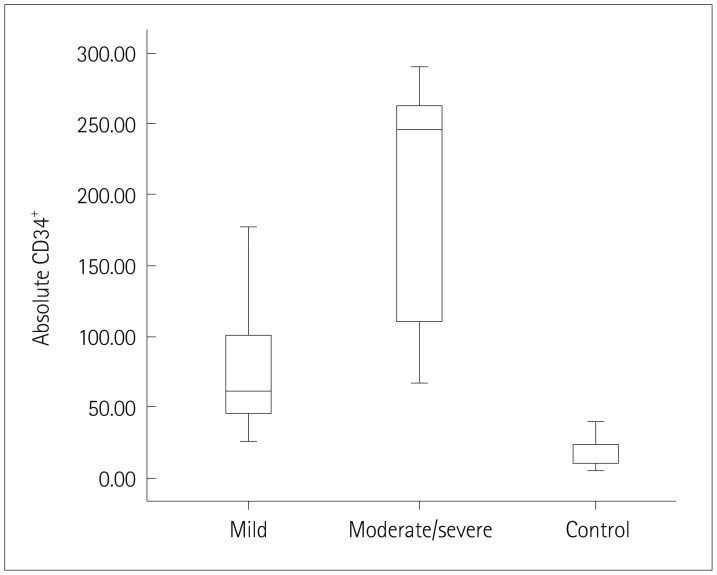
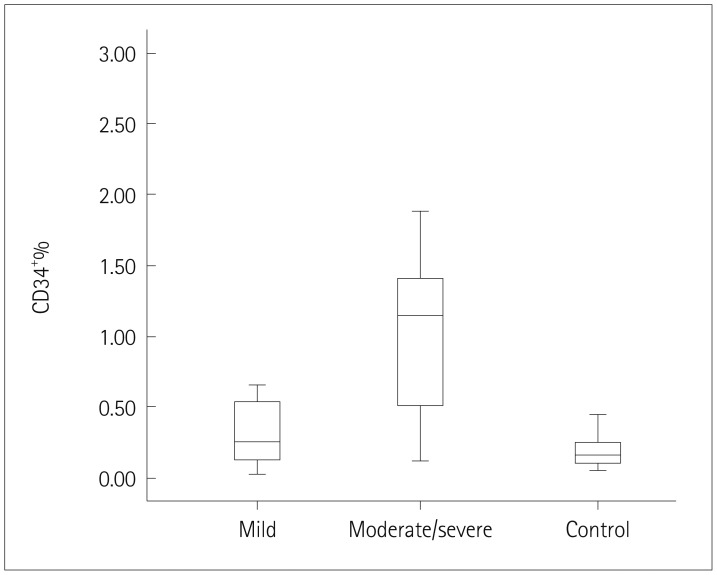
The absolute CD34⁺ cell count (p=0.02) and the relative CD34⁺ cell count (CD34⁺%) (p<0.001) in hUCB were higher in the HIE patients (n=20) than the healthy controls. The hUCB absolute CD34⁺ cell count (p=0.04), CD34⁺% (p<0.01), and Hobel risk scores (p=0.04) were higher in patients with moderate-to-severe HIE (n=9) than in those with mild HIE (n=11). The absolute CD34⁺ cell count was strongly correlated with CD34⁺% (p<0.001), Hobel risk score (p=0.04), total leukocyte count (TLC) (p<0.001), and NRBC count (p=0.01). CD34⁺% was correlated with TLC (p=0.02).
hUCB CD34⁺ cells can be used to predict the occurrence, severity, and mortality of neonatal HIE after PA.
新生儿缺氧缺血性脑病(HIE)是发展中国家神经功能障碍的主要原因之一。人脐带血(hUCB)CD34阳性(CD34⁺)干细胞具有神经修复潜力。我们检验了以下假设:在围产期窒息(PA)急性期上调的hUCB CD34⁺干细胞及其他细胞类型[白细胞和有核红细胞(NRBCs)]可能在HIE发生、严重程度及死亡率的早期预测中发挥作用。
本病例对照初步研究调查了连续的PA暴露新生儿。使用流式细胞仪检测单核层中hUCB CD34⁺细胞计数。20例足月PA新生儿和25例健康新生儿纳入研究。
HIE患者(n = 20)hUCB中CD34⁺细胞绝对计数(p = 0.02)和相对计数(CD34⁺%)(p < 0.001)高于健康对照组。中度至重度HIE患者(n = 9)的hUCB CD34⁺细胞绝对计数(p = 0.04)、CD34⁺%(p < 0.01)和霍贝尔风险评分(p = 0.04)高于轻度HIE患者(n = 11)。CD34⁺细胞绝对计数与CD34⁺%(p < 0.001)、霍贝尔风险评分(p = 0.04)、白细胞总数(TLC)(p < 0.001)和NRBC计数(p = 0.01)密切相关。CD34⁺%与TLC相关(p = 0.02)。
hUCB CD34⁺细胞可用于预测PA后新生儿HIE的发生、严重程度及死亡率。