Drain Paul K, Rousseau Christine
aDepartment of Global Health bDepartment of Medicine cDepartment of Epidemiology, University of Washington, Seattle, Washington dDepartment of Surgery, Massachusetts General Hospital, Harvard Medical School, Boston, Massachusetts eBill and Melinda Gates Foundation, Seattle, Washington, USA.
Curr Opin HIV AIDS. 2017 Mar;12(2):175-181. doi: 10.1097/COH.0000000000000351.
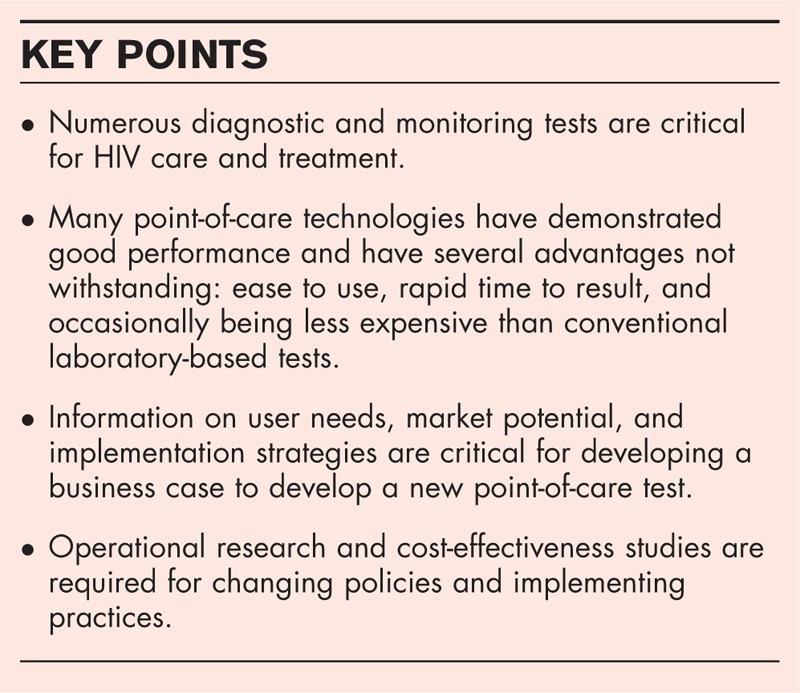
More point-of-care (POC) diagnostic tests are becoming available for HIV diagnosis and treatment in resource-limited settings. These novel technologies have the potential to foster decentralized HIV care and treatment for the benefit of clinical laboratories, HIV clinics, and HIV-infected patients. There continue to be many business, technological, and operational challenges that limit product development and regulatory approval, which limits products available for the required operational and cost-effectiveness studies and delays policy adoption and implementation.
Although the rapid HIV diagnostic test has been widely successful, the pathways for POC CD4 cell count and HIV viral load assay analyzers have been more challenging. We describe significant hurdles for product development, approval, and implementation, which include the business case, technical development, clinical impact, and integrating laboratory and clinical networks.
The objective of this review is to highlight the obstacles for developing and implementing appropriate strategies for POC HIV testing assays to improve the clinical services for HIV-infected patients in resource-limited settings.
在资源有限的环境中,越来越多的即时检验(POC)诊断测试可用于HIV诊断和治疗。这些新技术有可能促进分散式HIV护理和治疗,造福临床实验室、HIV诊所和HIV感染患者。仍然存在许多商业、技术和运营挑战,限制了产品开发和监管批准,这限制了可用于所需运营和成本效益研究的产品,并延迟了政策的采用和实施。
尽管快速HIV诊断测试已取得广泛成功,但POC CD4细胞计数和HIV病毒载量测定分析仪的发展路径更具挑战性。我们描述了产品开发、批准和实施的重大障碍,包括商业案例、技术开发、临床影响以及整合实验室和临床网络。
本综述的目的是强调在资源有限的环境中开发和实施适当的POC HIV检测策略以改善HIV感染患者临床服务的障碍。