Ren Zhengju, Ren Pengwei, Yang Bo, Fang Kun, Ren Shangqing, Liao Jian, Liu Shengzhuo, Liu Liangren, Peng Zhufeng, Dong Qiang
Department of Urology, Institute of Urology, West China Hospital, Sichuan University, Chengdu, Sichuan, China.
Department of Evidence-Based Medicine and Clinical Epidemiology, West China Hospital, Sichuan University, Chengdu, China.
PLoS One. 2017 Jan 12;12(1):e0169789. doi: 10.1371/journal.pone.0169789. eCollection 2017.
Methylenetetrahydrofolate reductase gene (MTHFR C677T and A1298C) and methionine synthase gene (MS A2756G) polymorphisms have shown an association with male infertility risk in several ethnic populations. Although several studies have evaluated these associations in Chinese populations, their small sample sizes and inconsistent outcomes have prevented strong conclusions. Therefore, the present meta-analysis was performed with published studies to evaluate the associations of the three single nucleotide polymorphisms (SNPs) and male infertility in a Chinese population.
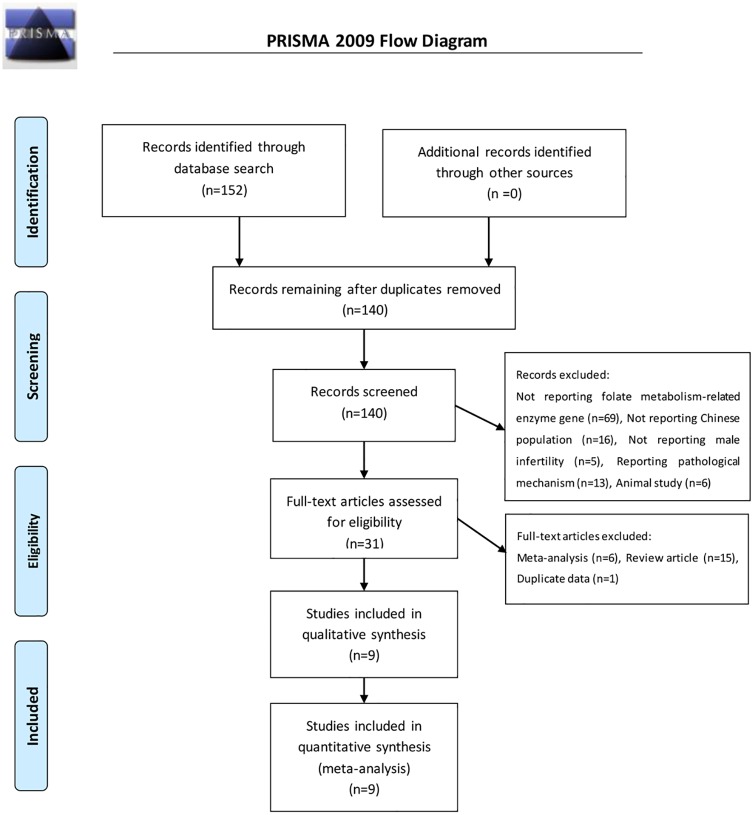
We conducted a search of PubMed, Embase, Web of Science, Chinese National Knowledge Infrastructure (CNKI), China biology medical literature (CBM), VIP, and Chinese literature (Wan Fang) databases up to May 31, 2016. Odds ratios (ORs) and 95% confidence intervals (95%CIs) were used to assess the strength of associations with a random-effect model or a fixed-effect model based on the heterogeneity analysis results. Sensitivity analysis was used to confirm the reliability and stability of the meta-analysis.
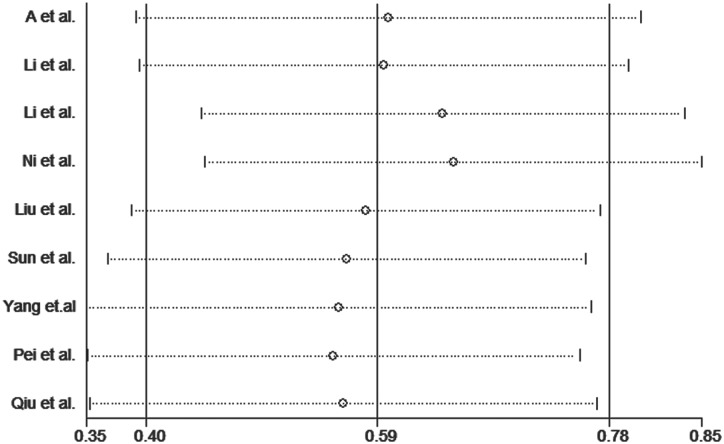
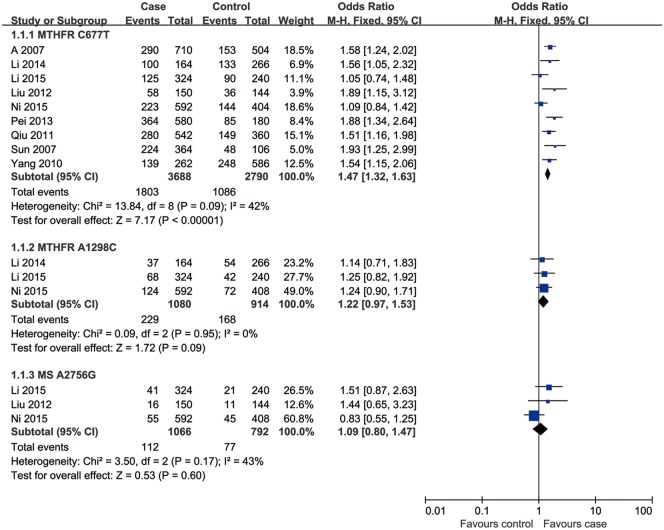
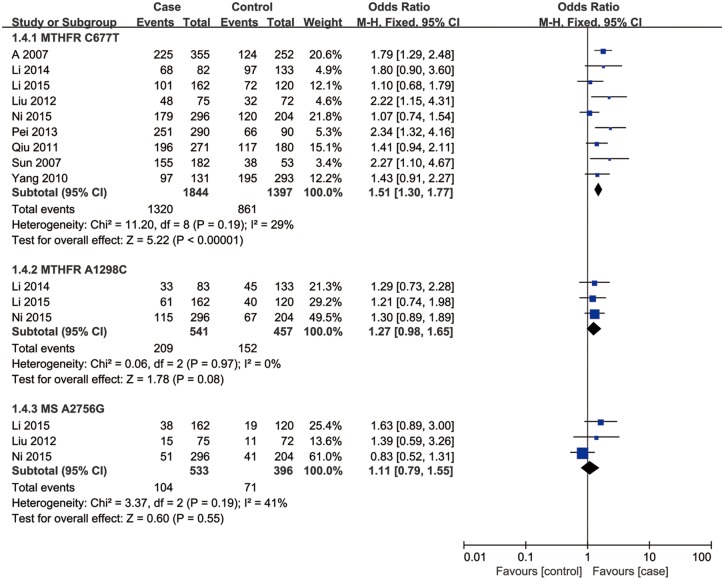
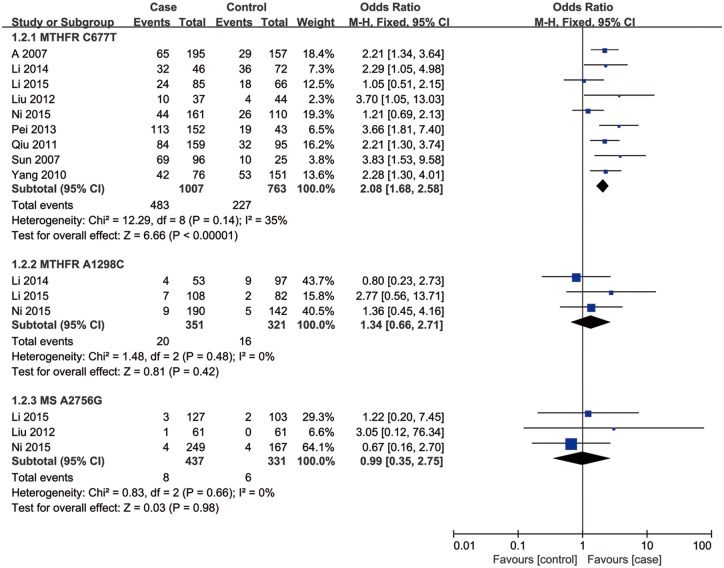
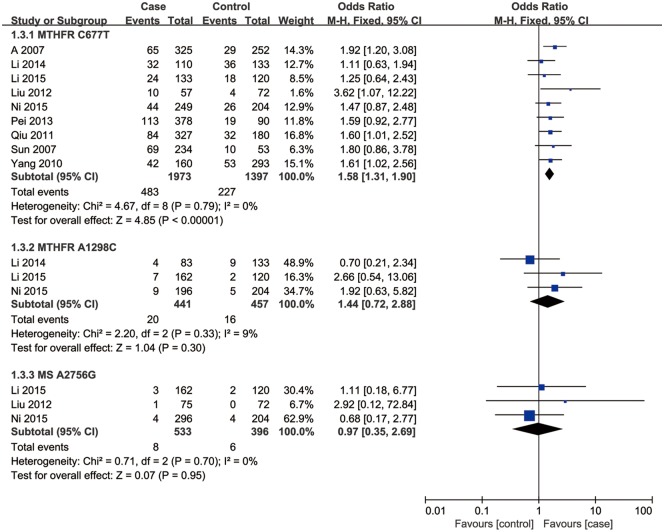
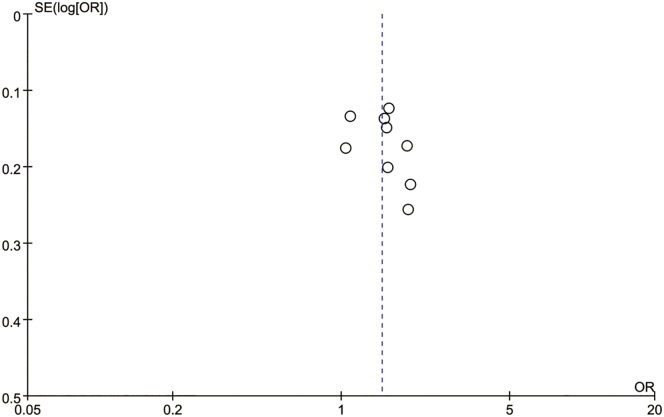
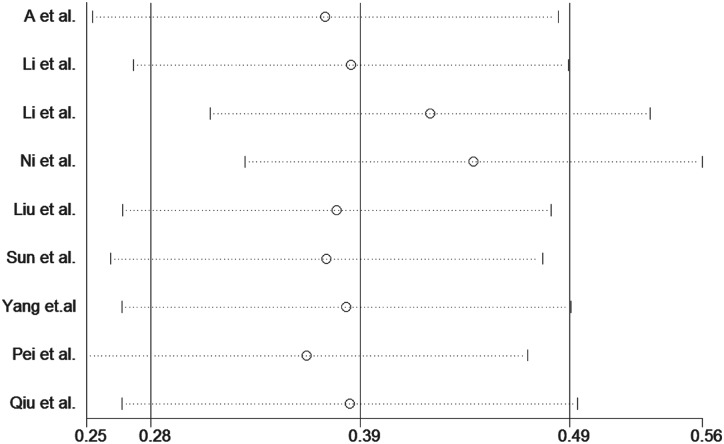
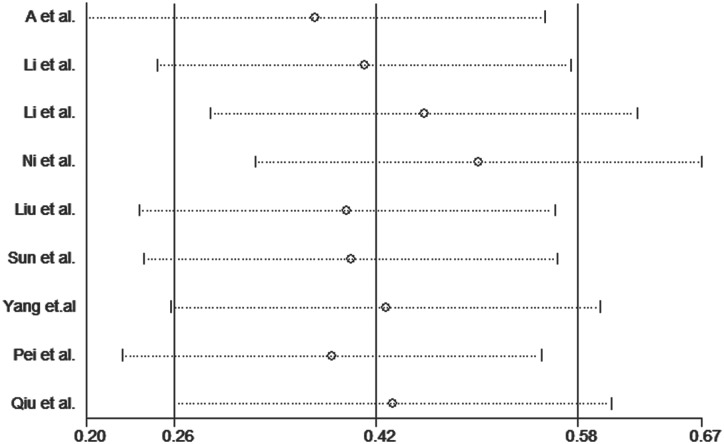
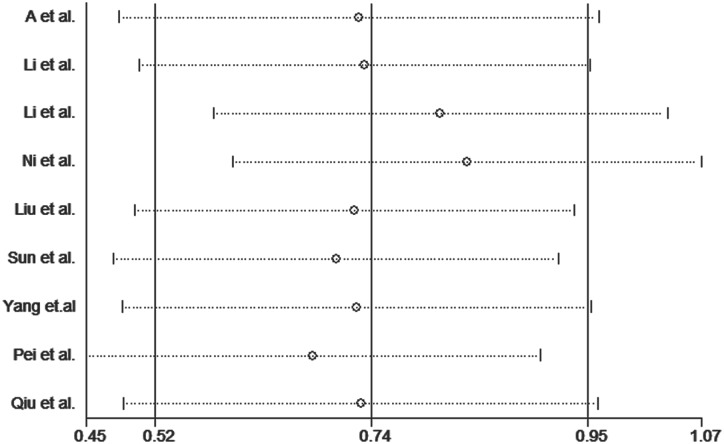
A total of nine studies, including 1,713 cases and 1,104 controls, were included in the meta-analysis. The pooled results indicated that the MTHFR C667T polymorphism was significantly associated with increased risk of male infertility in the Chinese population in the allele model (T vs. C: OR = 1.47, 95%CI = 1.32-1.63), the dominant model (TT + CT vs. CC: OR = 1.51, 95%CI = 1.30-1.77), the additive model (TT vs. CC: OR = 2.08, 95%CI = 1.68-2.58) and the recessive model (TT vs. CT+CC: OR = 1.58, 95%CI = 1.31-1.90), whereas the MTHFR A1298C and MS A2756G polymorphisms were not risk factors. There was no significant heterogeneity in any genotype contrasts among the studies. The sensitivity analysis indicated that the results of this meta-analysis were relatively stable.
This study suggests that the MTHFR C667T polymorphism may contribute to the genetic susceptibility to male infertility in the Chinese population, whereas MTHFR A1298C and MS A2756G polymorphisms may be unrelated to male infertility. Studies with larger sample sizes and representative population-based cases and well-matched controls are needed to validate our results.
亚甲基四氢叶酸还原酶基因(MTHFR C677T和A1298C)以及甲硫氨酸合成酶基因(MS A2756G)多态性在多个种族人群中显示与男性不育风险相关。尽管多项研究已对中国人群中的这些关联进行了评估,但样本量小以及结果不一致阻碍了得出有力结论。因此,本荟萃分析纳入已发表的研究,以评估这三种单核苷酸多态性(SNP)与中国人群男性不育的关联。
我们检索了截至2016年5月31日的PubMed、Embase、Web of Science、中国知网(CNKI)、中国生物医学文献数据库(CBM)、维普资讯(VIP)和万方数据库。根据异质性分析结果,采用随机效应模型或固定效应模型,用比值比(OR)和95%置信区间(95%CI)评估关联强度。采用敏感性分析确认荟萃分析的可靠性和稳定性。
荟萃分析共纳入9项研究,包括1713例病例和1104例对照。汇总结果表明,在等位基因模型(T vs. C:OR = 1.47,95%CI = 1.32 - 1.63)、显性模型(TT + CT vs. CC:OR = 1.51,95%CI = 1.30 - 1.77)、加性模型(TT vs. CC:OR = 2.08,95%CI = 1.68 - 2.58)和隐性模型(TT vs. CT + CC:OR = 1.58,95%CI = 1.31 - 1.90)中,MTHFR C667T多态性与中国人群男性不育风险增加显著相关,而MTHFR A1298C和MS A2756G多态性不是风险因素。各研究中任何基因型对比均无显著异质性。敏感性分析表明,本荟萃分析结果相对稳定。
本研究提示,MTHFR C667T多态性可能与中国人群男性不育的遗传易感性有关,而MTHFR A1298C和MS A2756G多态性可能与男性不育无关。需要更大样本量、基于人群的代表性病例以及匹配良好的对照的研究来验证我们的结果。