Vilela Mariane de Mendonça, Del Bem Luiz Eduardo, Van Sluys Marie-Anne, de Setta Nathalia, Kitajima João Paulo, Cruz Guilherme Marcelo Queiroga, Sforça Danilo Augusto, de Souza Anete Pereira, Ferreira Paulo Cavalcanti Gomes, Grativol Clícia, Cardoso-Silva Claudio Benicio, Vicentini Renato, Vincentz Michel
Centro de Biologia Molecular e Engenharia Genética, Departamento de Biologia Vegetal, Instituto de Biologia, Universidade Estadual de Campinas, Campinas, SP, Brazil.
Departamento de Botânica, Instituto de Biociências, Universidade de São Paulo, SP, Brazil.
Genome Biol Evol. 2017 Feb 1;9(2):266-278. doi: 10.1093/gbe/evw293.
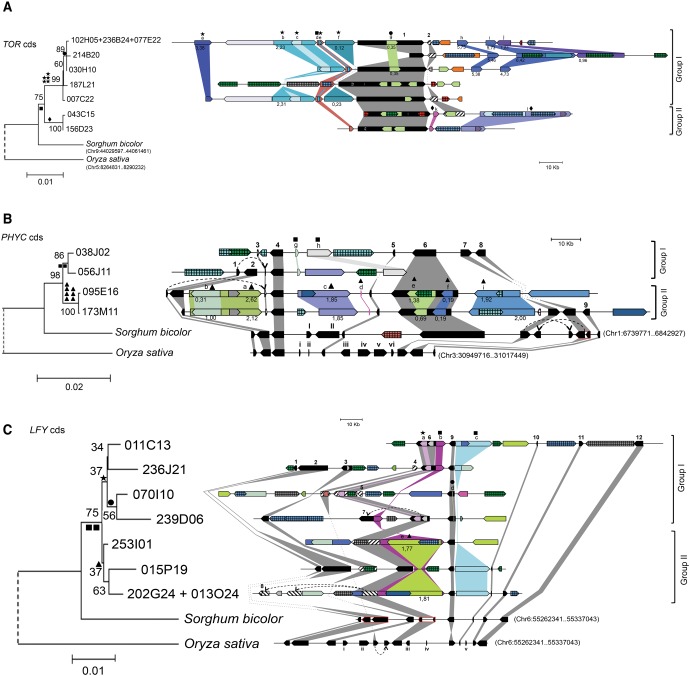
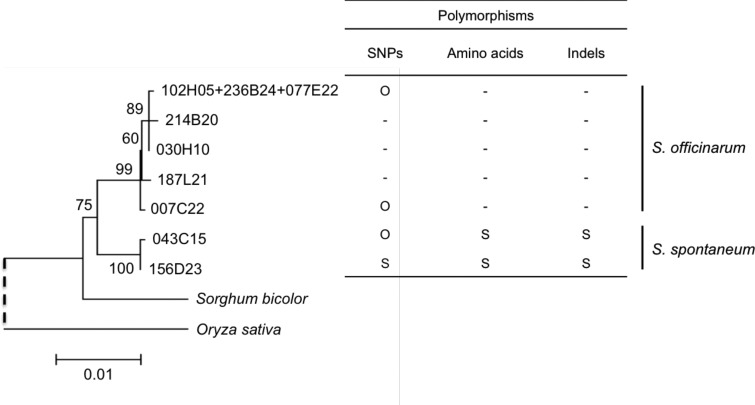
Whole genome duplication has played an important role in plant evolution and diversification. Sugarcane is an important crop with a complex hybrid polyploid genome, for which the process of adaptation to polyploidy is still poorly understood. In order to improve our knowledge about sugarcane genome evolution and the homo/homeologous gene expression balance, we sequenced and analyzed 27 BACs (Bacterial Artificial Chromosome) of sugarcane R570 cultivar, containing the putative single-copy genes LFY (seven haplotypes), PHYC (four haplotypes), and TOR (seven haplotypes). Comparative genomic approaches showed that these sugarcane loci presented a high degree of conservation of gene content and collinearity (synteny) with sorghum and rice orthologous regions, but were invaded by transposable elements (TE). All the homo/homeologous haplotypes of LFY, PHYC, and TOR are likely to be functional, because they are all under purifying selection (dN/dS ≪ 1). However, they were found to participate in a nonequivalently manner to the overall expression of the corresponding gene. SNPs, indels, and amino acid substitutions allowed inferring the S. officinarum or S. spontaneum origin of the TOR haplotypes, which further led to the estimation that these two sugarcane ancestral species diverged between 2.5 and 3.5 Ma. In addition, analysis of shared TE insertions in TOR haplotypes suggested that two autopolyploidization may have occurred in the lineage that gave rise to S. officinarum, after its divergence from S. spontaneum.
全基因组复制在植物进化和多样化过程中发挥了重要作用。甘蔗是一种重要的作物,具有复杂的杂交多倍体基因组,但其适应多倍体的过程仍知之甚少。为了增进我们对甘蔗基因组进化以及同源/同祖基因表达平衡的了解,我们对甘蔗R570品种的27个细菌人工染色体(BAC)进行了测序和分析,这些BAC包含推定的单拷贝基因LFY(七种单倍型)、PHYC(四种单倍型)和TOR(七种单倍型)。比较基因组学方法表明,这些甘蔗基因座与高粱和水稻的直系同源区域在基因含量和共线性(同线性)方面呈现出高度保守性,但受到转座元件(TE)的侵袭。LFY、PHYC和TOR的所有同源/同祖单倍型可能都具有功能,因为它们都处于纯化选择之下(dN/dS ≪ 1)。然而,发现它们以不等同的方式参与相应基因的整体表达。单核苷酸多态性(SNP)、插入缺失和氨基酸替换使得能够推断TOR单倍型的热带种或野生种起源,这进一步导致估计这两个甘蔗祖先物种在250万至350万年前分化。此外,对TOR单倍型中共享的TE插入分析表明,在热带种与野生种分化后,导致热带种的谱系中可能发生了两次同源多倍体化。