Glass Jennifer, Simon Robin W, Andersson Matthew A
University of Texas-Austin.
Wake Forest University.
AJS. 2016 Nov;122(3):886-929. doi: 10.1086/688892.
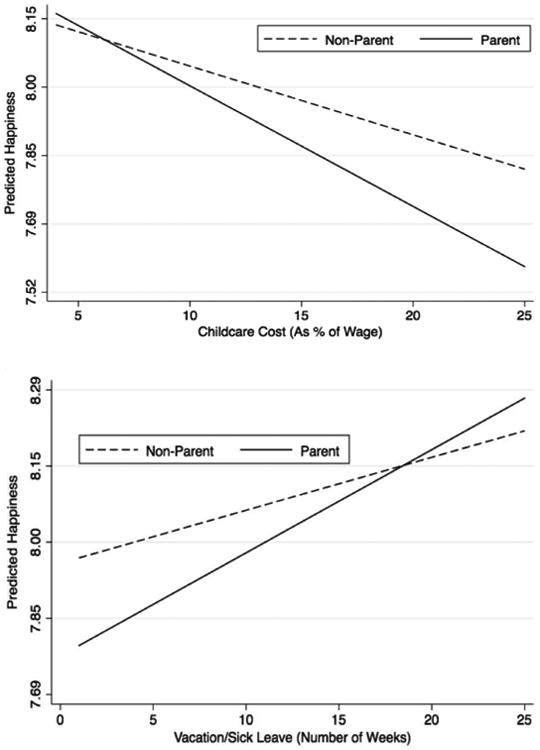
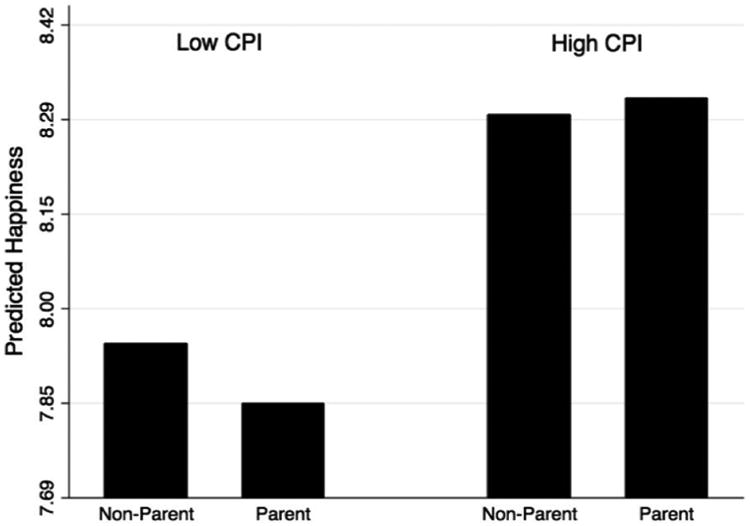
The recent proliferation of studies examining cross-national variation in the association between parenthood and happiness reveal accumulating evidence of lower levels of happiness among parents than nonparents in most advanced industrialized societies. Conceptualizing parenting as a stressor buffered by institutional support, we hypothesize that parental status differences in happiness are smaller in countries providing more resources and support to families. Our analyses of the European Social Surveys (ESS) and International Social Survey Programme (ISSP) reveal considerable variation in the parenthood gap in happiness across countries, with the U.S. showing the largest disadvantage of parenthood. We also find that more generous family policies, particularly paid time off and childcare subsidies, are associated with smaller disparities in happiness between parents and non-parents. Moreover, the policies that augment parental happiness do not reduce the happiness of nonparents. Our results shed light on macro-level causes of emotional processes, with important implications for public policy.
近期大量研究探讨了在不同国家中为人父母与幸福之间关联的差异,这些研究揭示出越来越多的证据表明,在大多数发达工业化社会中,父母的幸福水平低于非父母。我们将养育子女概念化为一种由制度支持缓冲的压力源,据此推测,在为家庭提供更多资源和支持的国家中,父母与非父母在幸福程度上的差异较小。我们对欧洲社会调查(ESS)和国际社会调查项目(ISSP)的分析表明,各国在为人父母与幸福之间的差距存在显著差异,美国的父母劣势最为明显。我们还发现,更为慷慨的家庭政策,尤其是带薪休假和儿童保育补贴,与父母和非父母之间较小的幸福差距相关。此外,增强父母幸福感的政策并不会降低非父母的幸福感。我们的研究结果揭示了情绪过程的宏观层面原因,对公共政策具有重要意义。