McClure Patrick, Kriegeskorte Nikolaus
MRC Cognition and Brain Sciences Unit Cambridge, UK.
Front Comput Neurosci. 2016 Dec 27;10:131. doi: 10.3389/fncom.2016.00131. eCollection 2016.
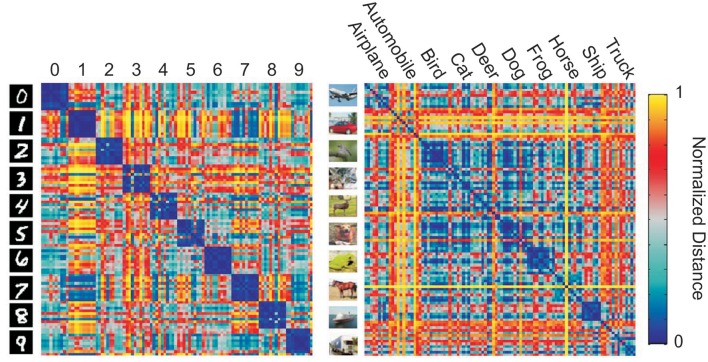
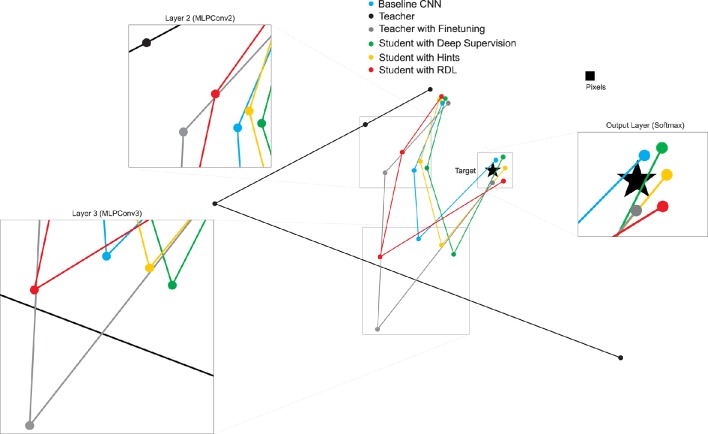
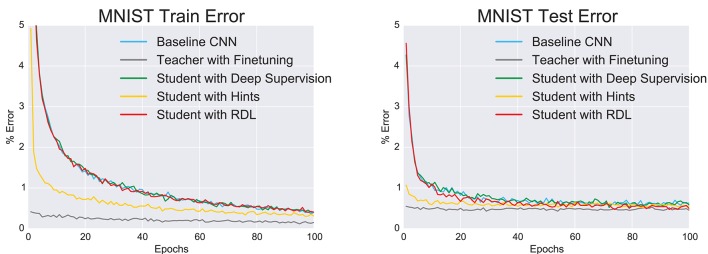
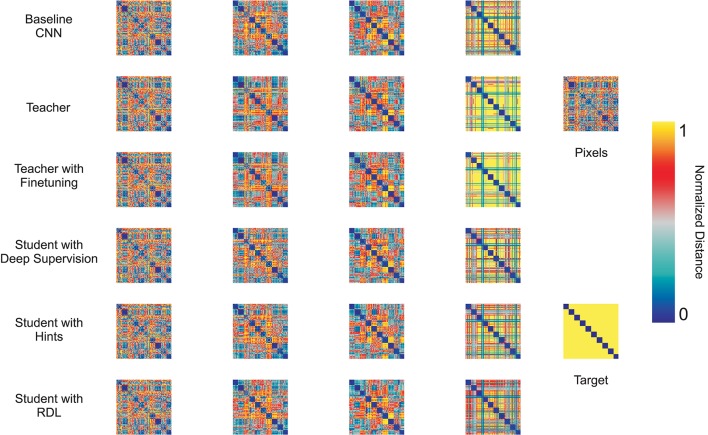
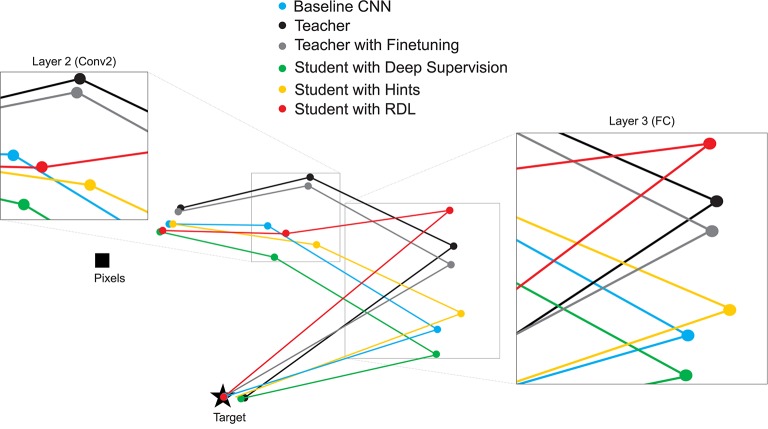
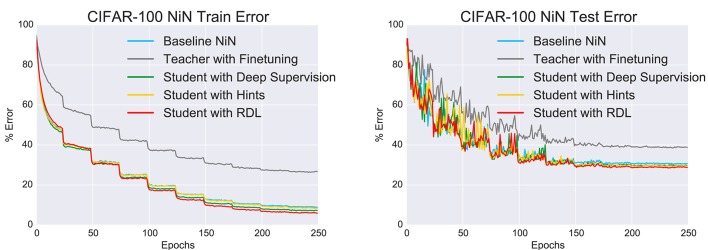
Deep neural networks (DNNs) provide useful models of visual representational transformations. We present a method that enables a DNN (student) to learn from the internal representational spaces of a reference model (teacher), which could be another DNN or, in the future, a biological brain. Representational spaces of the student and the teacher are characterized by representational distance matrices (RDMs). We propose representational distance learning (RDL), a stochastic gradient descent method that drives the RDMs of the student to approximate the RDMs of the teacher. We demonstrate that RDL is competitive with other transfer learning techniques for two publicly available benchmark computer vision datasets (MNIST and CIFAR-100), while allowing for architectural differences between student and teacher. By pulling the student's RDMs toward those of the teacher, RDL significantly improved visual classification performance when compared to baseline networks that did not use transfer learning. In the future, RDL may enable combined supervised training of deep neural networks using task constraints (e.g., images and category labels) and constraints from brain-activity measurements, so as to build models that replicate the internal representational spaces of biological brains.
深度神经网络(DNN)提供了视觉表征转换的有用模型。我们提出了一种方法,使DNN(学生网络)能够从参考模型(教师网络)的内部表征空间中学习,该参考模型可以是另一个DNN,或者在未来是生物大脑。学生网络和教师网络的表征空间由表征距离矩阵(RDM)来表征。我们提出了表征距离学习(RDL),这是一种随机梯度下降方法,可驱动学生网络的RDM去逼近教师网络的RDM。我们证明,对于两个公开可用的基准计算机视觉数据集(MNIST和CIFAR - 100),RDL与其他迁移学习技术具有竞争力,同时允许学生网络和教师网络之间存在架构差异。通过将学生网络的RDM拉向教师网络的RDM,与未使用迁移学习的基线网络相比,RDL显著提高了视觉分类性能。未来,RDL可能会实现使用任务约束(如图像和类别标签)以及来自大脑活动测量的约束对深度神经网络进行联合监督训练,从而构建能够复制生物大脑内部表征空间的模型。