• 文献检索
  • 文档翻译
  • 深度研究
  • 学术资讯
  • Suppr Zotero 插件Zotero 插件
  • 邀请有礼
  • 套餐&价格
  • 历史记录
应用&插件
Suppr Zotero 插件Zotero 插件浏览器插件Mac 客户端Windows 客户端微信小程序
定价
高级版会员购买积分包购买API积分包
服务
文献检索文档翻译深度研究API 文档MCP 服务
关于我们
关于 Suppr公司介绍联系我们用户协议隐私条款
关注我们

Suppr 超能文献

核心技术专利:CN118964589B侵权必究
粤ICP备2023148730 号-1Suppr @ 2026

文献检索

告别复杂PubMed语法,用中文像聊天一样搜索,搜遍4000万医学文献。AI智能推荐,让科研检索更轻松。

立即免费搜索

文件翻译

保留排版,准确专业,支持PDF/Word/PPT等文件格式,支持 12+语言互译。

免费翻译文档

深度研究

AI帮你快速写综述,25分钟生成高质量综述,智能提取关键信息,辅助科研写作。

立即免费体验

基于容错似然匹配调用和样本聚类的遗传标记重捕研究中的准确重捕识别。

Accurate recapture identification for genetic mark-recapture studies with error-tolerant likelihood-based match calling and sample clustering.

作者信息

Sethi Suresh A, Linden Daniel, Wenburg John, Lewis Cara, Lemons Patrick, Fuller Angela, Hare Matthew P

机构信息

US Geological Survey, New York Cooperative Fish and Wildlife Research Unit , Cornell University , Ithaca, NY 14853 , USA.

New York Cooperative Fish and Wildlife Research Unit , Department of Natural Resources, Cornell University , Ithaca, NY , USA.

出版信息

R Soc Open Sci. 2016 Dec 21;3(12):160457. doi: 10.1098/rsos.160457. eCollection 2016 Dec.

DOI:10.1098/rsos.160457
PMID:28083094
原文链接:https://pmc.ncbi.nlm.nih.gov/articles/PMC5210676/
Abstract

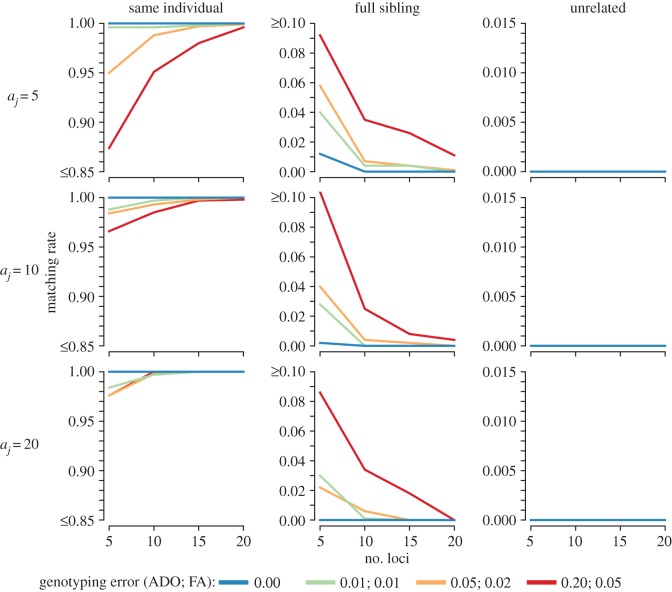
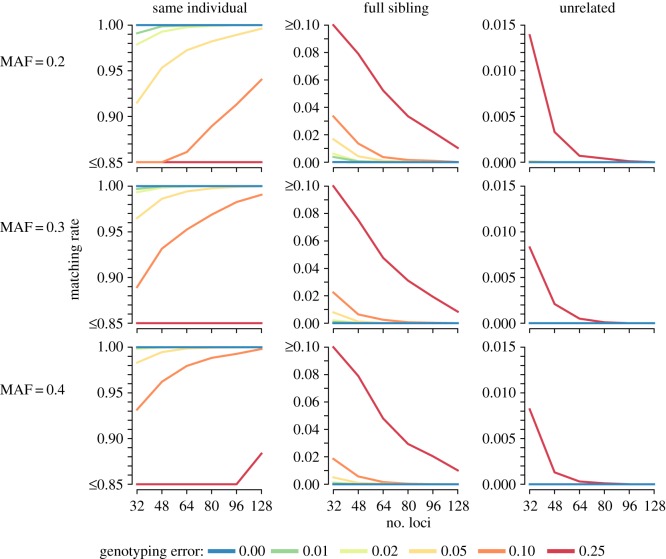
Error-tolerant likelihood-based match calling presents a promising technique to accurately identify recapture events in genetic mark-recapture studies by combining probabilities of latent genotypes and probabilities of observed genotypes, which may contain genotyping errors. Combined with clustering algorithms to group samples into sets of recaptures based upon pairwise match calls, these tools can be used to reconstruct accurate capture histories for mark-recapture modelling. Here, we assess the performance of a recently introduced error-tolerant likelihood-based match-calling model and sample clustering algorithm for genetic mark-recapture studies. We assessed both biallelic (i.e. single nucleotide polymorphisms; SNP) and multiallelic (i.e. microsatellite; MSAT) markers using a combination of simulation analyses and case study data on Pacific walrus () and fishers (). A novel two-stage clustering approach is demonstrated for genetic mark-recapture applications. First, repeat captures within a sampling occasion are identified. Subsequently, recaptures across sampling occasions are identified. The likelihood-based matching protocol performed well in simulation trials, demonstrating utility for use in a wide range of genetic mark-recapture studies. Moderately sized SNP (64+) and MSAT (10-15) panels produced accurate match calls for recaptures and accurate non-match calls for samples from closely related individuals in the face of low to moderate genotyping error. Furthermore, matching performance remained stable or increased as the number of genetic markers increased, genotyping error notwithstanding.

摘要

基于似然性的容错匹配调用提出了一种很有前景的技术,通过结合潜在基因型的概率和观察到的基因型的概率(其中可能包含基因分型错误),在遗传标记重捕研究中准确识别重捕事件。结合聚类算法,根据成对匹配调用将样本分组为重捕集,这些工具可用于为重捕建模重建准确的捕获历史。在这里,我们评估了一种最近引入的基于似然性的容错匹配调用模型和样本聚类算法在遗传标记重捕研究中的性能。我们使用模拟分析和关于太平洋海象()和渔貂()的案例研究数据的组合,评估了双等位基因(即单核苷酸多态性;SNP)和多等位基因(即微卫星;MSAT)标记。展示了一种用于遗传标记重捕应用的新颖的两阶段聚类方法。首先,识别采样期内的重复捕获。随后,识别跨采样期的重捕。基于似然性的匹配协议在模拟试验中表现良好,证明了其在广泛的遗传标记重捕研究中的实用性。面对低至中等的基因分型错误,中等大小的SNP(64个以上)和MSAT(10 - 15个)面板为重捕产生了准确的匹配调用,为来自密切相关个体的样本产生了准确的非匹配调用。此外,尽管存在基因分型错误,但随着遗传标记数量的增加,匹配性能保持稳定或提高。
https://cdn.ncbi.nlm.nih.gov/pmc/blobs/5c4d/5210676/8ea4f8c7ab3b/rsos160457-g2.jpg
https://cdn.ncbi.nlm.nih.gov/pmc/blobs/5c4d/5210676/a53aa1be3378/rsos160457-g1.jpg
https://cdn.ncbi.nlm.nih.gov/pmc/blobs/5c4d/5210676/8ea4f8c7ab3b/rsos160457-g2.jpg
https://cdn.ncbi.nlm.nih.gov/pmc/blobs/5c4d/5210676/a53aa1be3378/rsos160457-g1.jpg
https://cdn.ncbi.nlm.nih.gov/pmc/blobs/5c4d/5210676/8ea4f8c7ab3b/rsos160457-g2.jpg

相似文献

1
Accurate recapture identification for genetic mark-recapture studies with error-tolerant likelihood-based match calling and sample clustering.基于容错似然匹配调用和样本聚类的遗传标记重捕研究中的准确重捕识别。
R Soc Open Sci. 2016 Dec 21;3(12):160457. doi: 10.1098/rsos.160457. eCollection 2016 Dec.
2
Likelihood-based genetic mark-recapture estimates when genotype samples are incomplete and contain typing errors.当基因型样本不完整且包含分型错误时,基于似然性的遗传标记重捕估计。
Theor Popul Biol. 2011 Nov;80(3):185-96. doi: 10.1016/j.tpb.2011.06.006. Epub 2011 Jul 6.
3
multimark: an R package for analysis of capture-recapture data consisting of multiple "noninvasive" marks.multimark:一个用于分析由多个“非侵入性”标记组成的捕获-再捕获数据的R软件包。
Ecol Evol. 2015 Oct 13;5(21):4920-31. doi: 10.1002/ece3.1676. eCollection 2015 Nov.
4
Estimation of genotyping error rate from repeat genotyping, unintentional recaptures and known parent-offspring comparisons in 16 microsatellite loci for brown rockfish (Sebastes auriculatus).在 16 个微卫星基因座中,通过重复基因分型、非故意重捕和已知的亲代-后代比较,估算褐岩鱼(Sebastes auriculatus)的基因分型错误率。
Mol Ecol Resour. 2012 Nov;12(6):1114-23. doi: 10.1111/1755-0998.12002. Epub 2012 Sep 8.
5
Genotyping validates the efficacy of photographic identification in a capture-mark-recapture study based on the head scale patterns of the prairie lizard ().基因分型验证了在一项基于草原蜥蜴头部鳞片模式的标记重捕研究中,照片识别的有效性。
Ecol Evol. 2020 Nov 18;10(24):14309-14319. doi: 10.1002/ece3.7031. eCollection 2020 Dec.
6
Maximum likelihood estimation for model Mt,α for capture-recapture data with misidentification.针对存在误识别的捕获-再捕获数据的模型Mt,α的最大似然估计。
Biometrics. 2014 Dec;70(4):962-71. doi: 10.1111/biom.12195. Epub 2014 Jun 18.
7
How many genetic markers to tag an individual? An empirical assessment of false matching rates among close relatives.要标记个体需要多少遗传标记?近亲之间错误匹配率的实证评估。
Ecol Appl. 2011 Apr;21(3):877-87. doi: 10.1890/10-0348.1.
8
Multiple data sources improve DNA-based mark-recapture population estimates of grizzly bears.多个数据源改进了基于DNA的灰熊标记重捕种群估计。
Ecol Appl. 2008 Apr;18(3):577-89. doi: 10.1890/06-1941.1.
9
Reliability of trans-generational genetic mark-recapture (tGMR) for enumerating Pacific salmon.用于计数太平洋鲑鱼的跨代遗传标记重捕法(tGMR)的可靠性。
Evol Appl. 2024 Feb 7;17(2):e13647. doi: 10.1111/eva.13647. eCollection 2024 Feb.
10
Inferring species interactions through joint mark-recapture analysis.通过联合标记-重捕分析推断物种相互作用。
Ecology. 2018 Apr;99(4):812-821. doi: 10.1002/ecy.2166. Epub 2018 Feb 21.

引用本文的文献

1
Spatial proximity moderates genotype uncertainty in genetic tagging studies.空间接近度调节遗传标记研究中基因型不确定性。
Proc Natl Acad Sci U S A. 2020 Jul 28;117(30):17903-17912. doi: 10.1073/pnas.2000247117. Epub 2020 Jul 13.

本文引用的文献

1
Individual identification from genetic marker data: developments and accuracy comparisons of methods.基于遗传标记数据的个体识别:方法的发展与准确性比较
Mol Ecol Resour. 2016 Jan;16(1):163-75. doi: 10.1111/1755-0998.12452. Epub 2015 Aug 20.
2
Use of genotyping by sequencing data to develop a high-throughput and multifunctional SNP panel for conservation applications in Pacific lamprey.利用测序数据进行基因分型,开发高通量多功能 SNP 面板,用于太平洋七鳃鳗的保护应用。
Mol Ecol Resour. 2015 Jan;15(1):187-202. doi: 10.1111/1755-0998.12283. Epub 2014 Jun 5.
3
Genotyping-by-sequencing in ecological and conservation genomics.
生态与保护基因组学中的简化基因组测序
Mol Ecol. 2013 Jun;22(11):2841-7. doi: 10.1111/mec.12350. Epub 2013 May 25.
4
Allelematch: an R package for identifying unique multilocus genotypes where genotyping error and missing data may be present.Allelematch:一个用于识别存在基因分型错误和缺失数据的独特多位点基因型的 R 包。
Mol Ecol Resour. 2012 Jul;12(4):771-8. doi: 10.1111/j.1755-0998.2012.03137.x. Epub 2012 Mar 29.
5
Genomics and the future of conservation genetics.基因组学与保护遗传学的未来。
Nat Rev Genet. 2010 Oct;11(10):697-709. doi: 10.1038/nrg2844.
6
Genetic relatedness analysis: modern data and new challenges.遗传相关性分析:现代数据与新挑战。
Nat Rev Genet. 2006 Oct;7(10):771-80. doi: 10.1038/nrg1960.
7
Informativeness of genetic markers for pairwise relationship and relatedness inference.用于成对关系和亲缘关系推断的遗传标记的信息性。
Theor Popul Biol. 2006 Nov;70(3):300-21. doi: 10.1016/j.tpb.2005.11.003. Epub 2006 Jan 4.
8
Genotyping errors: causes, consequences and solutions.基因分型错误:原因、后果及解决方法。
Nat Rev Genet. 2005 Nov;6(11):847-59. doi: 10.1038/nrg1707.
9
Sibship reconstruction from genetic data with typing errors.基于存在分型错误的遗传数据进行同胞关系重建。
Genetics. 2004 Apr;166(4):1963-79. doi: 10.1534/genetics.166.4.1963.
10
Population size estimation in Yellowstone wolves with error-prone noninvasive microsatellite genotypes.利用易出错的非侵入性微卫星基因型估计黄石公园狼的种群数量
Mol Ecol. 2003 Jul;12(7):2003-9. doi: 10.1046/j.1365-294x.2003.01868.x.