Department of Endocrinology, Metabolism and Nephrology, Kochi Medical School, Kochi University, Nankoku, Japan.
Fukuda Clinic, Kochi, Japan.
J Diabetes Investig. 2017 Jul;8(4):489-495. doi: 10.1111/jdi.12622. Epub 2017 Feb 24.
AIMS/INTRODUCTION: Mannose is a monosaccharide constituent of glycoproteins and glycolipids. Experiments in rats have shown previously that the plasma mannose level decreases after glucose load, but does not decrease in diabetic rats, and that hepatic glycogenolysis is a source of this plasma mannose; however, these results are not fully elucidated in humans. Plasma mannose levels before/after glucose loading in humans with various degrees of glucose intolerance were examined to analyze their association with clinical factors.
The 75-g oral glucose tolerance test was carried out in Japanese individuals not taking diabetes medications. Participants were classified into normal glucose tolerance, impaired glucose metabolism and diabetes mellitus groups. Insulinogenic index as an index of insulin secretion, and Matsuda Index as an index of insulin sensitivity were calculated. Mannose was assayed by the established method using high-performance liquid chromatography after labeling.
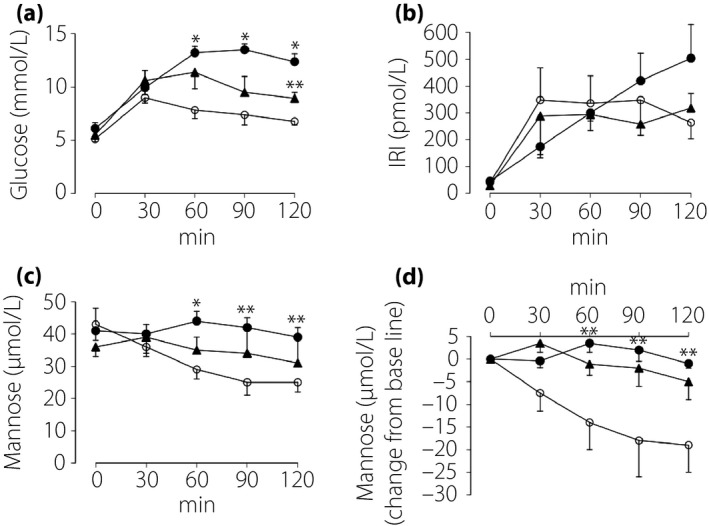
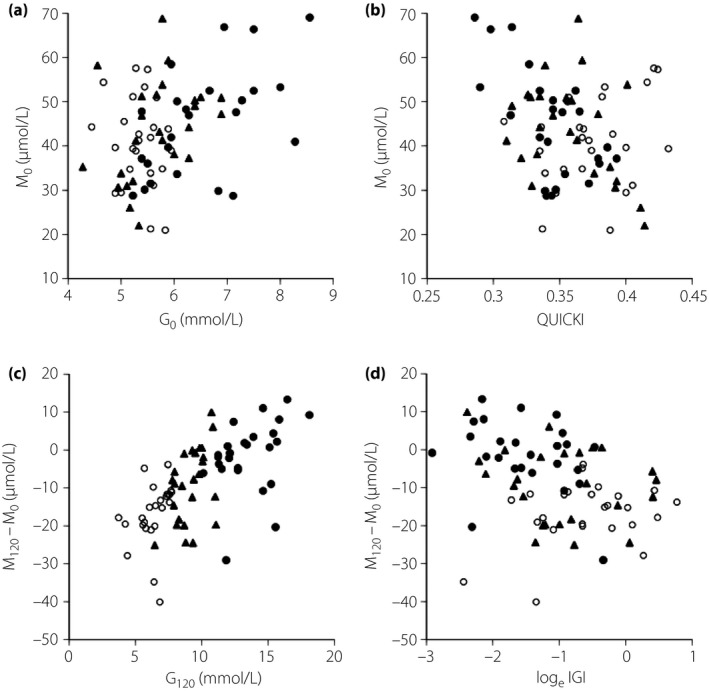
After glucose load, the plasma mannose level decreased gradually in the normal glucose tolerance group, but did not decrease in the diabetes mellitus group. Plasma mannose changes during 120 min from baseline (M -M ) were significantly different among the three groups (normal glucose tolerance: -16.7 ± 1.7; impaired glucose metabolism: -9.0 ± 1.9; diabetes mellitus: -1.4 ± 1.8 μmol/L [n = 25 in each group], P < 0.0001). Plasma glucose 120 min after glucose loading (R = 0.412) or log -insulinogenic index, log -Matsuda Index and age (R = 0.230) were determinants of M -M in multiple regression analyses.
We clarified the relationship between plasma mannose level and glucose tolerance in humans. The present results are compatible with those using rats, in which mannose derived from glycogenolysis plays an important role in the alteration of mannose levels after glucose loading.
目的/引言:甘露糖是糖蛋白和糖脂的单糖成分。先前的大鼠实验表明,葡萄糖负荷后血浆甘露糖水平下降,但糖尿病大鼠的血浆甘露糖水平没有下降,肝糖原分解是这种血浆甘露糖的来源;然而,这些结果在人类中尚未完全阐明。检查了不同程度葡萄糖耐量受损的人类在葡萄糖负荷前后的血浆甘露糖水平,以分析其与临床因素的关系。
对未服用糖尿病药物的日本人进行了 75g 口服葡萄糖耐量试验。参与者分为正常糖耐量、糖代谢受损和糖尿病组。计算了胰岛素原指数作为胰岛素分泌的指标和 Matsuda 指数作为胰岛素敏感性的指标。采用高效液相色谱法建立的方法测定甘露糖。
在正常糖耐量组,葡萄糖负荷后血浆甘露糖水平逐渐下降,但在糖尿病组没有下降。三组之间(正常糖耐量组:-16.7±1.7;糖代谢受损组:-9.0±1.9;糖尿病组:-1.4±1.8μmol/L[每组 25 人]),M-M 在 120 分钟时的变化差异有统计学意义(n=25),P<0.0001)。葡萄糖负荷后 120 分钟的血浆葡萄糖(R=0.412)或 log-胰岛素原指数、log-Matsuda 指数和年龄(R=0.230)是多元回归分析中 M-M 的决定因素。
我们阐明了人类血浆甘露糖水平与葡萄糖耐量之间的关系。本研究结果与大鼠实验结果一致,即肝糖原分解产生的甘露糖在葡萄糖负荷后甘露糖水平的变化中起着重要作用。