Institute of Virology, Konsiliarlabor für Adenoviren (KLA, Adenovirus Reference Laboratory); Hannover Medical School, Hannover, Germany.
Department for Infectious Disease Epidemiology, Unit for Nosocomial Infections, Surveillance of Antimicrobial Resistance and Consumption, Robert Koch Institut, Berlin, Germany.
Sci Rep. 2017 Jan 13;7:40680. doi: 10.1038/srep40680.
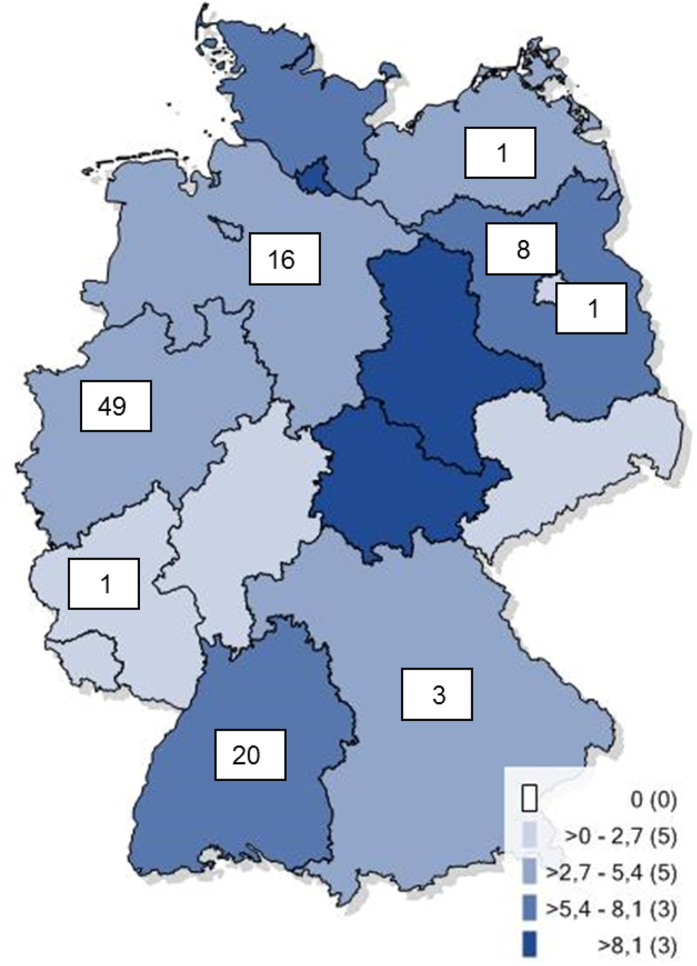
The German infectious disease surveillance system revealed an increase of epidemic keratoconjunctivitis (EKC) from an average of 320 cases/year (2001 to 2010) up to 2146 and 1986 cases in 2012 and 2013, respectively. From November 2011 until December 2013 (epidemic period) 85% of typed isolates were human adenovirus type 8 (HAdV-D8), whereas only low level circulation (19%) of HAdV-D8 was observed outside the epidemic period. In order to investigate whether a novel monophyletic HAdV-D8 strain prevailed during the epidemic period, complete genomic sequences of 23 HAdV-D8 isolates were generated by deep sequencing and analyzed phylogenetically. For comparison, eight HAdV-D8 isolates from outside the epidemic period were sequenced. HAdV-D8 isolates of the epidemic period had a very high sequence identity of at least 99.9% and formed a monophyletic cluster with two subclusters. A single outlier was closely related to HAdV-D8 strains isolated prior to the epidemic period. Circulation of the epidemic strain was detected as early as 2010 but not after the epidemic period in 2014. In conclusion, molecular phylogeny of complete genomic sequences proved a monophyletic HAdV-D8 epidemic. However, co-circulation of other HAdV types as well as better reporting may have contributed to the huge increase of reported cases.
德国传染病监测系统显示,流行角结膜炎(EKC)的病例数从 2001 年至 2010 年的平均 320 例增加到 2012 年的 2146 例和 2013 年的 1986 例。2011 年 11 月至 2013 年 12 月(流行期)期间,85%的定型分离株为人腺病毒 8 型(HAdV-D8),而在流行期之外,仅观察到 HAdV-D8 的低水平循环(19%)。为了研究在流行期是否存在新型单系 HAdV-D8 株,通过深度测序生成了 23 株 HAdV-D8 分离株的完整基因组序列,并进行了系统进化分析。为了比较,对流行期之外的 8 株 HAdV-D8 分离株进行了测序。流行期的 HAdV-D8 分离株具有至少 99.9%的极高序列同一性,并形成一个单系聚类,其中有两个亚群。一个孤立的样本与流行期之前分离的 HAdV-D8 株密切相关。流行株的循环早在 2010 年就已被检测到,但在 2014 年流行期之后并未被检测到。总之,完整基因组序列的分子系统发育证明了 HAdV-D8 的单系流行。然而,其他 HAdV 型的共同循环以及更好的报告可能促成了报告病例的大量增加。