Arizpe Joseph M, McKean Danielle L, Tsao Jack W, Chan Annie W-Y
Department of Neurology, University of Tennessee Health Science Center, Memphis, Tennessee, United States of America.
Le Bonheur Children's Hospital, Memphis, Tennessee, United States of America.
PLoS One. 2017 Jan 13;12(1):e0169148. doi: 10.1371/journal.pone.0169148. eCollection 2017.
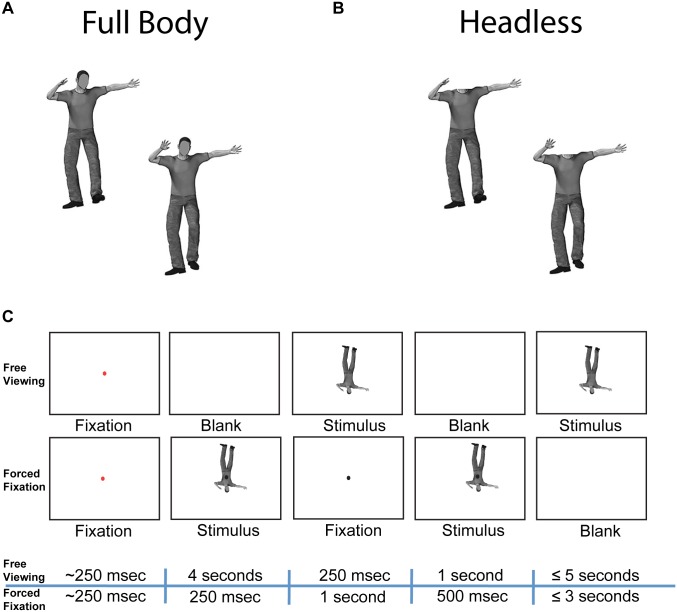
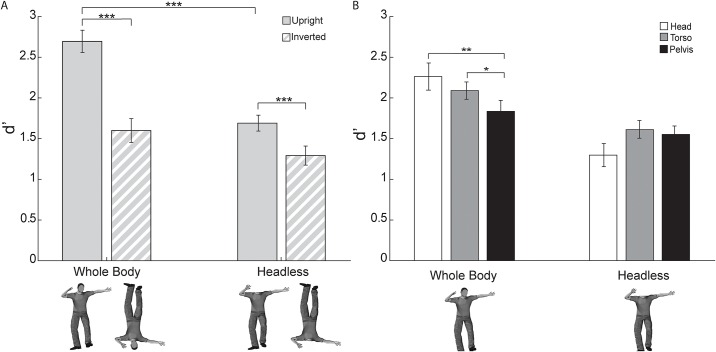
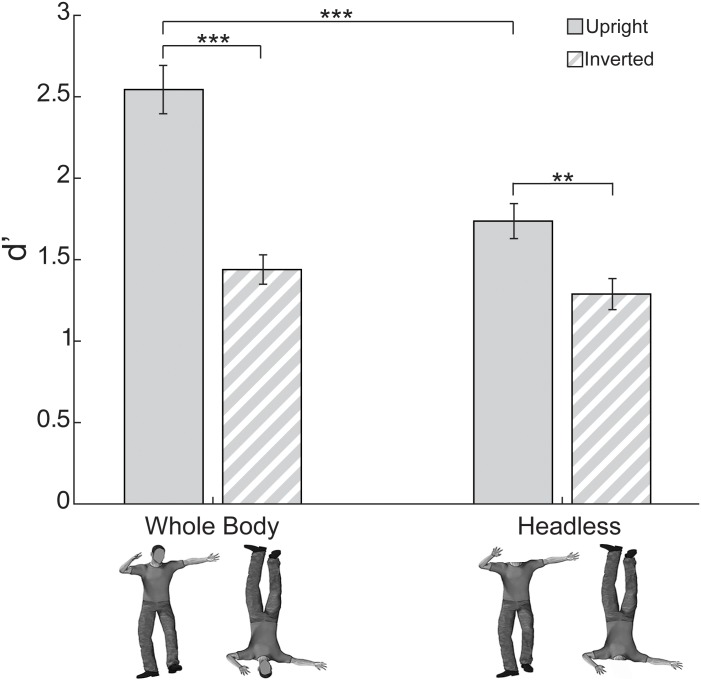
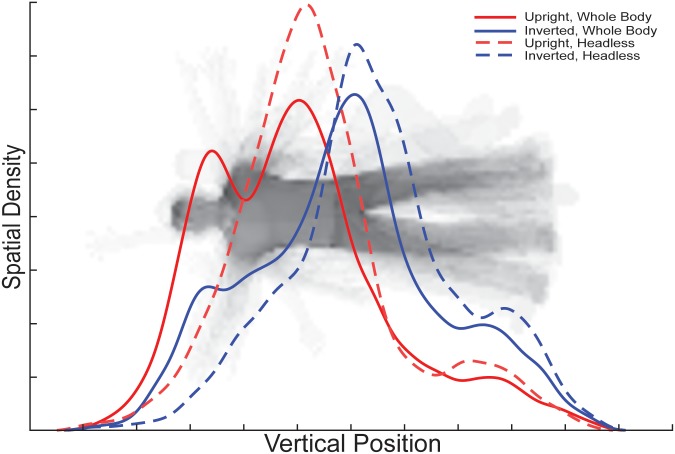
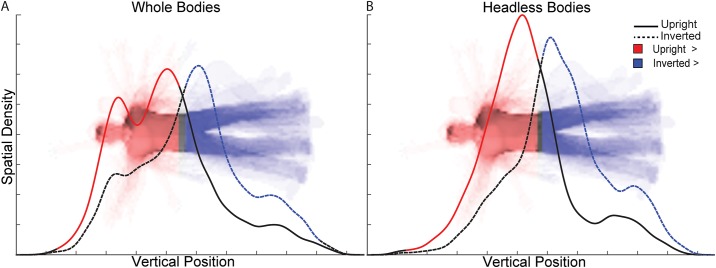
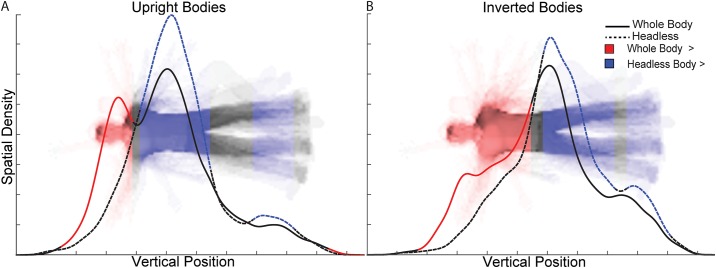
The Body Inversion Effect (BIE; reduced visual discrimination performance for inverted compared to upright bodies) suggests that bodies are visually processed configurally; however, the specific importance of head posture information in the BIE has been indicated in reports of BIE reduction for whole bodies with fixed head position and for headless bodies. Through measurement of gaze patterns and investigation of the causal relation of fixation location to visual body discrimination performance, the present study reveals joint contributions of feature and configuration processing to visual body discrimination. Participants predominantly gazed at the (body-centric) upper body for upright bodies and the lower body for inverted bodies in the context of an experimental paradigm directly comparable to that of prior studies of the BIE. Subsequent manipulation of fixation location indicates that these preferential gaze locations causally contributed to the BIE for whole bodies largely due to the informative nature of gazing at or near the head. Also, a BIE was detected for both whole and headless bodies even when fixation location on the body was held constant, indicating a role of configural processing in body discrimination, though inclusion of the head posture information was still highly discriminative in the context of such processing. Interestingly, the impact of configuration (upright and inverted) to the BIE appears greater than that of differential preferred gaze locations.
身体倒置效应(BIE;与直立身体相比,倒置身体的视觉辨别能力下降)表明身体在视觉上是作为一个整体进行加工的;然而,在关于固定头部位置的全身和无头身体的BIE降低的报告中,已经指出了头部姿势信息在BIE中的具体重要性。通过测量注视模式以及研究注视位置与视觉身体辨别能力之间的因果关系,本研究揭示了特征加工和整体加工对视觉身体辨别能力的共同作用。在与先前BIE研究直接可比的实验范式背景下,参与者主要注视直立身体的(以身体为中心的)上半身,以及倒置身体的下半身。随后对注视位置的操纵表明,这些优先注视位置在很大程度上对全身的BIE有因果贡献,这主要是由于注视头部或头部附近所提供的信息性质。此外,即使身体上的注视位置保持不变,在全身和无头身体上都检测到了BIE,这表明整体加工在身体辨别中发挥了作用,尽管在这种加工背景下,包含头部姿势信息仍然具有高度的辨别性。有趣的是,整体(直立和倒置)对BIE的影响似乎大于不同的优先注视位置的影响。