Cui Aili, Zhu Zhen, Hu Ying, Deng Xiuying, Sun Zhaodan, Zhang Yan, Mao Naiying, Xu Songtao, Fang Xueqiang, Gao Hui, Si Yuan, Lei Yake, Zheng Huanying, He Jilan, Wu Hongwei, Xu Wenbo
WHO WPRO Regional Reference Measles/Rubella Laboratory and Key Laboratory of Medical Virology Ministry of Health, National Institute for Viral Disease Control and Prevention, Beijing, People's Republic of China.
Jiangsu Provincial Centers for Disease Control and Prevention, Nanjing, People's Republic of China.
PLoS One. 2017 Jan 13;12(1):e0169561. doi: 10.1371/journal.pone.0169561. eCollection 2017.
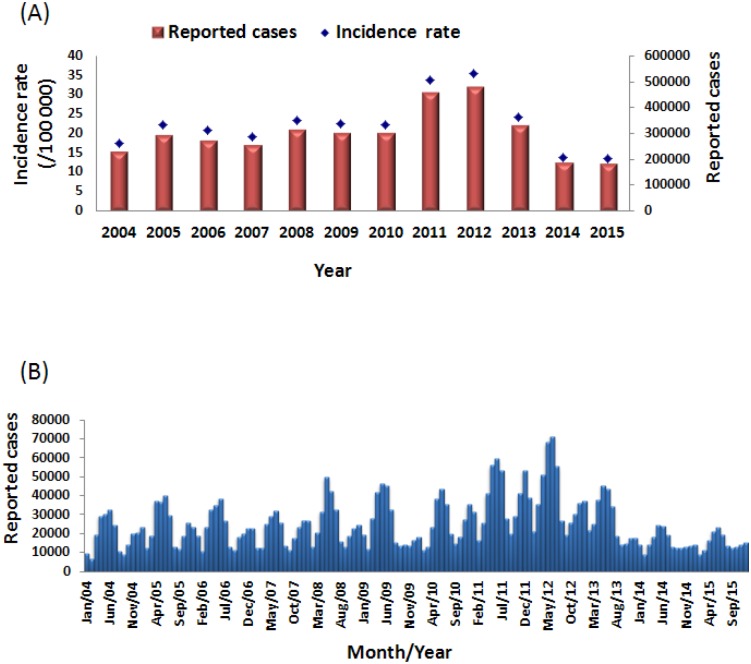
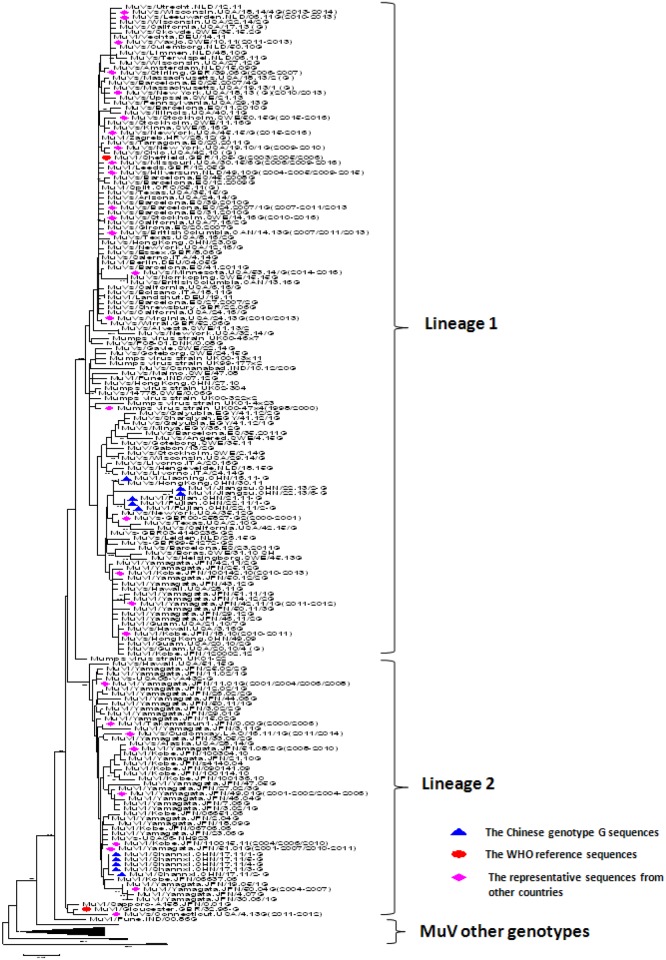
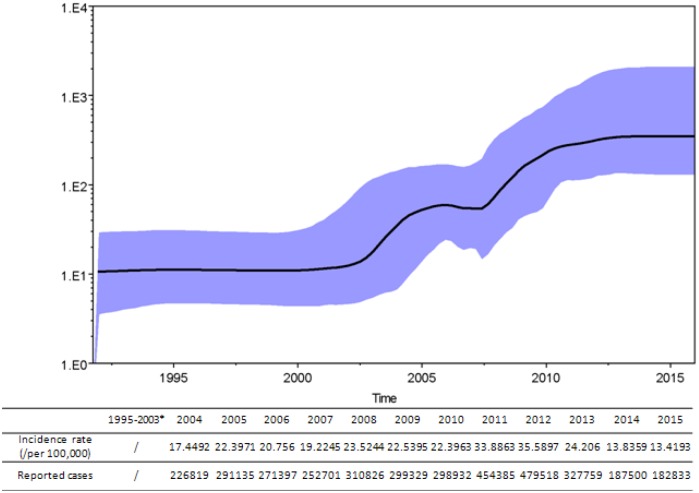
With the implementation of mumps virus (MuV) vaccination in the expanded program on immunization (EPI) in mainland China since 2008, the incidence of mumps has decreased, and the natural epidemic pattern of mumps has slightly changed during 2013-2015. The two epidemic peaks (April-July and November-December) became less obvious than those observed from 2004 to 2012. Children and adolescents younger than 15, particularly in the five-to-nine-year-old age group, remain the target group and should be the focus of high-quality immunization activities in mainland China. However, it was also found that the incidence and reported cases of mumps decreased in each age group during 2013-2015, particularly in the five-to-nine-year-old and ten-to-fourteen-year-old age groups. The proportion of mumps cases among adults in some provinces also increased. Unlike the changes in the epidemiological characteristics of mumps affected by vaccination, the data of MuV virology surveillance indicated that most of the MuV transmission chains have not yet been effectively interrupted, and MuV remains a natural epidemic pattern in mainland China. In the MuV virology surveillance, 194 MuV strains during 2013-2015 were isolated from 10 of 31 provinces in mainland China. Based on the phylogenetic analysis of the small hydrophobic (SH) gene, both genotype F (99.0%) and G (1.0%) were identified, and genotype F was still the predominant genotype continuously circulating in mainland China. Representative genotype F and G strains isolated in China from 1995 to 2012 were selected for further analysis. The results indicated that there were multiple transmission chains within genotype F, with no obvious geographical or time differences. The high genetic diversity of genotype F strains could be a result of the continuous transmission and evolution of the MuV in mainland China. Genotype G was also detected in four provinces in mainland China. Because of the limited epidemiological data, it was uncertain whether the genotype G MuV strains found in 2011 and 2013 were imported from other countries. Therefore, combined high-quality epidemiological and virological surveillance is necessary for mumps control; it can also be used to observe the changes in epidemiological characteristics and viral transmission of mumps over time after mumps-containing vaccine (MuCV) implementation and to provide a comprehensive epidemiological and genetic baseline for mumps elimination in mainland China.
自2008年中国大陆扩大国家免疫规划(EPI)实施腮腺炎病毒(MuV)疫苗接种以来,腮腺炎发病率有所下降,2013 - 2015年期间腮腺炎的自然流行模式略有变化。两个流行高峰(4 - 7月和11 - 12月)不如2004年至2012年期间明显。15岁及以下儿童和青少年,特别是5至9岁年龄组,仍然是目标人群,应成为中国大陆高质量免疫活动的重点。然而,还发现2013 - 2015年期间各年龄组的腮腺炎发病率和报告病例数均有所下降,特别是5至9岁和10至14岁年龄组。一些省份成人中腮腺炎病例的比例也有所增加。与接种疫苗影响的腮腺炎流行病学特征变化不同,MuV病毒学监测数据表明,大多数MuV传播链尚未得到有效阻断,MuV在中国大陆仍呈自然流行模式。在MuV病毒学监测中,2013 - 2015年期间从中国大陆31个省份中的10个省份分离出194株MuV毒株。基于小疏水(SH)基因的系统发育分析,鉴定出基因型F(99.0%)和G(1.0%),基因型F仍然是在中国大陆持续传播的主要基因型。选择1995年至2012年在中国分离的代表性基因型F和G毒株进行进一步分析。结果表明,基因型F内存在多个传播链,无明显地理或时间差异。基因型F毒株的高遗传多样性可能是MuV在中国大陆持续传播和进化的结果。在中国大陆四个省份也检测到基因型G。由于流行病学数据有限,不确定2011年和2013年发现的基因型G MuV毒株是否从其他国家输入。因此,结合高质量的流行病学和病毒学监测对于控制腮腺炎是必要的;它还可用于观察含腮腺炎疫苗(MuCV)实施后腮腺炎流行病学特征和病毒传播随时间的变化,并为中国大陆消除腮腺炎提供全面的流行病学和基因基线。