Shi Qi, Liu Shanshan, Li Wen, Zong Shaoqi, Han Susu, Yang Wei, Li Hongjia, Hou Fenggang
Oncology Department of Municipal Hospital of Traditional Chinese Medicine, Shanghai University of Traditional Chinese Medicine, Shanghai 200071, China.
Oncotarget. 2017 Feb 21;8(8):13488-13495. doi: 10.18632/oncotarget.14567.
To clarify the effect of tradional Chinese medicine (TCM) on different stage patients and to explore medication duration based on survival analysis.
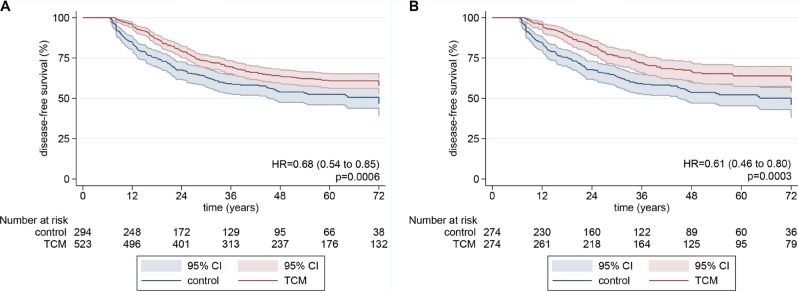
523 and 294 patients were respectively in the TCM group and the control group. For all patients, 6-year disease-free survival (DFS) was 57.6% after TCM and 46.6% after non-TCM (p = 0.0006). 6-year DFS for patients with stage I disease in the TCM group was 79.5% compared with 89.1% in the control group (p = 0.65). For patients with stage II disease, 6-year DFS was 63.1% in the TCM group compared with 50.2% in the control group (p = 0.054), and for patients with stage III disease, it was 43.3% in the TCM group compared with 22.0% in the control group (p = 0.0000).
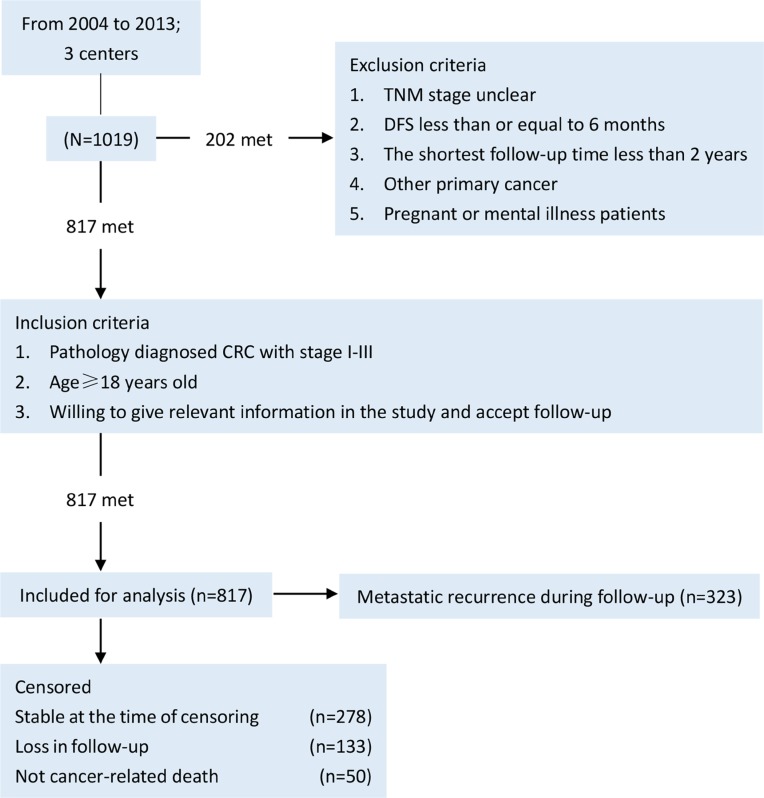
Data for patients with stage I-III disease between 2004 and 2013 were retrieved for this study, who underwent TCM after surgery were in the TCM group and the others were in the control group. Clinic appointments or phone were used to collect data by research assistants. Survival data were collected on Nov 2015 from the database, which is continuously updated by the researchers.
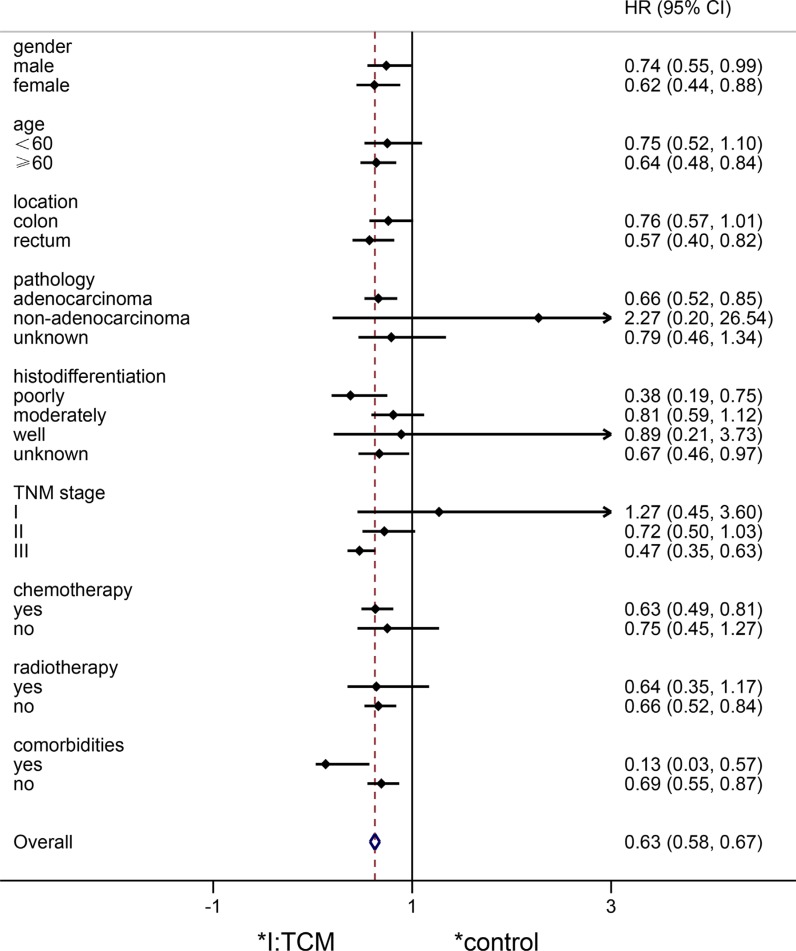
TCM is associated with significantly improved disease-free survival, in particular for patients with stage III disease. Among of these, TCM is not necessary for patients with stage I disease, and postoperative patients with stage II disease should be recommended to take 2 years of TCM. For patients with stage III disease, adherence to medication of TCM during the 6-year follow-up is worthy of being recommended.
阐明中药对不同分期患者的疗效,并基于生存分析探索用药时长。
中药组和对照组分别有523例和294例患者。所有患者中,中药治疗后6年无病生存率(DFS)为57.6%,非中药治疗后为46.6%(p = 0.0006)。中药组I期疾病患者的6年DFS为79.5%,而对照组为89.1%(p = 0.65)。II期疾病患者中,中药组6年DFS为63.1%,对照组为50.2%(p = 0.054);III期疾病患者中,中药组为43.3%,对照组为22.0%(p = 0.0000)。
本研究检索了2004年至2013年期间I - III期疾病患者的数据,术后接受中药治疗的患者纳入中药组,其他患者纳入对照组。研究助理通过门诊预约或电话收集数据。生存数据于2015年11月从数据库中收集,该数据库由研究人员持续更新。
中药与显著改善的无病生存率相关,特别是对于III期疾病患者。其中,I期疾病患者无需使用中药,II期疾病术后患者应建议服用2年中药。对于III期疾病患者,在6年随访期间坚持服用中药值得推荐。