Miyamoto Norio, Yoshida Masa-Aki, Koga Hiroyuki, Fujiwara Yoshihiro
Japan Agency for Marine-Earth Science and Techonology, Yokosuka, Kanagawa, Japan.
National Institute of Genetics, Mishima, Shizuoka, Japan.
BMC Evol Biol. 2017 Jan 13;17(1):17. doi: 10.1186/s12862-016-0844-4.
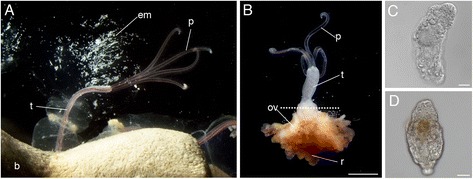
Bone-eating worms of the genus Osedax (Annelida, Siboglinidae) have adapted to whale fall environments by acquiring a novel characteristic called the root, which branches and penetrates into sunken bones. The worms lack a digestive tract and mouth opening, and it has been suggested that Osedax degrade vertebrate bones and uptake nutrients through acidification and secretion of enzymes from the root. Symbiotic bacteria in the root tissue may have a crucial role in the metabolism of Osedax. However, the molecular mechanisms and cells responsible for bone digestion and nutrient uptake are still unclear, and information on the metabolic interaction between Osedax and symbiotic bacteria is limited.
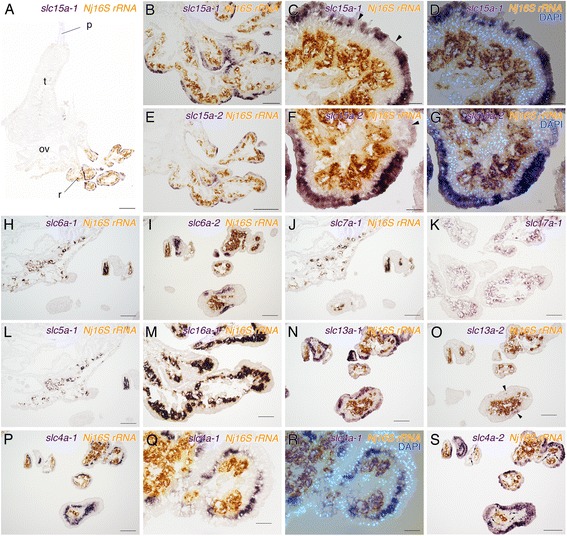
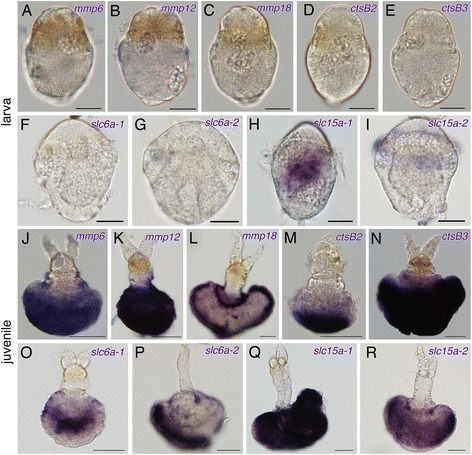
We compared transcriptomes from three different RNA samples from the following tissues: trunk + palps, root + ovisac, and larva + male. A Pfam domain enrichment analysis revealed that protease- and transporter-related genes were enriched in the root + ovisac specific genes compared with the total transcriptome. Through targeted gene annotation we found gene family expansions resulting in a remarkably large number of matrix metalloproteinase (mmp) genes in the Osedax compared with other invertebrates. Twelve of these Osedax mmp genes were expressed in the root epidermal cells. Genes encoding various types of transporters, including amino acid, oligopeptide, bicarbonate, and sulfate/carboxylate transporters, were also expressed in root epidermal cells. In addition, amino acid and other metabolite transporter genes were expressed in bacteriocytes. These protease and transporter genes were first expressed in root tissues at the juvenile stage, when the root starts to develop.
The expression of various proteinase and transporter genes in the root epidermis supports the theory that the root epidermal cells are responsible for bone digestion and subsequent nutrient uptake. Expression of transporter genes in the host bacteriocytes suggests the presence of metabolic interaction between Osedax and symbiotic bacteria.
食骨蠕虫属(多毛纲,西伯加林虫科)的蠕虫通过获得一种名为“根”的新特征适应了鲸落环境,这种“根”会分支并穿透沉入海底的骨骼。这些蠕虫没有消化道和口部开口,有人认为食骨蠕虫通过酸化和从“根”分泌酶来降解脊椎动物骨骼并摄取营养。“根”组织中的共生细菌可能在食骨蠕虫的新陈代谢中起关键作用。然而,负责骨骼消化和营养摄取的分子机制和细胞仍不清楚,关于食骨蠕虫与共生细菌之间代谢相互作用的信息也有限。
我们比较了来自以下三种不同组织的RNA样本的转录组:躯干+触须、根+卵囊以及幼虫+雄性。Pfam结构域富集分析表明,与总转录组相比,蛋白酶和转运蛋白相关基因在根+卵囊特异性基因中富集。通过靶向基因注释,我们发现与其他无脊椎动物相比,食骨蠕虫中基因家族发生扩张,导致基质金属蛋白酶(mmp)基因数量显著增多。其中12个食骨蠕虫mmp基因在根表皮细胞中表达。编码各种类型转运蛋白的基因,包括氨基酸、寡肽、碳酸氢盐和硫酸盐/羧酸盐转运蛋白,也在根表皮细胞中表达。此外,氨基酸和其他代谢物转运蛋白基因在含菌细胞中表达。这些蛋白酶和转运蛋白基因在幼年阶段根开始发育时首次在根组织中表达。
根表皮中各种蛋白酶和转运蛋白基因的表达支持了根表皮细胞负责骨骼消化和随后营养摄取的理论。宿主含菌细胞中转运蛋白基因的表达表明食骨蠕虫与共生细菌之间存在代谢相互作用。