Armstrong Melissa J, Gronseth Gary S, Dubinsky Richard, Potrebic Sonja, Penfold Murray Rebecca, Getchius Thomas S D, Rheaume Carol, Gagliardi Anna R
Department of Neurology, University of Florida College of Medicine, Gainesville, FL, USA.
University of Maryland School of Medicine, Baltimore, MD, USA.
BMC Med Inform Decis Mak. 2017 Jan 13;17(1):9. doi: 10.1186/s12911-016-0404-2.
Clinical guidelines support decision-making at the point-of-care but the onus is often on individual users such as physicians to implement them. Research shows that the inclusion of implementation tools in or with guidelines (GItools) is associated with guideline use. However, there is little research on which GItools best support implementation by individual physicians. The purpose of this study was to investigate naturalistic access and use of GItools produced by the American Academy of Neurology (AAN) to inform future tool development.
Website accesses over six months were summarized for eight AAN guidelines and associated GItools published between July 2012 and August 2013. Academy members were surveyed about use of tools accompanying the sport concussion guideline. Data were analyzed using summary statistics and the Chi-square test.
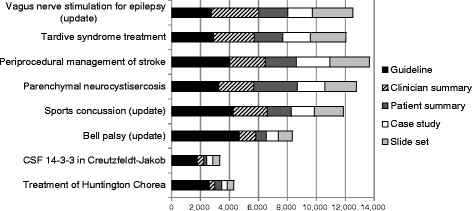
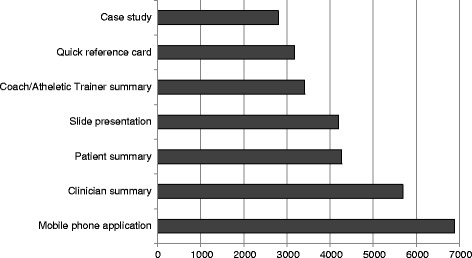
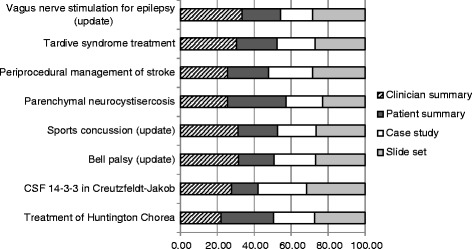
The clinician summary was accessed more frequently (29.0%, p < 0.001) compared with the slide presentation (26.8%), patient summary (23.2%) or case study (20.9%), although this varied by guideline topic. For the sport concussion guideline, which was accompanied by a greater variety of GItools, the mobile phone quick reference check application was most frequently accessed, followed by the clinician summary, patient summary, and slide presentation. For the sports concussion guideline survey, most respondents (response rate 21.8%, 168/797) were aware of the guideline (88.1%) and had read the guideline (78.6%). For GItool use, respondents indicated reading the reference card (51.2%), clinician summary (45.2%), patient summary (28.0%), mobile phone application (26.2%), and coach/athletic trainer summary (20.2%). Patterns of sports concussion GItool use were similar between respondents who said they had and had not yet implemented the guideline.
Developers faced with resource limitations may wish to prioritize the development of printable or mobile application clinician summaries, which were accessed significantly more than other types of GItools. Further research is needed to understand how to optimize the design of such GItools.
临床指南有助于即时医疗决策,但通常由医生等个体用户负责实施。研究表明,在指南中纳入实施工具(指南实施工具,GItools)与指南的使用相关。然而,关于哪些指南实施工具最能支持个体医生实施指南的研究较少。本研究的目的是调查美国神经病学学会(AAN)制作的指南实施工具的自然使用情况,以为未来工具开发提供参考。
总结了2012年7月至2013年8月期间发布的8项AAN指南及相关指南实施工具在六个月内的网站访问情况。对学会成员就运动性脑震荡指南所附工具的使用情况进行了调查。使用汇总统计和卡方检验对数据进行分析。
与幻灯片演示文稿(26.8%)、患者摘要(23.2%)或案例研究(20.9%)相比,临床医生摘要的访问频率更高(29.0%,p<0.001),不过这因指南主题而异。对于附带更多种指南实施工具的运动性脑震荡指南,手机快速参考检查应用程序的访问频率最高,其次是临床医生摘要、患者摘要和幻灯片演示文稿。对于运动性脑震荡指南调查,大多数受访者(回复率21.8%,168/797)知晓该指南(88.1%)且已阅读该指南(78.6%)。对于指南实施工具的使用,受访者表示阅读了参考卡片(51.2%)、临床医生摘要(45.2%)、患者摘要(28.0%)、手机应用程序(26.2%)以及教练/运动训练师摘要(20.2%)。表示已实施和尚未实施该指南的受访者在运动性脑震荡指南实施工具的使用模式上相似。
面临资源限制的开发者可能希望优先开发可打印的或移动应用程序的临床医生摘要,其访问量显著高于其他类型的指南实施工具。需要进一步研究以了解如何优化此类指南实施工具的设计。