Salgueiro Vivian Carolina, Iorio Natalia Lopes Pontes, Ferreira Marcelle Cristina, Chamon Raiane Cardoso, Dos Santos Kátia Regina Netto
Departamento de Microbiologia Médica, Instituto de Microbiologia Paulo de Góes, Universidade Federal do Rio de Janeiro, Av Carlos Chagas Filho, no 373, CCS, Bloco I, Sala 010, Cidade Universitária, Rio de Janeiro, Brazil.
Departamento de Ciências Básicas, Universidade Federal Fluminense, R. Dr. Silvio Henrique Braune, no 22, Nova Friburgo, Rio de Janeiro, Brazil.
BMC Microbiol. 2017 Jan 13;17(1):15. doi: 10.1186/s12866-017-0930-9.
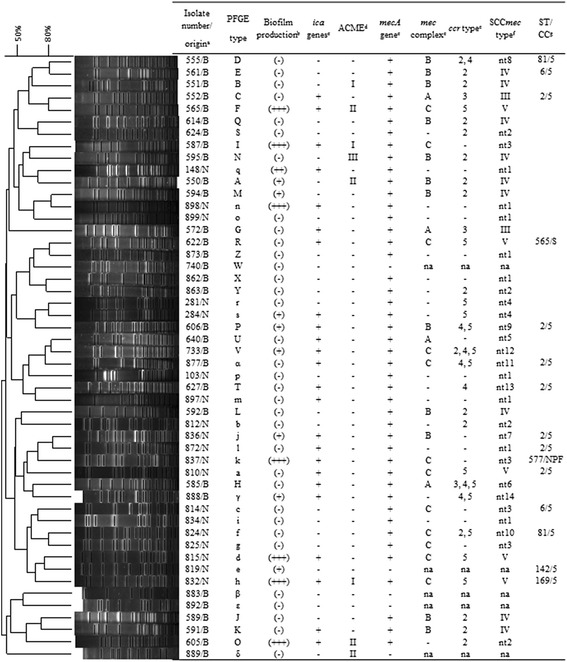
Staphylococcus epidermidis is an opportunistic pathogen involved in hospital-acquired infections, particularly in those related to medical devices. This study characterized 50 genetically unrelated S. epidermidis isolates from bloodstream infections (BSIs, n = 31) and nares (n = 19) of neonates in relation to staphylococcal chromosomal cassette mec (SCCmec) type, biofilm production and associated genes, and the arginine catabolic mobile elements (ACME), in order to detect virulence factors that could discriminate a potential invasiveness isolate or predict an increasing pathogenicity.
Isolates from both groups showed no difference for biofilm production and ACME genes detection. However, BSI isolates harbored more frequently the sdrF and sesI genes (p < 0.05), whereas biofilm producer isolates were associated with presence of the aap gene. The sdrF gene was also significantly more in the biofilm producer isolates from BSI. The SCCmec type IV and the ccr2 complex were related to BSI isolates (p < 0.05), while 83% of the nasal isolates were non-typeable for the SCCmec elements, with the mec complex and ccr undetectable as the most frequent profile.
Despite the great clonal diversity displayed by S. epidermidis isolates from neonates, BSI isolates harbored more frequently the sdrF and sesI adhesin genes, while nasal isolates were very variable in SCCmec composition. These aspects could be advantageous to improve colonization in the host increasing its pathogenicity.
表皮葡萄球菌是一种与医院获得性感染有关的机会致病菌,尤其是与医疗设备相关的感染。本研究对50株来自新生儿血流感染(BSIs,n = 31)和鼻腔(n = 19)的基因不相关的表皮葡萄球菌分离株进行了特征分析,涉及葡萄球菌染色体盒式mec(SCCmec)类型、生物膜产生及相关基因,以及精氨酸分解代谢移动元件(ACME),以检测可区分潜在侵袭性分离株或预测致病性增加的毒力因子。
两组分离株在生物膜产生和ACME基因检测方面无差异。然而,BSI分离株更频繁地携带sdrF和sesI基因(p < 0.05),而生物膜产生菌分离株与aap基因的存在有关。sdrF基因在来自BSI的生物膜产生菌分离株中也显著更多。SCCmec IV型和ccr2复合体与BSI分离株有关(p < 0.05),而83%的鼻腔分离株无法对SCCmec元件进行分型,最常见的情况是无法检测到mec复合体和ccr。
尽管新生儿表皮葡萄球菌分离株表现出很大的克隆多样性,但BSI分离株更频繁地携带sdrF和sesI黏附素基因,而鼻腔分离株的SCCmec组成非常多变。这些方面可能有利于改善在宿主体内的定植,增加其致病性。