Zhou Yuzhen, Xu Zongda, Yong Xue, Ahmad Sagheer, Yang Weiru, Cheng Tangren, Wang Jia, Zhang Qixiang
Beijing Key Laboratory of Ornamental Plants Germplasm Innovation & Molecular Breeding, National Engineering Research Center for Floriculture, Beijing Laboratory of Urban and Rural Ecological Environment, Key Laboratory of Genetics and Breeding in Forest Trees and Ornamental Plants of Ministry of Education, School of Landscape Architecture, Beijing Forestry University, Beijing, 100083, China.
BMC Plant Biol. 2017 Jan 13;17(1):10. doi: 10.1186/s12870-016-0954-6.
Flower phylogenetics and genetically controlled development have been revolutionised during the last two decades. However, some of these evolutionary aspects are still debatable. MADS-box genes are known to play essential role in specifying the floral organogenesis and differentiation in numerous model plants like Petunia hybrida, Arabidopsis thaliana and Antirrhinum majus. SEPALLATA (SEP) genes, belonging to the MADS-box gene family, are members of the ABCDE and quartet models of floral organ development and play a vital role in flower development. However, few studies of the genes in Prunus mume have yet been conducted.
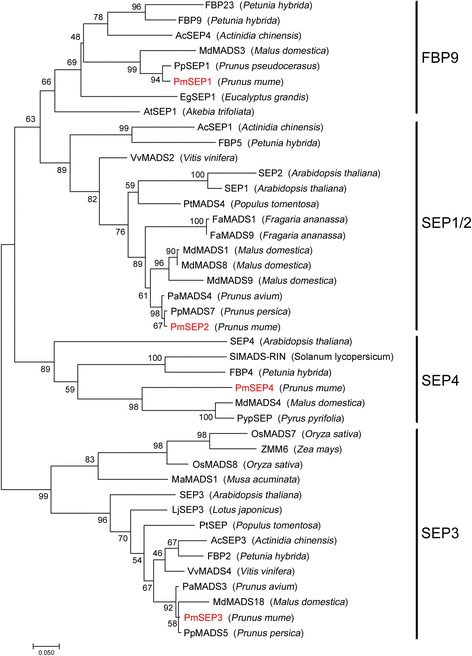
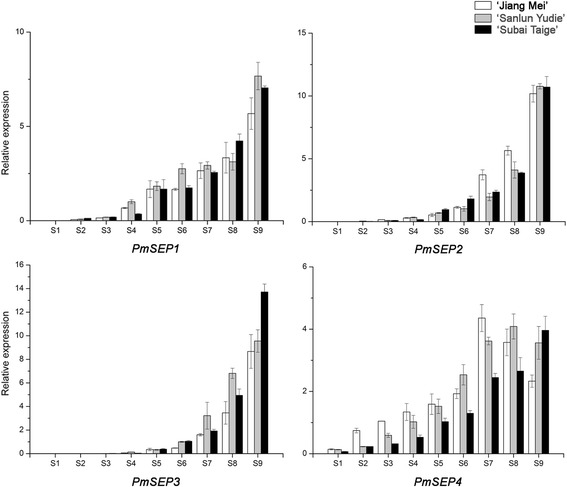
In this study, we cloned four PmSEPs and investigated their phylogenetic relationship with other species. Expression pattern analyses and yeast two-hybrid assays of these four genes indicated their involvement in the floral organogenesis with PmSEP4 specifically related to specification of the prolificated flowers in P. mume. It was observed that the flower meristem was specified by PmSEP1 and PmSEP4, the sepal by PmSEP1 and PmSEP4, petals by PmSEP2 and PmSEP3, stamens by PmSEP2 and PmSEP3 and pistils by PmSEP2 and PmSEP3.
With the above in mind, flower development in P. mume might be due to an expression of SEP genes. Our findings can provide a foundation for further investigations of the transcriptional factors governing flower development, their molecular mechanisms and genetic basis.
在过去二十年中,花卉系统发育学和基因控制的发育过程发生了革命性变化。然而,其中一些进化方面仍存在争议。已知MADS-box基因在许多模式植物如矮牵牛、拟南芥和金鱼草的花器官发生和分化中起关键作用。SEPALLATA(SEP)基因属于MADS-box基因家族,是花器官发育的ABCDE模型和四重奏模型的成员,在花的发育中起着至关重要的作用。然而,对梅花中这些基因的研究还很少。
在本研究中,我们克隆了四个PmSEP基因,并研究了它们与其他物种的系统发育关系。对这四个基因的表达模式分析和酵母双杂交试验表明它们参与了花器官发生,其中PmSEP4与梅花中多花的特化特别相关。观察到花分生组织由PmSEP1和PmSEP4特化,萼片由PmSEP1和PmSEP4特化,花瓣由PmSEP2和PmSEP3特化,雄蕊由PmSEP2和PmSEP3特化,雌蕊由PmSEP2和PmSEP3特化。
基于以上情况,梅花的花发育可能归因于SEP基因的表达。我们的研究结果可为进一步研究调控花发育的转录因子、其分子机制和遗传基础提供基础。