Chopra Ratan, Burow Gloria, Burke John J, Gladman Nicholas, Xin Zhanguo
Plant Stress & Germplasm Development Unit, Cropping Systems Research Laboratory, USDA-ARS, Lubbock, TX, 79415, USA.
BMC Plant Biol. 2017 Jan 13;17(1):12. doi: 10.1186/s12870-016-0966-2.
Climate variability due to fluctuation in temperature is a worldwide concern that imperils crop production. The need to understand how the germplasm variation in major crops can be utilized to aid in discovering and developing breeding lines that can withstand and adapt to temperature fluctuations is more necessary than ever. Here, we analyzed the genetic variation associated with responses to thermal stresses in a sorghum association panel (SAP) representing major races and working groups to identify single nucleotide polymorphisms (SNPs) that are associated with resilience to temperature stress in a major cereal crop.
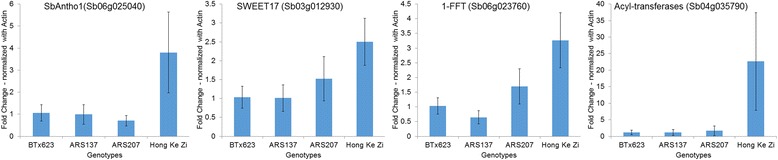
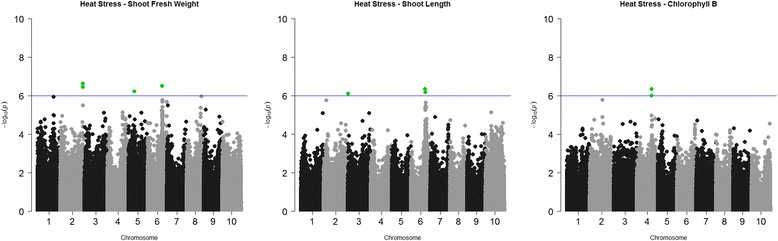
The SAP exhibited extensive variation for seedling traits under cold and heat stress. Genome-wide analyses identified 30 SNPs that were strongly associated with traits measured at seedling stage under cold stress and tagged genes that act as regulators of anthocyanin expression and soluble carbohydrate metabolism. Meanwhile, 12 SNPs were significantly associated with seedling traits under heat stress and these SNPs tagged genes that function in sugar metabolism, and ion transport pathways. Evaluation of co-expression networks for genes near the significantly associated SNPs indicated complex gene interactions for cold and heat stresses in sorghum. We focused and validated the expression of four genes in the network of Sb06g025040, a basic-helix-loop-helix (bHLH) transcription factor that was proposed to be involved in purple color pigmentation of leaf, and observed that genes in this network were upregulated during cold stress in a moderately tolerant line as compared to the more sensitive line.
This study facilitated the tagging of genome regions associated with variation in seedling traits of sorghum under cold and heat stress. These findings show the potential of genotype information for development of temperature resilient sorghum cultivars and further characterization of genes and their networks responsible for adaptation to thermal stresses. Knowledge on the gene networks from this research can be extended to the other cereal crops to better understand the genetic basis of resilience to temperature fluctuations during plant developmental stages.
温度波动导致的气候变化是一个全球性问题,危及作物生产。如今,比以往任何时候都更需要了解如何利用主要作物的种质变异,以帮助发现和培育能够耐受并适应温度波动的育种系。在此,我们分析了一个代表主要品种和工作组的高粱关联群体(SAP)中与热应激反应相关的遗传变异,以鉴定与一种主要谷类作物温度胁迫抗性相关的单核苷酸多态性(SNP)。
SAP在冷应激和热应激下的幼苗性状表现出广泛变异。全基因组分析确定了30个与冷应激下幼苗期测量性状强烈相关的SNP,并标记了作为花青素表达和可溶性碳水化合物代谢调节因子的基因。同时,12个SNP与热应激下的幼苗性状显著相关,这些SNP标记了在糖代谢和离子转运途径中起作用的基因。对显著相关SNP附近基因的共表达网络评估表明,高粱在冷应激和热应激下存在复杂的基因相互作用。我们聚焦并验证了网络中四个基因的表达,该网络中的一个碱性螺旋-环-螺旋(bHLH)转录因子Sb06g025040被认为参与叶片紫色色素沉着,并观察到与更敏感的品系相比,该网络中的基因在冷应激期间在一个中等耐受品系中上调。
本研究有助于标记与高粱在冷应激和热应激下幼苗性状变异相关的基因组区域。这些发现展示了基因型信息在培育抗温度高粱品种以及进一步表征负责适应热应激的基因及其网络方面的潜力。本研究中关于基因网络的知识可扩展到其他谷类作物,以更好地理解植物发育阶段对温度波动抗性的遗传基础。