Zhong Yu-Ping, Zhang Yi-Zhuo, Liao Ai-Jun, Li Su-Xia, Tian Chen, Lu Jin
Department of Hematology, Beijing Chaoyang Hospital (West), Capital Medical University, Beijing University Clinical Research Institute, Beijing 100043, China.
Department of Hematology, Tianjin Medical University Cancer Institute and Hospital, Tianjin Cancer Hospital, Tianjin 300000, China.
Chin Med J (Engl). 2017 Jan 20;130(2):130-134. doi: 10.4103/0366-6999.197977.
Elderly multiple myeloma (MM) patients often tend to suffer a variety of diseases, so the treatment of choice is very difficult for the elderly myeloma patients. The overall survival (OS) time and side effects with elderly patients are unclear in China. The study tried to find out the role of geriatric assessment in the Chinese elderly MM.
We retrospectively analyzed the data of 628 newly diagnosed patients from six hospitals from June 2011 to June 2013. A geriatric assessment had been performed to assess comorbidities, cognitive, and physical status for these patients. The primary endpoint was to evaluate different physical states of elderly patients with OS time and treatment-related side effects.
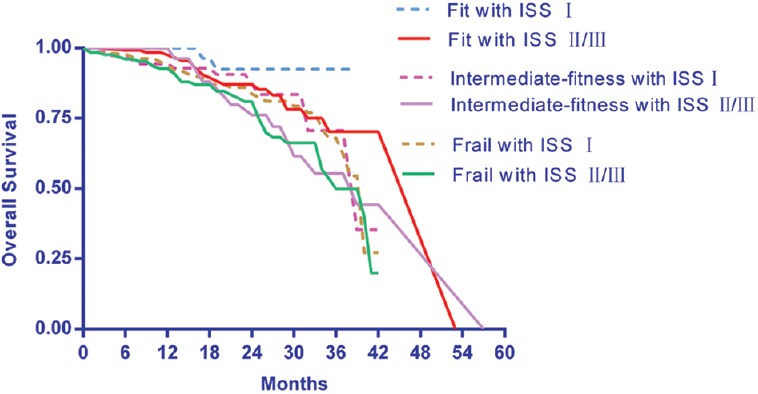
An additive scoring system (range: 0-5), based on age, Katz's Activity of Daily Living (ADL) and Lawton's Instrumental Activity of Daily Living (IADL) ≤5 and Charlson Comorbidity Index (CCI) was developed to identify three groups: fit (score = 0); intermediate-fitness (score = 1); and frail (score ≥2). The 3-year OS was 63% in fit patients, 63% in intermediate-fitness patients, and 49% in frail patients ≥3 hematologic adverse events (AEs) were documented in 45 (35.4%) fit, 34 (34%) intermediate-fitness, and 121 (30.2%) frail patients. The risk of a grade ≥3 hematologic AEs was not significantly increase in intermediate-fitness (hazard ratios [HR]: 0.99, 95% confidence interval [CI]: 0.54-1.47, P = 1.000) and in frail patients (HR: 1.16, 95% CI: 0.70-1.93, P = 0.558) compared with fit ones.
MM occurs earlier in life and being advanced when the diagnosis is made in the mainland of China. The overall survival in frailty with International Staging System (ISS) II/III was the worst in all patients.
老年多发性骨髓瘤(MM)患者常易患多种疾病,因此老年骨髓瘤患者的治疗选择非常困难。在中国,老年患者的总生存期(OS)及副作用尚不清楚。本研究试图明确老年评估在中国老年MM患者中的作用。
我们回顾性分析了2011年6月至2013年6月期间来自6家医院的628例新诊断患者的数据。对这些患者进行了老年评估,以评估其合并症、认知和身体状况。主要终点是评估老年患者不同身体状态下的OS时间及治疗相关副作用。
基于年龄、卡茨日常生活活动能力(ADL)和劳顿工具性日常生活活动能力(IADL)≤5以及查尔森合并症指数(CCI),开发了一种累加评分系统(范围:0 - 5),以识别三组患者:健康组(评分 = 0);中等健康组(评分 = 1);虚弱组(评分≥2)。健康组患者的3年总生存率为63%,中等健康组为63%,虚弱组为49%。45例(35.4%)健康患者、34例(34%)中等健康患者和121例(30.2%)虚弱患者记录有≥3级血液学不良事件(AE)。与健康组相比,中等健康组(风险比[HR]:0.99,95%置信区间[CI]:0.54 - 1.47,P = 1.000)和虚弱组(HR:1.16,95% CI:0.70 - 1.93,P = 0.558)发生≥3级血液学AE的风险未显著增加。
MM在中国大陆患者中发病年龄较早,诊断时病情往往已进展。在所有患者中,国际分期系统(ISS)II/III期虚弱患者的总生存期最差。