Department of Applied Chemistry, Kyung Hee University, Yongin, Gyeonggi 17104, Republic of Korea.
Pohang Accelerator Laboratory, Pohang, Gyeongbuk 37673, Republic of Korea.
Nat Commun. 2017 Jan 16;8:14068. doi: 10.1038/ncomms14068.
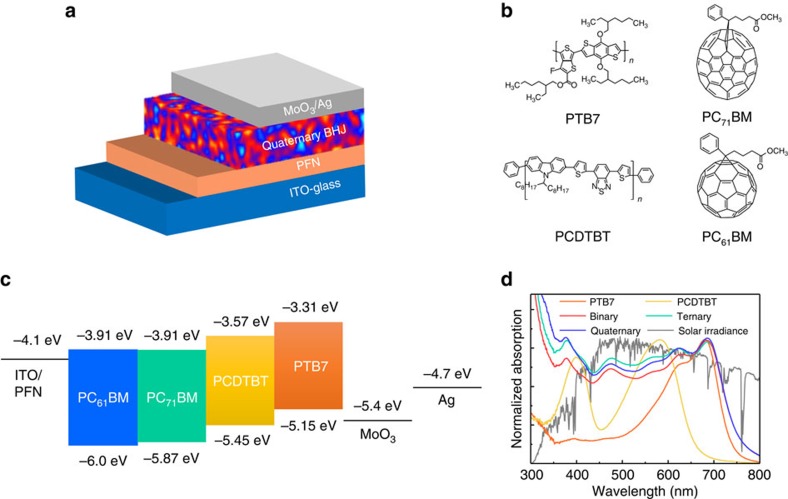
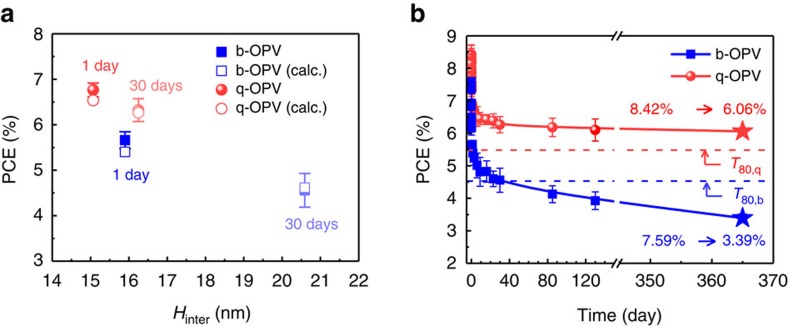
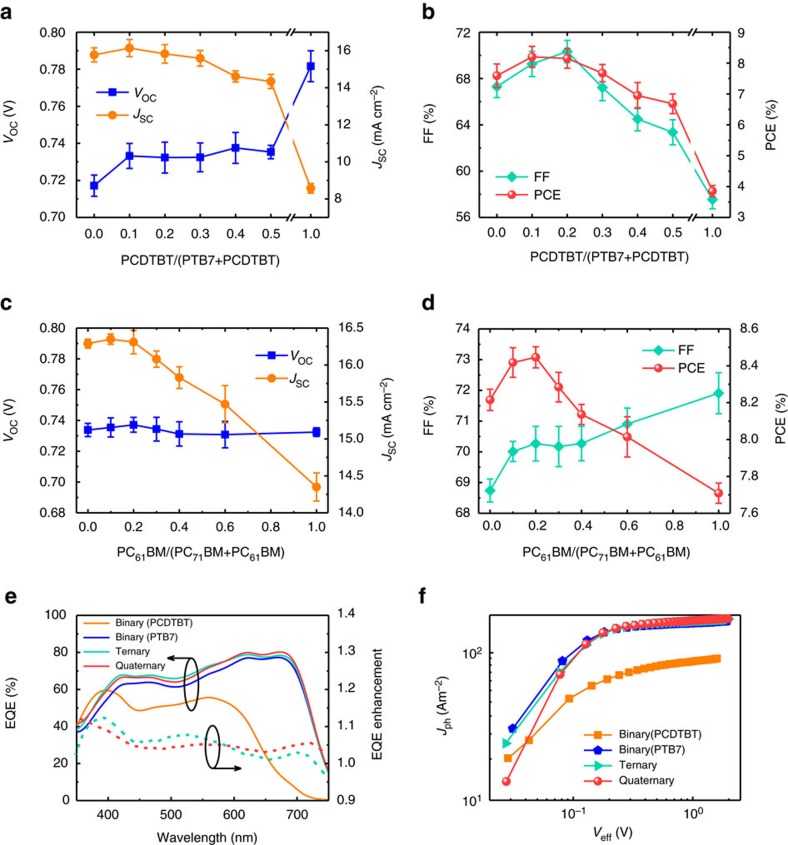
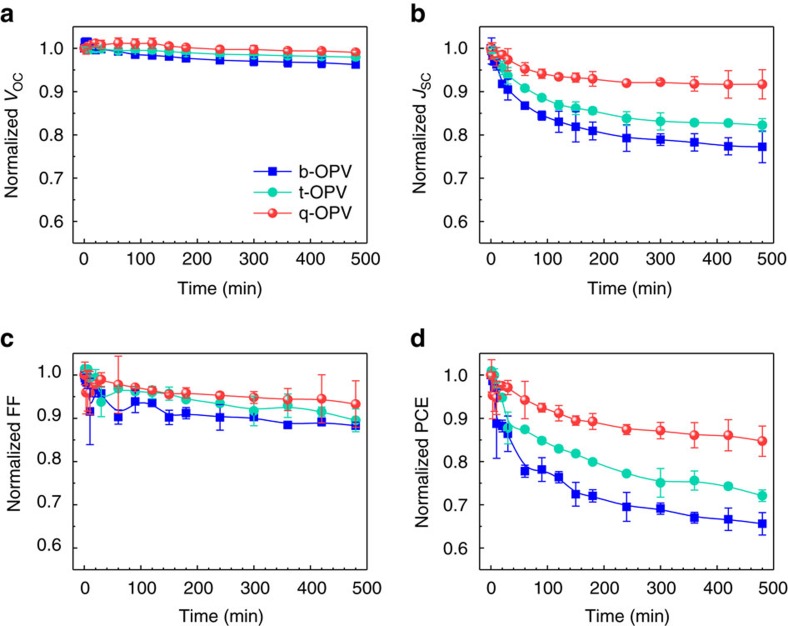
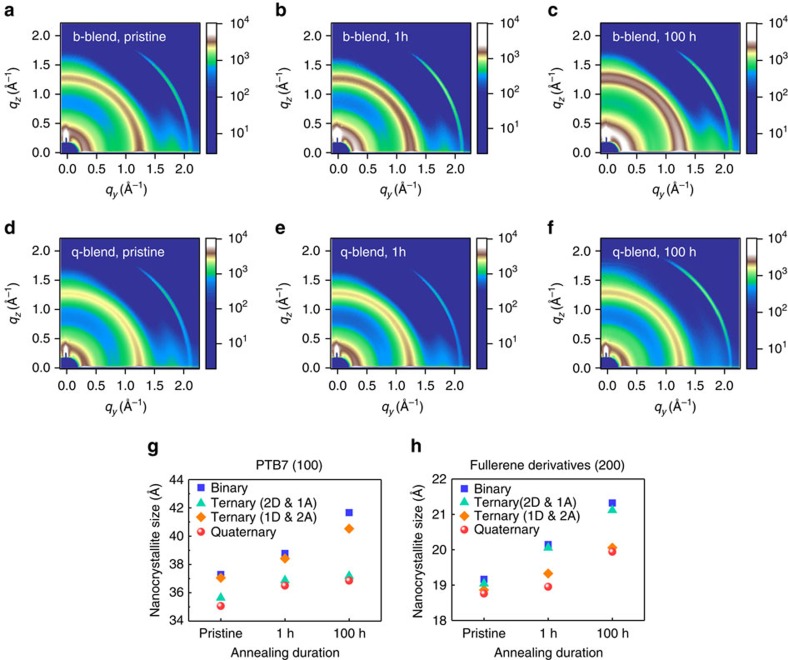
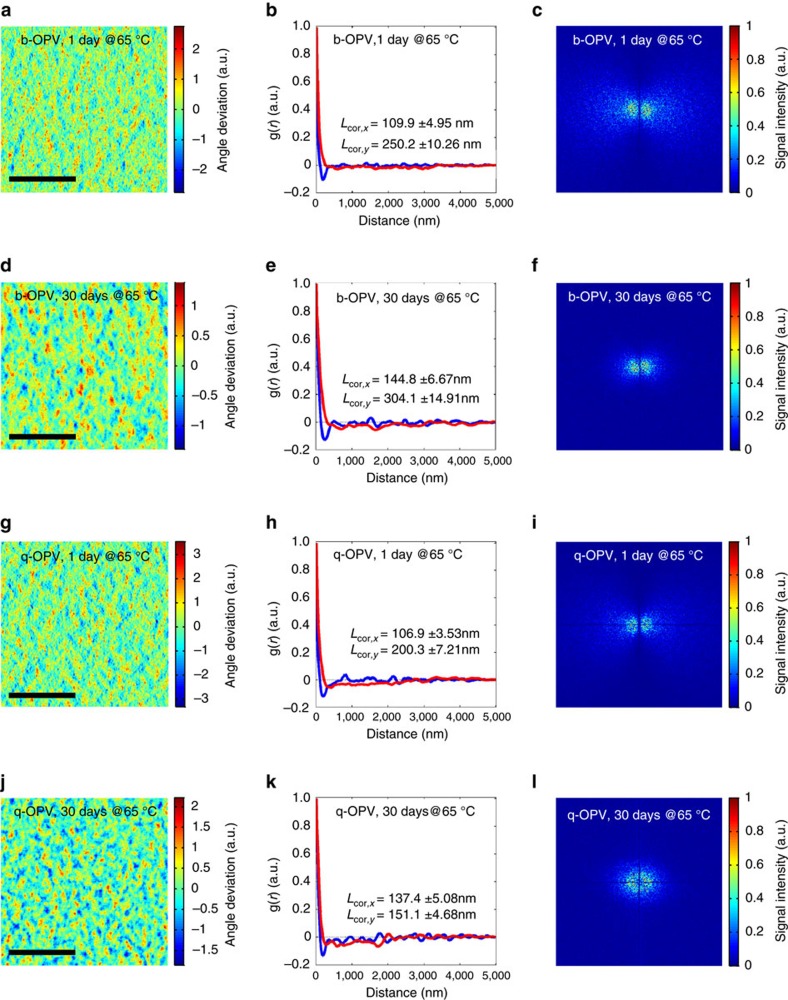
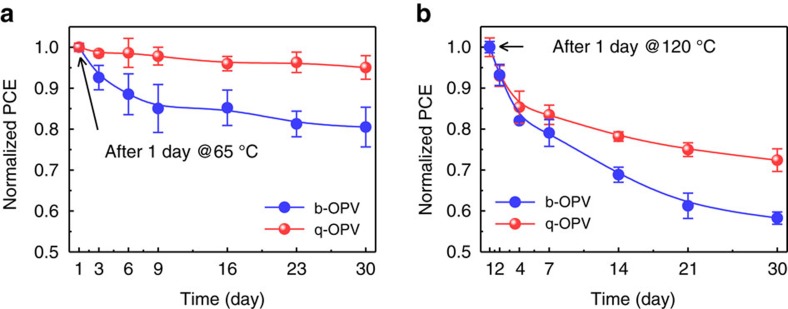
A major impediment to the commercialization of organic photovoltaics (OPVs) is attaining long-term morphological stability of the bulk heterojunction (BHJ) layer. To secure the stability while pursuing optimized performance, multi-component BHJ-based OPVs have been strategically explored. Here we demonstrate the use of quaternary BHJs (q-BHJs) composed of two conjugated polymer donors and two fullerene acceptors as a novel platform to produce high-efficiency and long-term durable OPVs. A q-BHJ OPV (q-OPV) with an experimentally optimized composition exhibits an enhanced efficiency and extended operational lifetime than does the binary reference OPV. The q-OPV would retain more than 72% of its initial efficiency (for example, 8.42-6.06%) after a 1-year operation at an elevated temperature of 65 °C. This is superior to those of the state-of-the-art BHJ-based OPVs. We attribute the enhanced stability to the significant suppression of domain growth and phase separation between the components via kinetic trapping effect.
有机光伏电池(OPV)商业化的一个主要障碍是实现体异质结(BHJ)层的长期形态稳定性。为了在追求优化性能的同时确保稳定性,已经有策略地探索了基于多组分 BHJ 的 OPV。在这里,我们展示了使用由两个共轭聚合物给体和两个富勒烯受体组成的四元 BHJ(q-BHJ)作为一种生产高效和长期耐用 OPV 的新平台。具有实验优化组成的 q-BHJ OPV(q-OPV)表现出比二元参考 OPV 更高的效率和更长的工作寿命。q-OPV 在 65°C 的高温下运行 1 年后仍能保留初始效率的 72%以上(例如,8.42-6.06%)。这优于最先进的基于 BHJ 的 OPV。我们将这种增强的稳定性归因于通过动力学捕获效应显著抑制了各组分之间的畴生长和相分离。