Munthe Sune, Halle Bo, Boldt Henning B, Christiansen Helle, Schmidt Steffen, Kaimal Vivek, Xu Jessica, Zabludoff Sonya, Mollenhauer Jan, Poulsen Frantz R, Kristensen Bjarne W
Department of Pathology, Odense University Hospital, Winsløwparken 15, 3rd floor, 5000, Odense C, Denmark.
Institute of Clinical Research, University of Southern Denmark, Winsløwparken 19, 5000, Odense C, Denmark.
J Neurooncol. 2017 Mar;132(1):45-54. doi: 10.1007/s11060-016-2356-x. Epub 2017 Jan 13.
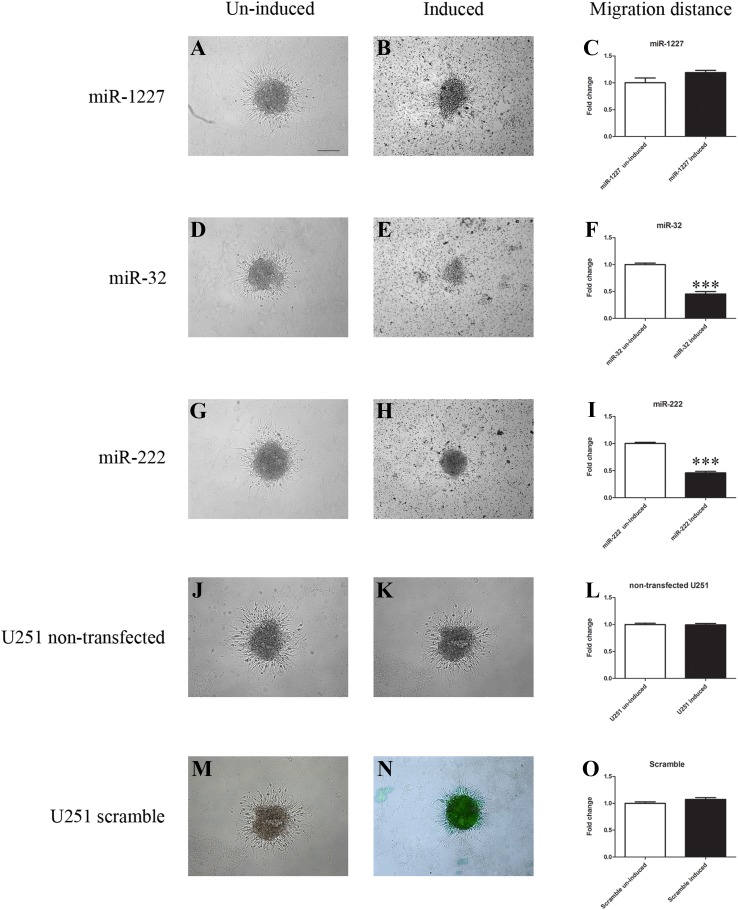
Glioblastoma multiforme (GBM) is the most frequent malignant primary brain tumor. A major reason for the overall median survival being only 14.6 months is migrating tumor cells left behind after surgery. Another major reason is tumor cells having a so-called cancer stem cell phenotype being therefore resistant towards traditional chemo- and radiotherapy. A group of novel molecular targets are microRNAs (miRNAs). MiRNAs are small non-coding RNAs exerting post-transcriptional regulation of gene expression. The aim of this study was to identify differentially expressed miRNAs in migrating GBM cells using serum-free stem cell conditions. We used patient-derived GBM spheroid cultures for a novel serum-free migration assay. MiRNA expression of migrating tumor cells isolated at maximum migration speed was compared with corresponding spheroids using an OpenArray Real-Time PCR System. The miRNA profiling revealed 30 miRNAs to be differentially expressed. In total 13 miRNAs were upregulated and 17 downregulated in migrating cells compared to corresponding spheroids. The three most deregulated miRNAs, miR-1227 (up-regulated), miR-32 (down-regulated) and miR-222 (down-regulated), were experimentally overexpressed. A non-significantly increased migration rate was observed after miR-1227 overexpression. A significantly reduced migration rate was observed after miR-32 and miR-222 overexpression. In conclusion a shift in microRNA profile upon glioma cell migration was identified using an assay avoiding serum-induced migration. Both the miRNA profiling and the functional validation suggested that miR-1227 may be associated with increased migration and miR-32 and miR-222 with decreased migration. These miRNAs may represent potential novel targets in migrating glioma cells.
多形性胶质母细胞瘤(GBM)是最常见的原发性恶性脑肿瘤。总体中位生存期仅为14.6个月的一个主要原因是手术后残留的迁移肿瘤细胞。另一个主要原因是具有所谓癌症干细胞表型的肿瘤细胞对传统化疗和放疗具有抗性。一组新的分子靶点是微小RNA(miRNA)。miRNA是小的非编码RNA,可在转录后调节基因表达。本研究的目的是在无血清干细胞条件下,鉴定迁移的GBM细胞中差异表达的miRNA。我们使用患者来源的GBM球状体培养物进行了一项新的无血清迁移试验。使用OpenArray实时PCR系统,将以最大迁移速度分离的迁移肿瘤细胞的miRNA表达与相应的球状体进行比较。miRNA谱分析显示有30种miRNA差异表达。与相应的球状体相比,迁移细胞中共有13种miRNA上调,17种下调。对三种失调最严重的miRNA,即上调的miR-1227、下调的miR-