Kaier Klaus, Hils Silvia, Fetzer Stefan, Hehn Philip, Schmid Anja, Hauschke Dieter, Bogatyreva Lioudmila, Jänigen Bernd, Pisarski Przemyslaw
Institute for Medical Biometry and Statistics, Faculty of Medicine and Medical Center - University of Freiburg, Stefan-Meier-Str 26, 79104, Freiburg, Germany.
Transplantation Center, Department of General and Visceral Surgery, Medical Center, Faculty of Medicine, University of Freiburg, Hugstetter Str 55, 79106, Freiburg, Germany.
Health Econ Rev. 2017 Dec;7(1):1. doi: 10.1186/s13561-016-0141-3. Epub 2017 Jan 13.
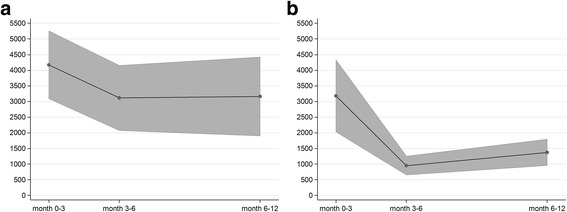
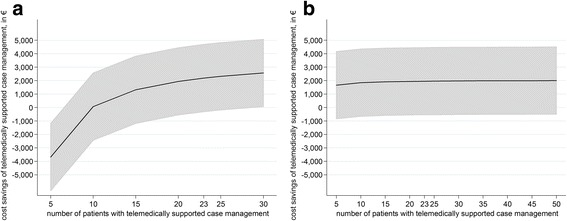
ᅟ: We analyze one-year costs and savings of a telemedically supported case management program after kidney transplantation from the perspective of the German Healthcare System. Recipients of living donor kidney transplantation (N = 46) were randomly allocated to either (1) standard aftercare or (2) standard aftercare plus additional telemedically supported case management. A range of cost figures of each patient's medical service utilization were calculated at month 3, 6 and 12 and analyzed using two-part regression models. In comparison to standard aftercare, patients receiving telemedically supported case management are associated with substantial lower costs related to unscheduled hospitalizations (mean difference: €3,417.46 per patient for the entire one-year period, p = 0.003). Taking all cost figures into account, patients receiving standard aftercare are associated, on average, with one-year medical service utilization costs of €10,449.28, while patients receiving telemedically supported case management are associated with €5,504.21 of costs (mean difference: € 4,945.07 per patient, p < 0.001). With estimated expenditures of €3,001.5 for telemedically supported case management of a single patient, we determined a mean difference of €1,943.57, but this result is not statistically significant (p = 0.128). Sensitivity analyses show that the program becomes cost-neutral at around ten participating patients, and was beneficial starting at 15 patients. Routine implementation of telemedically supported case management in German medium and high-volume transplant centers would result in annual cost savings of €791,033 for the German healthcare system. Patients with telemedically supported case management showed a lower utilization of medical services as well as better medical outcomes. Therefore, such programs should be implemented in medium and high-volume transplant centers.
DRKS00007634 ( http://www.drks.de/DRKS00007634 ).
我们从德国医疗保健系统的角度分析了肾移植后远程医疗支持的病例管理计划的一年成本和节省情况。活体供肾移植受者(N = 46)被随机分配到以下两组之一:(1)标准随访护理组或(2)标准随访护理加额外的远程医疗支持病例管理组。在第3、6和12个月计算了每位患者医疗服务利用的一系列成本数据,并使用两部分回归模型进行分析。与标准随访护理相比,接受远程医疗支持病例管理的患者与计划外住院相关的成本大幅降低(平均差异:整个一年期间每位患者3417.46欧元,p = 0.003)。考虑所有成本数据,接受标准随访护理的患者一年医疗服务利用成本平均为10449.28欧元,而接受远程医疗支持病例管理的患者成本为5504.21欧元(平均差异:每位患者4945.07欧元,p < 0.001)。对于单例患者的远程医疗支持病例管理估计支出为3001.5欧元,我们确定平均差异为1943.57欧元,但该结果无统计学意义(p = 0.128)。敏感性分析表明,该计划在约10名参与患者时成本持平,从15名患者开始有益。在德国的中大型移植中心常规实施远程医疗支持的病例管理将为德国医疗保健系统每年节省791033欧元。接受远程医疗支持病例管理的患者医疗服务利用率较低,医疗结局更好。因此,此类计划应在中大型移植中心实施。
DRKS00007634(http://www.drks.de/DRKS00007634)