Gandolfini Ilaria, Palmisano Alessandra, Fiaccadori Enrico, Cravedi Paolo, Maggiore Umberto
Department of Medicine and Surgery, University of Parma, Parma, Italy.
Nephrology Unit, University Hospital of Parma, Parma, Italy.
Clin Kidney J. 2022 Jan 14;15(7):1253-1274. doi: 10.1093/ckj/sfac017. eCollection 2022 Jul.
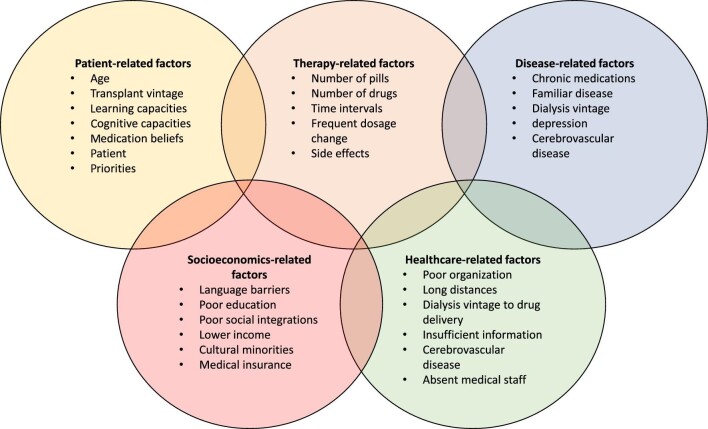
Medication non-adherence (MNA) is a major issue in kidney transplantation and it is associated with increased risk of rejection, allograft loss, patients' death and higher healthcare costs. Despite its crucial importance, it is still unclear what are the best strategies to diagnose, prevent and treat MNA. MNA can be intentional (deliberate refusal to take the medication as prescribed) or unintentional (non-deliberate missing the prescribed medication). Its diagnosis may rely on direct methods, aiming at measuring drug ingestions, or indirect methods that analyse the habits of patients to adhere to correct drug dose (taking adherence) and interval (time adherence). Identifying individual risk factors for MNA may provide the basis for a personalized approach to the treatment of MNA. Randomized control trials performed so far have tested a combination of strategies, such as enhancing medication adherence through the commitment of healthcare personnel involved in drug distribution, the use of electronic reminders, therapy simplification or various multidisciplinary approaches to maximize the correction of individual risk factors. Although most of these approaches reduced MNA in the short-term, the long-term effects on MNA and, more importantly, on clinical outcomes remain unclear. In this review, we provide a critical appraisal of traditional and newer methods for detecting, preventing and treating non-adherence to immunosuppression after kidney transplantation from the perspective of the practising physician.
药物治疗不依从(MNA)是肾移植中的一个主要问题,它与排斥反应风险增加、移植肾丢失、患者死亡以及更高的医疗成本相关。尽管其至关重要,但目前仍不清楚诊断、预防和治疗MNA的最佳策略是什么。MNA可以是故意的(故意拒绝按规定服药)或非故意的(非故意漏服规定药物)。其诊断可能依赖于旨在测量药物摄入的直接方法,或分析患者遵守正确药物剂量(服药依从性)和间隔(时间依从性)习惯的间接方法。识别MNA的个体风险因素可能为MNA的个性化治疗方法提供依据。迄今为止进行的随机对照试验测试了多种策略的组合,例如通过参与药物分发的医护人员的承诺来提高药物依从性、使用电子提醒、简化治疗或采用各种多学科方法来最大限度地纠正个体风险因素。尽管这些方法大多在短期内降低了MNA,但对MNA的长期影响,更重要的是对临床结果的长期影响仍不清楚。在本综述中,我们从执业医师的角度对检测、预防和治疗肾移植后免疫抑制治疗不依从的传统方法和新方法进行了批判性评估。