Ali Asad, Yousafzai Mohammad Tahir, Waris Rabbia, Jafri Fatima, Aziz Fatima, Abbasi Imran Naeem, Zaidi Anita
Department of Pediatrics and Child Health, Aga Khan University, Stadium Road, Karachi, Pakistan.
J Med Virol. 2017 Jul;89(7):1151-1157. doi: 10.1002/jmv.24768. Epub 2017 Feb 24.
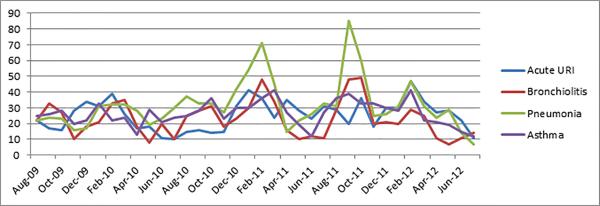
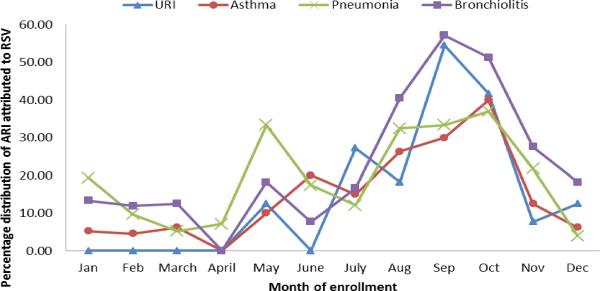
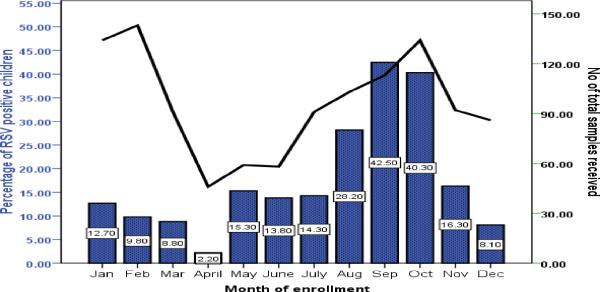
Major progress is being made in vaccines against Respiratory Syncytial Virus (RSV), with multiple vaccine candidates currently in the clinical phase of development. Making an investment case for public sector financing of RSV vaccine will require estimation of burden, cost-effectiveness, and impact. The aim of this study is to determine the proportion, age distribution and clinical spectrum of RSV associated hospitalizations in children in Karachi, Pakistan. A three years prospective study was conducted at the Aga Khan University Hospital in Karachi, a city of 20 million in south Pakistan, from August 2009 to June 2012. Children less than five years old admitted with acute respiratory infections (ARI) were enrolled. Throat swabs were collected and tested for RSV using real-time PCR. Multivariable log binomial regression analysis was performed to identify the associated factors of RSV infection. Out of 1150 children enrolled, RSV was detected among 223 (19%). Highest rate of RSV detection was in young infants less than 3 months of age (48/168, 29%), which accounted for 22% of all RSV detected. Most common diagnosis in RSV positive infants (<12 months of age) was bronchiolitis followed by pneumonia, while in older children between the ages of one and 5 years of age, pneumonia and asthma were the most common diagnosis. Although identified year-round, RSV was most prevalent from August to October with peak in September, coinciding with the rainy season. This study identified RSV to be independently associated with younger age (P = 0.036), rainy season (P < 0.001), post-tussive emesis (P = 0.008), intubation (P = 0.003), and discharge diagnosis of bronchiolitis (P = 0.004). Vaccines against RSV that target this age group are likely to yield remarkable benefit.
针对呼吸道合胞病毒(RSV)的疫苗正在取得重大进展,目前有多种候选疫苗正处于临床开发阶段。要为公共部门资助RSV疫苗提供投资依据,需要对疾病负担、成本效益和影响进行评估。本研究的目的是确定巴基斯坦卡拉奇儿童中RSV相关住院病例的比例、年龄分布和临床谱。2009年8月至2012年6月,在巴基斯坦南部拥有2000万人口的卡拉奇市的阿迦汗大学医院进行了一项为期三年的前瞻性研究。纳入了因急性呼吸道感染(ARI)入院的五岁以下儿童。采集咽拭子并使用实时PCR检测RSV。进行多变量对数二项回归分析以确定RSV感染的相关因素。在纳入的1150名儿童中,223名(19%)检测到RSV。RSV检测率最高的是年龄小于3个月的婴儿(48/168,29%),占所有检测到的RSV的22%。RSV阳性婴儿(<12个月)最常见的诊断是细支气管炎,其次是肺炎,而在1至5岁的大龄儿童中,肺炎和哮喘是最常见的诊断。虽然RSV全年都有发现,但8月至10月最为流行,9月达到高峰,与雨季一致。本研究确定RSV与年龄较小(P = 0.036)、雨季(P < 0.001)、咳嗽后呕吐(P = 0.008)、插管(P = 0.003)以及细支气管炎出院诊断(P = 0.004)独立相关。针对该年龄组的RSV疫苗可能会产生显著益处。