Costa Sebastiano, Hausenblas Heather A, Oliva Patrizia, Cuzzocrea Francesca, Larcan Rosalba
Department of Human and Social Sciences, University of Messina , Messina, Italy.
Department of Kinesiology, Jacksonville University , Jacksonville, FL, USA.
J Behav Addict. 2016 Mar;5(1):77-89. doi: 10.1556/2006.5.2016.004.
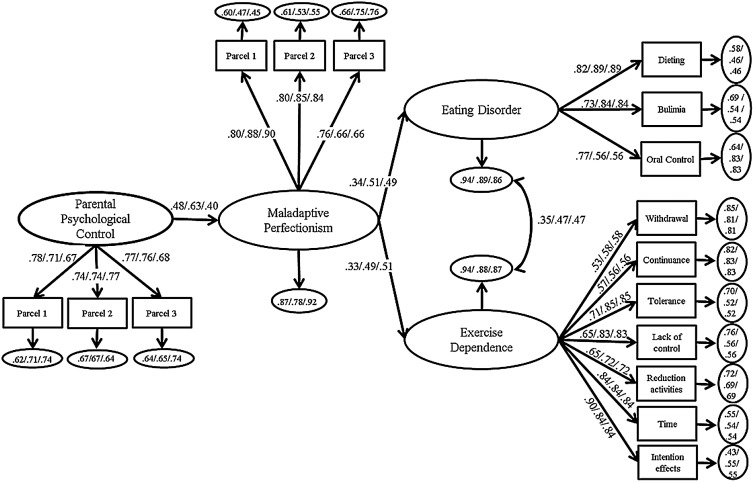
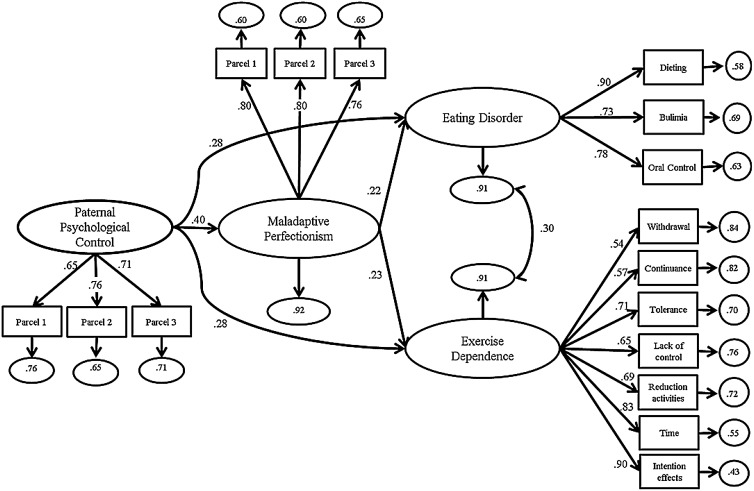
Background and aims The current study examined the mediating role of maladaptive perfectionism among parental psychological control, eating disorder symptoms, and exercise dependence symptoms by gender in habitual exercisers. Methods Participants were 348 Italian exercisers (n = 178 men and n = 170 women; M age = 20.57, SD = 1.13) who completed self-report questionnaires assessing their parental psychological control, maladaptive perfectionism, eating disorder symptoms, and exercise dependence symptoms. Results Results of the present study confirmed the mediating role of maladaptive perfectionism for eating disorder and exercise dependence symptoms for the male and female exercisers in the maternal data. In the paternal data, maladaptive perfectionism mediated the relationships between paternal psychological control and eating disorder and exercise dependence symptoms as full mediator for female participants and as partial mediator for male participants. Discussion Findings of the present study suggest that it may be beneficial to consider dimensions of maladaptive perfectionism and parental psychological control when studying eating disorder and exercise dependence symptoms in habitual exerciser.
本研究探讨了在习惯性运动者中,适应不良完美主义在父母心理控制、饮食失调症状和运动依赖症状之间的中介作用,并按性别进行了分析。方法:研究对象为348名意大利运动者(男性178名,女性170名;平均年龄=20.57,标准差=1.13),他们完成了自我报告问卷,评估其父母心理控制、适应不良完美主义、饮食失调症状和运动依赖症状。结果:本研究结果证实了在母亲的数据中,适应不良完美主义对男性和女性运动者的饮食失调和运动依赖症状具有中介作用。在父亲的数据中,适应不良完美主义在父亲心理控制与饮食失调和运动依赖症状之间起中介作用,对女性参与者是完全中介,对男性参与者是部分中介。讨论:本研究结果表明,在研究习惯性运动者的饮食失调和运动依赖症状时,考虑适应不良完美主义和父母心理控制的维度可能是有益的。