Boone-Heinonen J, Tillotson C J, O'Malley J P, Cottrell E K, Gaudino J A, Amofah A, Rivo M L, Brickman A, Mayer K, McBurnie M A, Gold R, DeVoe J E
OHSU-PSU School of Public Health, 3181 SW Sam Jackson Park Rd., Mail Code CB669, Portland, OR, 97239-3098, USA.
OCHIN, 1881 SW Naito Parkway, Portland, OR, 97201, USA.
Matern Child Health J. 2017 Mar;21(3):421-431. doi: 10.1007/s10995-016-2232-5.
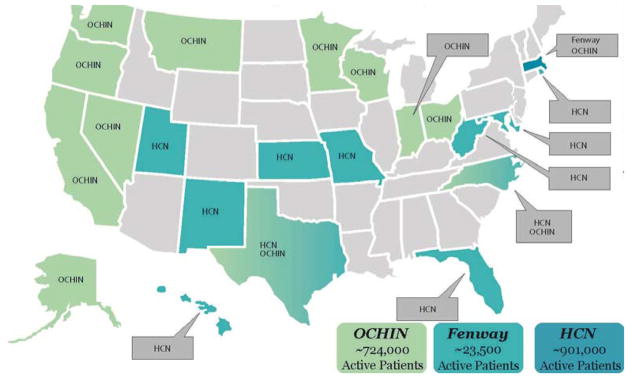
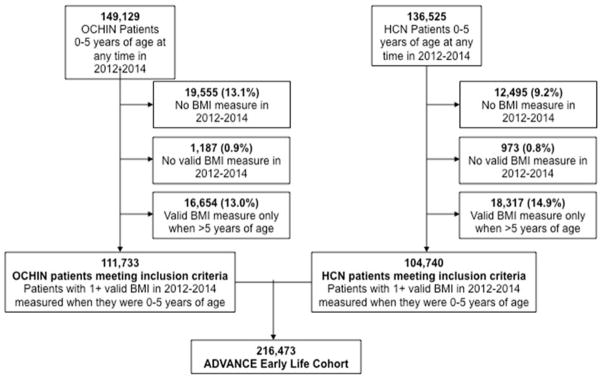
Introduction Low-income populations have elevated exposure to early life risk factors for obesity, but are understudied in longitudinal research. Our objective was to assess the utility of a cohort derived from electronic health record data from safety net clinics for investigation of obesity emerging in early life. Methods We examined data from the PCORNet ADVANCE Clinical Data Research Network, a national network of Federally-Qualified Health Centers serving >1.7 million safety net patients across the US. This cohort includes patients who, in 2012-2014, had ≥1 valid body mass index measure when they were 0-5 years of age. We characterized the cohort with respect to factors required for early life obesity research in vulnerable subgroups: sociodemographic diversity, weight status based on World Health Organization (<2 years) or Centers for Disease Control (≥2 years) growth curves, and data longitudinality. Results The cohort includes 216,473 children and is racially/ethnically diverse (e.g., 17.9% Black, 45.4% Hispanic). A majority (56.9%) had family incomes below the Federal Poverty Level (FPL); 32% were <50% of FPL. Among children <2 years, 7.6 and 5.3% had high and low weight-for-length, respectively. Among children 2-5 years, 15.0, 12.7 and 2.4% were overweight, obese, and severely obese, respectively; 5.3% were underweight. In the study period, 79.2% of children had ≥2 BMI measures. Among 4-5 year olds, 21.9% had >1 BMI measure when they were <2 years. Discussion The ADVANCE Early Life cohort offers unique opportunities to investigate early life determinants of obesity in the understudied population of low income and minority children.
引言 低收入人群在生命早期接触肥胖风险因素的几率更高,但在纵向研究中却未得到充分研究。我们的目标是评估一个源自安全网诊所电子健康记录数据的队列,用于研究生命早期出现的肥胖问题的效用。方法 我们研究了PCORNet ADVANCE临床数据研究网络的数据,这是一个全国性网络,由联邦合格健康中心组成,为美国超过170万安全网患者提供服务。该队列包括在2012年至2014年期间0至5岁时至少有1次有效体重指数测量值的患者。我们根据脆弱亚组中生命早期肥胖研究所需的因素对该队列进行了特征描述:社会人口统计学多样性、基于世界卫生组织(2岁以下)或疾病控制中心(2岁及以上)生长曲线的体重状况以及数据纵向性。结果 该队列包括216,473名儿童,种族/族裔多样(例如,17.9%为黑人,45.4%为西班牙裔)。大多数(56.9%)家庭收入低于联邦贫困线(FPL);32%低于FPL的50%。在2岁以下儿童中,分别有7.6%和5.3%的儿童身长体重偏高和偏低。在2至5岁儿童中,分别有15.0%、12.7%和2.4%的儿童超重、肥胖和严重肥胖;5.3%体重过轻。在研究期间,79.2%的儿童有至少2次体重指数测量值。在4至5岁儿童中,21.9%在2岁以下时体重指数测量值超过1次。讨论 ADVANCE生命早期队列提供了独特的机会,可用于研究低收入和少数族裔儿童这一未得到充分研究的人群中肥胖的生命早期决定因素。