Santos Bruno F S, van der Werf Julius H J, Gibson John P, Byrne Timothy J, Amer Peter R
AbacusBio Limited, PO Box 5585, Dunedin, 9058, New Zealand.
School of Environmental and Rural Science, University of New England, Armidale, NSW, Australia.
Genet Sel Evol. 2017 Jan 17;49(1):10. doi: 10.1186/s12711-016-0281-2.
Performance recording and genotyping in the multiplier tier of multi-tiered sheep breeding schemes could potentially reduce the difference in the average genetic merit between nucleus and commercial flocks, and create additional economic benefits for the breeding structure.
The genetic change in a multiple-trait breeding objective was predicted for various selection strategies that included performance recording, parentage testing and genomic selection. A deterministic simulation model was used to predict selection differentials and the flow of genetic superiority through the different tiers. Cumulative discounted economic benefits were calculated based on trait gains achieved in each of the tiers and considering the extra revenue and associated costs of applying recording, genotyping and selection practices in the multiplier tier of the breeding scheme.
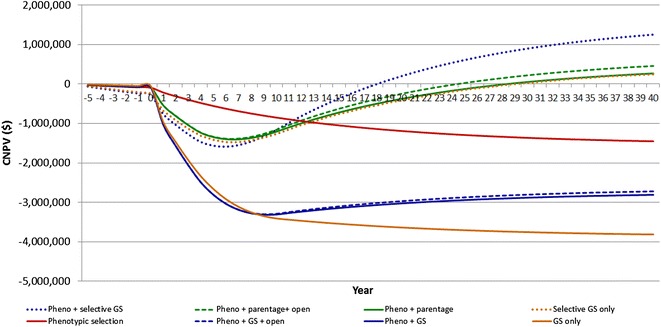
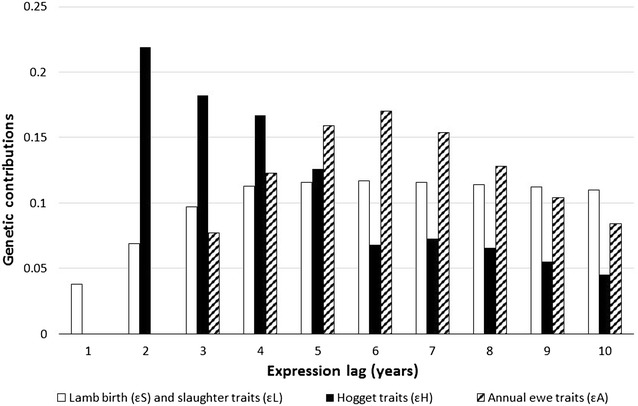
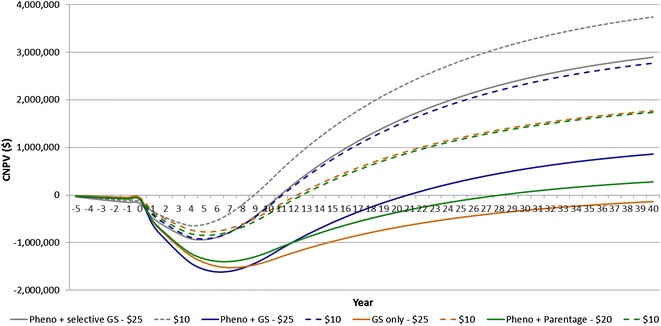
Performance recording combined with genomic or parentage information in the multiplier tier reduced the genetic lag between the nucleus and commercial flock by 2 to 3 years. The overall economic benefits of improved performance in the commercial tier offset the costs of recording the multiplier. However, it took more than 18 years before the cumulative net present value of benefits offset the costs at current test prices. Strategies in which recorded multiplier ewes were selected as replacements for the nucleus flock did modestly increase profitability when compared to a closed nucleus structure. Applying genomic selection is the most beneficial strategy if testing costs can be reduced or by genotyping only a proportion of the selection candidates. When the cost of genotyping was reduced, scenarios that combine performance recording with genomic selection were more profitable and reached breakeven point about 10 years earlier.
Economic benefits can be generated in multiplier flocks by implementing performance recording in conjunction with either DNA pedigree recording or genomic technology. These recording practices reduce the long genetic lag between the nucleus and commercial flocks in multi-tiered breeding programs. Under current genotyping costs, the time to breakeven was found to be generally very long, although this varied between strategies. Strategies using either genomic selection or DNA pedigree verification were found to be economically viable provided the price paid for the tests is lower than current prices, in the long-term.
在多层绵羊育种计划的扩繁层进行性能记录和基因分型,有可能缩小核心群和商业羊群之间平均遗传价值的差异,并为育种结构创造额外的经济效益。
针对包括性能记录、亲子鉴定和基因组选择在内的各种选择策略,预测了多性状育种目标中的遗传变化。使用确定性模拟模型来预测选择差异以及遗传优势在不同层级间的传递。基于各层级所取得的性状增益,并考虑在育种计划的扩繁层应用记录、基因分型和选择方法所带来的额外收入和相关成本,计算累积贴现经济效益。
在扩繁层将性能记录与基因组或亲子信息相结合,可使核心群和商业羊群之间的遗传滞后缩短2至3年。商业层性能提升带来的总体经济效益抵消了扩繁群记录的成本。然而,按当前检测价格计算,累计净现值的收益需要超过18年才能抵消成本。与封闭核心群结构相比,选择有记录的扩繁母羊作为核心群的替代方案,适度提高了盈利能力。如果能够降低检测成本或仅对一部分选择候选羊进行基因分型,应用基因组选择是最有益的策略。当基因分型成本降低时,将性能记录与基因组选择相结合的方案更具盈利性,且盈亏平衡点提前约10年达到。
通过将性能记录与DNA系谱记录或基因组技术相结合,可在扩繁群中产生经济效益。这些记录方法减少了多层育种计划中核心群和商业羊群之间长期存在的遗传滞后。在当前基因分型成本下,盈亏平衡时间通常很长,尽管不同策略之间存在差异。从长远来看,如果检测支付的价格低于当前价格,使用基因组选择或DNA系谱验证的策略在经济上是可行的。