Raoul Jérôme, Swan Andrew A, Elsen Jean-Michel
Institut de l'Elevage, Castanet-Tolosan, France.
GenPhySE, INRA, Castanet-Tolosan, France.
Genet Sel Evol. 2017 Oct 24;49(1):76. doi: 10.1186/s12711-017-0351-0.
Building an efficient reference population for genomic selection is an issue when the recorded population is small and phenotypes are poorly informed, which is often the case in sheep breeding programs. Using stochastic simulation, we evaluated a genomic design based on a reference population with medium-density genotypes [around 45 K single nucleotide polymorphisms (SNPs)] of dams that were imputed from very low-density genotypes (≤ 1000 SNPs).
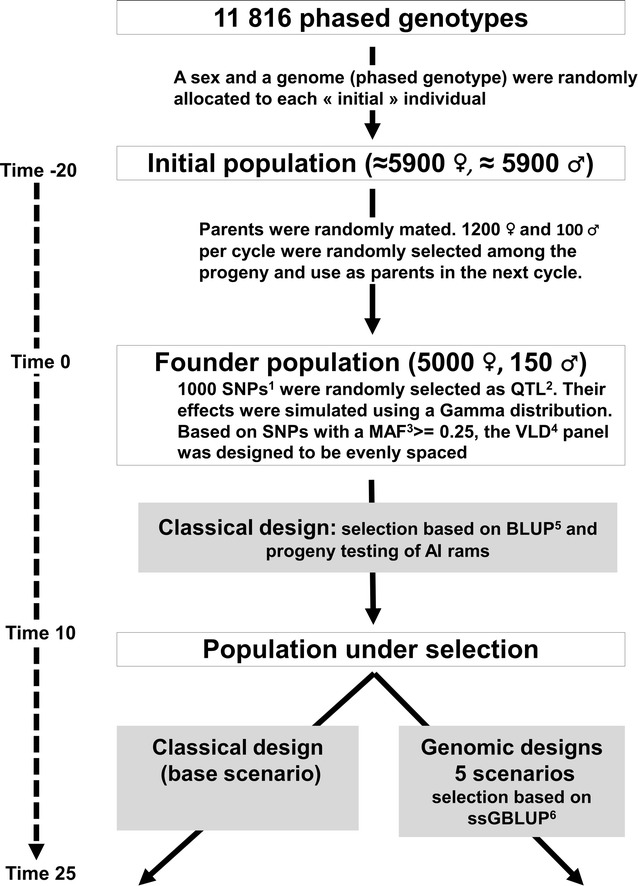
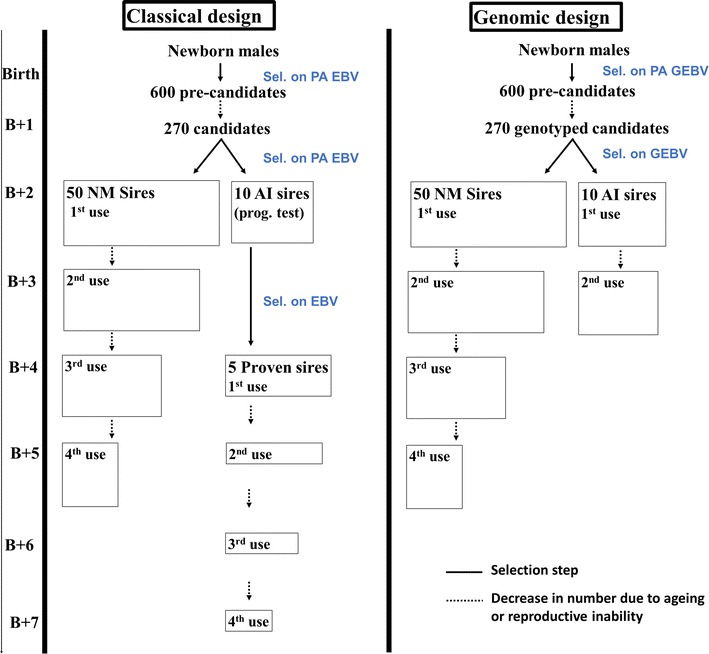
A population under selection for a maternal trait was simulated using real genotypes. Genetic gains realized from classical selection and genomic selection designs were compared. Genomic selection scenarios that differed in reference population structure (whether or not dams were included in the reference) and genotype quality (medium-density or imputed to medium-density from very low-density) were evaluated.
The genomic design increased genetic gain by 26% when the reference population was based on sire medium-density genotypes and by 54% when the reference population included both sire and dam medium-density genotypes. When medium-density genotypes of male candidates and dams were replaced by imputed genotypes from very low-density SNP genotypes (1000 SNPs), the increase in gain was 22% for the sire reference population and 42% for the sire and dam reference population. The rate of increase in inbreeding was lower (from - 20 to - 34%) for the genomic design than for the classical design regardless of the genomic scenario.
We show that very low-density genotypes of male candidates and dams combined with an imputation process result in a substantial increase in genetic gain for small sheep breeding programs.
当记录的群体规模较小且表型信息不足时,构建用于基因组选择的高效参考群体是一个问题,这在绵羊育种计划中经常出现。我们使用随机模拟评估了一种基于从极低密度基因型(≤1000个单核苷酸多态性(SNP))推算出的具有中等密度基因型(约45K SNP)的母羊参考群体的基因组设计。
使用真实基因型模拟一个针对母系性状进行选择的群体。比较了经典选择和基因组选择设计所实现的遗传进展。评估了参考群体结构(参考群体中是否包含母羊)和基因型质量(中等密度或从极低密度推算为中等密度)不同的基因组选择方案。
当参考群体基于父系中等密度基因型时,基因组设计使遗传进展提高了26%;当参考群体同时包含父系和母系中等密度基因型时,遗传进展提高了54%。当雄性候选个体和母羊的中等密度基因型被从极低密度SNP基因型(1000个SNP)推算出的基因型取代时,对于父系参考群体,遗传进展提高了22%;对于父系和母系参考群体,遗传进展提高了42%。无论基因组方案如何,基因组设计的近亲繁殖增加率都低于经典设计(从-20%降至-34%)。
我们表明,雄性候选个体和母羊的极低密度基因型与推算过程相结合,可使小型绵羊育种计划的遗传进展大幅提高。