Lippman Sheri A, Pettifor Audrey, Rebombo Dumisani, Julien Aimée, Wagner Ryan G, Kang Dufour Mi-Suk, Kabudula Chodziwadziwa Whiteson, Neilands Torsten B, Twine Rhian, Gottert Ann, Gómez-Olivé F Xavier, Tollman Stephen M, Sanne Ian, Peacock Dean, Kahn Kathleen
Center for AIDS Prevention Studies, Department of Medicine, University of California San Francisco, 550 16th Street, 3rd Floor, San Francisco, 94158-2549, CA, USA.
MRC/Wits Rural Public Health and Health Transitions Research Unit (Agincourt), Faculty of Health Sciences, School of Public Health, University of the Witwatersrand, 27 St Andrews Road, Parktown 2193, Johannesburg, South Africa.
Implement Sci. 2017 Jan 17;12(1):9. doi: 10.1186/s13012-016-0541-0.
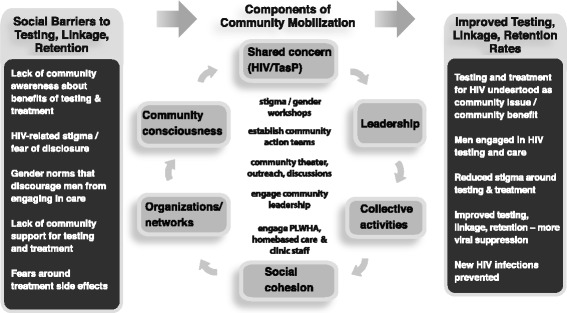
HIV transmission can be decreased substantially by reducing the burden of undiagnosed HIV infection and expanding early and consistent use of antiretroviral therapy (ART). Treatment as prevention (TasP) has been proposed as key to ending the HIV epidemic. To activate TasP in high prevalence countries, like South Africa, communities must be motivated to know their status, engage in care, and remain in care. Community mobilization (CM) has the potential to significantly increase uptake testing, linkage to and retention in care by addressing the primary social barriers to engagement with HIV care-including poor understanding of HIV care; fear and stigma associated with infection, clinic attendance and disclosure; lack of social support; and gender norms that deter men from accessing care.
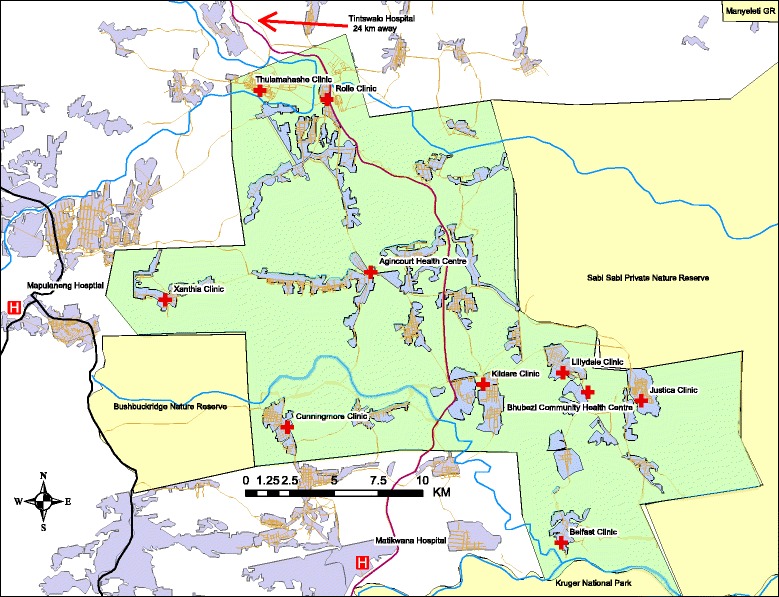
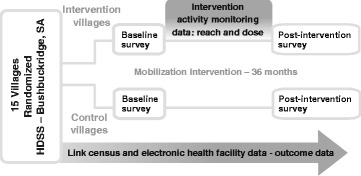
METHODS/DESIGN: Using a cluster randomized trial design, we are implementing a 3-year-theory-based CM intervention and comparing gains in HIV testing, linkage, and retention in care among individuals residing in 8 intervention communities to that of individuals residing in 7 control communities. Eligible communities include 15 villages within a health and demographic surveillance site (HDSS) in rural Mpumalanga, South Africa, that were not exposed to previous CM efforts. CM activities conducted in the 8 intervention villages map onto six mobilization domains that comprise the key components for community mobilization around HIV prevention. To evaluate the intervention, we will link a clinic-based electronic clinical tracking system in all area clinics to the HDSS longitudinal census data, thus creating an open, population-based cohort with over 30,000 18-49-year-old residents. We will estimate the marginal effect of the intervention on individual outcomes using generalized estimating equations. In addition, we will evaluate CM processes by conducting baseline and endline surveys among a random sample of 1200 community residents at each time point to monitor intervention exposure and community level change using validated measures of CM.
Given the known importance of community social factors with regard to uptake of testing and HIV care, and the lack of rigorously evaluated community-level interventions effective in improving testing uptake, linkage and retention, the proposed study will yield much needed data to understand the potential of CM to improve the prevention and care cascade. Further, our work in developing a CM framework and domain measures will permit validation of a CM conceptual framework and process, which should prove valuable for community programming in Africa.
NCT02197793 Registered July 21, 2014.
通过减轻未诊断出的艾滋病毒感染负担以及扩大抗逆转录病毒疗法(ART)的早期持续使用,可以大幅降低艾滋病毒传播。治疗即预防(TasP)已被提议作为终结艾滋病毒流行的关键。为了在南非等高流行率国家激活TasP,必须激励社区了解自身状况、接受护理并持续接受护理。社区动员(CM)有潜力通过消除参与艾滋病毒护理的主要社会障碍,显著提高检测率、护理联系率和护理留存率,这些障碍包括对艾滋病毒护理的理解不足;与感染、就诊和披露相关的恐惧和耻辱感;缺乏社会支持;以及阻碍男性获得护理的性别规范。
方法/设计:我们采用整群随机试验设计,实施一项基于理论的为期3年的CM干预措施,并比较居住在8个干预社区的个体与居住在7个对照社区的个体在艾滋病毒检测、护理联系和护理留存方面的进展。符合条件的社区包括南非姆普马兰加农村地区一个健康与人口监测点(HDSS)内的15个村庄,这些村庄此前未接触过CM活动。在8个干预村庄开展的CM活动对应六个动员领域,这些领域构成围绕艾滋病毒预防进行社区动员的关键要素。为了评估干预措施,我们将把所有地区诊所基于诊所的电子临床跟踪系统与HDSS纵向普查数据相链接,从而创建一个拥有超过30,000名18 - 49岁居民的开放的、基于人群的队列。我们将使用广义估计方程来估计干预对个体结果的边际效应。此外,我们将通过在每个时间点对1200名社区居民的随机样本进行基线和终末调查来评估CM过程,以使用经过验证的CM测量方法监测干预暴露情况和社区层面的变化。
鉴于社区社会因素在检测和艾滋病毒护理接受方面的已知重要性,以及缺乏经过严格评估且有效提高检测接受率、护理联系率和护理留存率的社区层面干预措施,拟议的研究将产生急需的数据,以了解CM在改善预防和护理级联反应方面的潜力。此外,我们在制定CM框架和领域测量方法方面的工作将允许对CM概念框架和过程进行验证,这对非洲的社区规划应具有重要价值。
NCT02197793,于2014年7月21日注册。