Kinjo Kentaro, Sairenji Tomoko, Koga Hidenobu, Osugi Yasuhiro, Yoshida Shin, Ichinose Hidefumi, Nagai Yasunori, Imura Hiroshi, South-Paul Jeannette E, Meyer Mark, Honda Yoshihisa
Department of General Medicine, Morinosato Hospital/Kameda Hospital, Tokai University, Keio University, 3-1-1 Morinosato, Atsugi, Kanagawa, 243-0122, Japan.
Department of Family Medicine, University of Washington, E304 Health Sciences 1959 NE Pacific Street, Seattle, WA, 98195-6390, USA.
BMC Health Serv Res. 2017 Jan 17;17(1):40. doi: 10.1186/s12913-016-1961-x.
Physician-led home visit care with medical teams (Zaitaku care) has been developed on a national scale to support those who wish to stay at home at the end of life, and promote a system of community-based integrated care in Japan. Medical care at the end of life can be expensive, and is an urgent socioeconomic issue for aging societies. However medical costs of physician-led home visits care have not been well studied. We compared the medical costs of Zaitaku care and hospital care at the end of life in a rapidly aging community in a rural area in Japan.
A cross-sectional study was performed to compare the total medical costs during patients' final days of life (30 days or less) between Zaitaku care and hospital care from September 2012 to August 2013 in Fukuoka Prefecture, Japan.
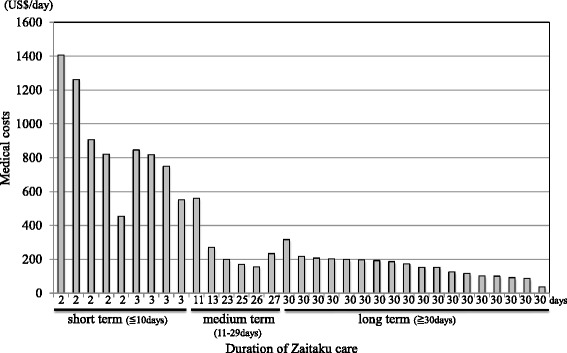
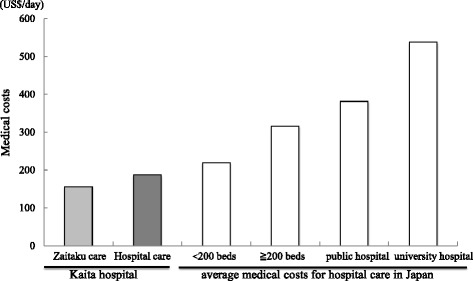
Thirty four patients died at home under Zaitaku care, and 72 patients died in the hospital during this period. The average daily cost of care during the last 30 days did not differ significantly between the two groups. Although Zaitaku care costs were higher than hospital care costs in the short-term (≦10 days, Zaitaku care $371.2 vs. Hospital care $202.0, p = 0.492), medical costs for Zaitaku care in the long-term care (≧30 days) were less than that of hospital care ($155.8 vs. $187.4, p = 0.055).
Medical costs of Zaitaku care were less compared with hospital care if incorporated early for long term care, but it was high if incorporated late for short term care. For long term care, medical costs for Zaitaku care was 16.7% less than for hospitalization at the end of life. This physician-led home visit care model should be an available option for patients who wish to die at home, and may be beneficial financially over time.
由医生带领医疗团队进行的居家探访护理(宅家护理)已在全国范围内开展,旨在支持那些希望在生命末期居家生活的人,并推动日本基于社区的综合护理体系发展。临终医疗费用高昂,这是老龄化社会面临的紧迫社会经济问题。然而,由医生主导的居家探访护理的医疗费用尚未得到充分研究。我们比较了日本农村一个快速老龄化社区中宅家护理和临终医院护理的医疗费用。
进行了一项横断面研究,以比较2012年9月至2013年8月期间日本福冈县宅家护理和医院护理的患者生命最后阶段(30天或更短时间)的总医疗费用。
在此期间,34名患者在宅家护理下在家中死亡,72名患者在医院死亡。两组在最后30天的平均每日护理费用无显著差异。虽然宅家护理费用在短期内(≤10天,宅家护理371.2美元对医院护理202.0美元,p = 0.492)高于医院护理费用,但长期护理(≥30天)中宅家护理的医疗费用低于医院护理(155.8美元对187.4美元,p = 0.055)。
如果早期纳入长期护理,宅家护理的医疗费用低于医院护理,但如果晚期纳入短期护理则费用较高。对于长期护理,宅家护理的医疗费用比临终住院护理低16.7%。这种由医生主导的居家探访护理模式对于希望在家中离世的患者应是一个可行选择,并且从长远来看可能在经济上有益。