Benko Zsigmond, Liang Dong, Li Ge, Elder Robert T, Sarkar Anindya, Takayama Jun, Ghosh Arun K, Zhao Richard Y
Department of Pathology, University of Maryland School of Medicine, Baltimore, MD 21201 USA ; Department of Membrane Biochemistry, Institute of Animal Biochemistry and Genetics, Centre of Biosciences, SAS, 84005 Bratislava, Slovakia.
Department of Pathology, University of Maryland School of Medicine, Baltimore, MD 21201 USA.
Cell Biosci. 2017 Jan 11;7:5. doi: 10.1186/s13578-016-0131-5. eCollection 2017.
HIV-1 protease (PR) is an essential enzyme for viral production. Thus, PR inhibitors (PIs) are the most effective class of anti-HIV drugs. However, the main challenge to the successful use of PI drugs in patient treatment is the emergence of multidrug resistant PRs (PRs). This study aimed to develop a fission yeast cell-based system for rapid testing of new PIs that combat PRs.
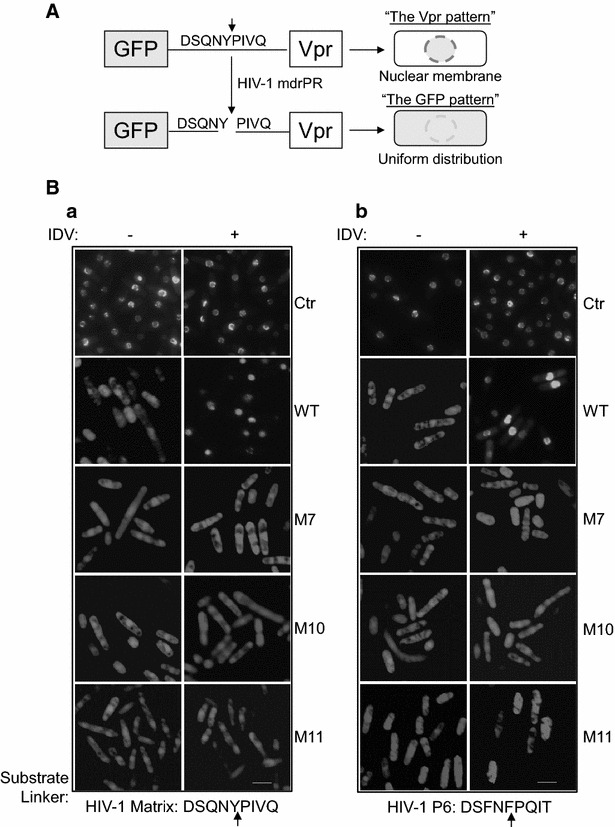
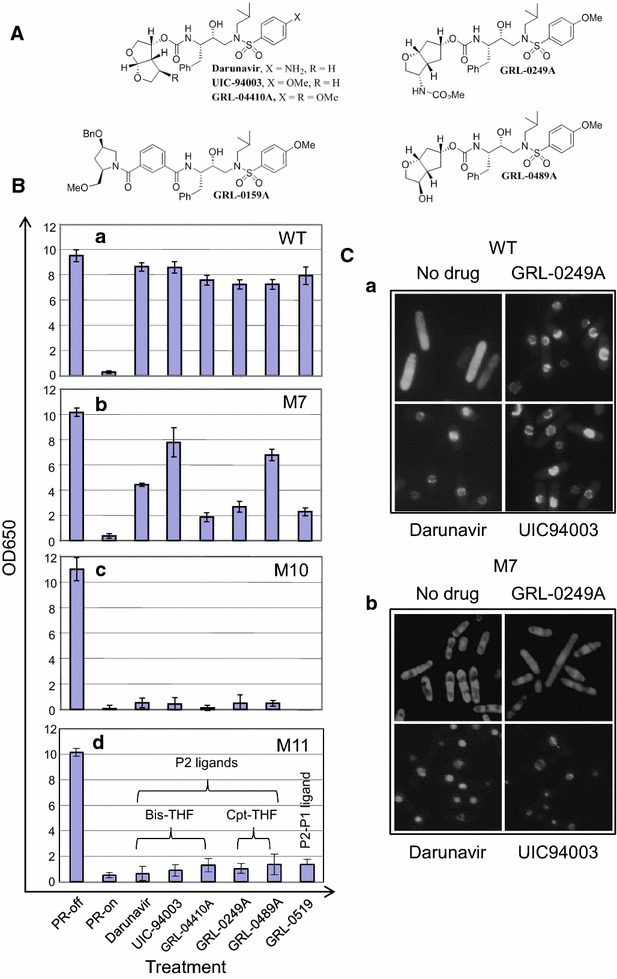
Three PRs were isolated from HIV-infected patients that carried seven (PR), ten (PR) and eleven (PR) gene mutations, respectively. They were cloned and expressed in fission yeast under an inducible promoter to allow the measurement of PR-specific proteolysis and drug resistance. The results showed that all three PRs maintained their abilities to proteolyze HIV viral substrates (MA↓CA and p6) and to confer drug resistance. Production of these proteins in the fission yeast caused cell growth inhibition, oxidative stress and altered mitochondrial morphologies that led to cell death. Five investigational PIs were used to test the utility of the established yeast system with an FDA-approved PI drug Darunavir (DRV) as control. All six compounds suppressed the wildtype PR (PR) and the PR-mediated activities. However, none of them were able to suppress the PR or the PR.
The three clinically isolated PRs maintained their viral proteolytic activities and drug resistance in the fission yeast. Furthermore, those viral PR activities were coupled with the induction of growth inhibition and cell death, which could be used to test the PI activities. Indeed, the five investigational PIs and DRV suppressed the PR in fission yeast as they did in mammalian cells. Significantly, two of the high level PRs (PR and PR) were resistant to all of the existing PI drugs including DRV. This observation underscores the importance of continued searching for new PIs against PRs.
HIV-1蛋白酶(PR)是病毒产生所必需的酶。因此,PR抑制剂(PIs)是最有效的抗HIV药物类别。然而,在患者治疗中成功使用PI药物的主要挑战是多药耐药PRs(PRs)的出现。本研究旨在开发一种基于裂殖酵母细胞的系统,用于快速测试对抗PRs的新型PIs。
从HIV感染患者中分离出三种PRs,分别携带七个(PR)、十个(PR)和十一个(PR)基因突变。它们在诱导型启动子下克隆并在裂殖酵母中表达,以测量PR特异性蛋白水解和耐药性。结果表明,所有三种PRs均保持其蛋白水解HIV病毒底物(MA↓CA和p6)以及赋予耐药性的能力。这些蛋白在裂殖酵母中的产生导致细胞生长抑制、氧化应激和线粒体形态改变,进而导致细胞死亡。使用五种研究性PIs测试已建立的酵母系统的效用,以FDA批准的PI药物达芦那韦(DRV)作为对照。所有六种化合物均抑制野生型PR(PR)和PR介导的活性。然而,它们均无法抑制PR或PR。
三种临床分离的PRs在裂殖酵母中保持其病毒蛋白水解活性和耐药性。此外,那些病毒PR活性与生长抑制和细胞死亡的诱导相关,可用于测试PI活性。实际上,五种研究性PIs和DRV在裂殖酵母中与在哺乳动物细胞中一样抑制PR。值得注意的是,两种高水平PRs(PR和PR)对包括DRV在内的所有现有PI药物均耐药。这一观察结果强调了继续寻找针对PRs的新型PIs的重要性。