Gagliano Sarah A, Pouget Jennie G, Hardy John, Knight Jo, Barnes Michael R, Ryten Mina, Weale Michael E
Department of Medical & Molecular Genetics Guy's Hospital King's College London 8th Floor Tower Wing London SE1 9RT United Kingdom; Campbell Family Mental Health Research Institute Centre for Addiction and Mental Health 250 College Street Toronto Ontario M5T 1R8 Canada; Institute of Medical Science University of Toronto 1 King's College Circle Room 2374 Toronto Ontario M5S 1A8 Canada.
Campbell Family Mental Health Research Institute Centre for Addiction and Mental Health 250 College Street Toronto Ontario M5T 1R8 Canada; Institute of Medical Science University of Toronto 1 King's College Circle Room 2374 Toronto Ontario M5S 1A8 Canada; Department of Psychiatry University of Toronto 250 College Street 8th Floor Toronto Ontario M5T 1R8 Canada.
Ann Clin Transl Neurol. 2016 Nov 4;3(12):924-933. doi: 10.1002/acn3.369. eCollection 2016 Dec.
We assessed the current genetic evidence for the involvement of various cell types and tissue types in the etiology of neurodegenerative diseases, especially in relation to the neuroinflammatory hypothesis of neurodegenerative diseases.
We obtained large-scale genome-wide association study (GWAS) summary statistics from Parkinson's disease (PD), Alzheimer's disease (AD), and amyotrophic lateral sclerosis (ALS). We used multiple sclerosis (MS), an autoimmune disease of the central nervous system, as a positive control. We applied stratified LD score regression to determine if functional marks for cell type and tissue activity, and gene-set lists were enriched for genetic heritability. We compared our results to those from two gene-set enrichment methods (Ingenuity Pathway Analysis and enrichr).
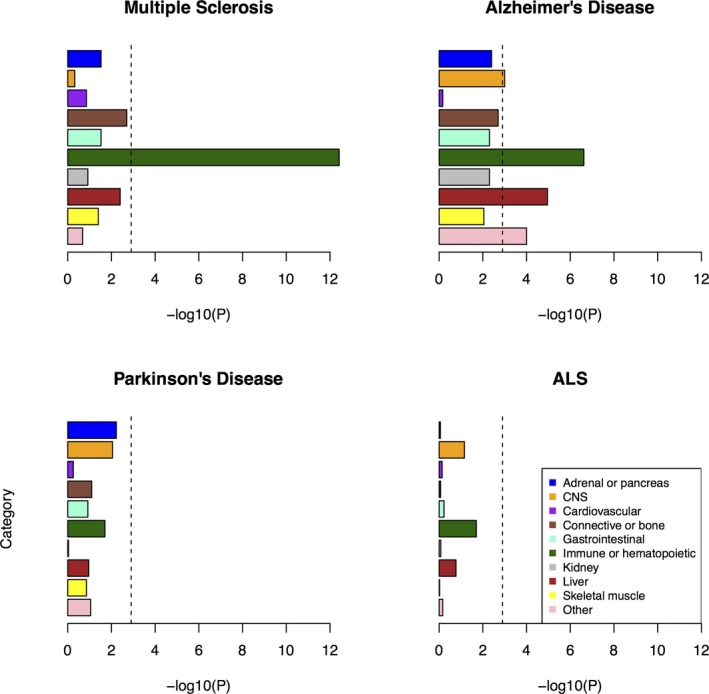
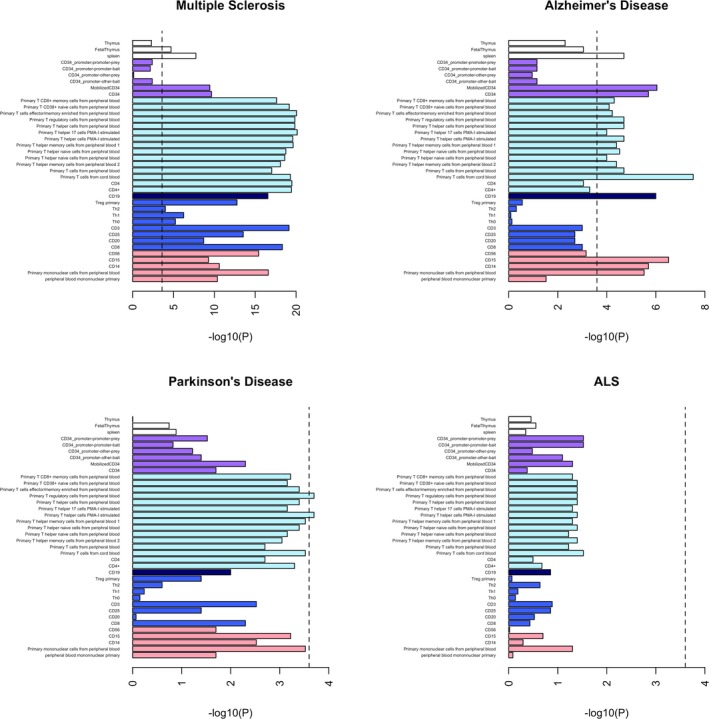
There were no significant heritability enrichments for annotations marking genes active within brain regions, but there were significant heritability enrichments for annotations marking genes active within cell types that form part of both the innate and adaptive immune systems. We found this for MS (as expected) and also for AD and PD. The strongest signals were from the adaptive immune system (e.g., T cells) for PD, and from both the adaptive (e.g., T cells) and innate (e.g., CD14: a marker for monocytes, and CD15: a marker for neutrophils) immune systems for AD. Annotations from the liver were also significant for AD. Pathway analysis provided complementary results.
For AD and PD, we found significant enrichment of heritability in annotations marking gene activity in immune cells.
我们评估了目前关于各种细胞类型和组织类型参与神经退行性疾病病因的遗传证据,特别是与神经退行性疾病的神经炎症假说相关的证据。
我们获取了帕金森病(PD)、阿尔茨海默病(AD)和肌萎缩侧索硬化症(ALS)的大规模全基因组关联研究(GWAS)汇总统计数据。我们将中枢神经系统自身免疫性疾病多发性硬化症(MS)用作阳性对照。我们应用分层LD评分回归来确定细胞类型和组织活性的功能标记以及基因集列表是否富含遗传遗传性。我们将我们的结果与两种基因集富集方法(Ingenuity通路分析和enrichr)的结果进行了比较。
标记脑区内活跃基因的注释没有显著的遗传性富集,但标记构成先天和适应性免疫系统一部分的细胞类型内活跃基因的注释有显著的遗传性富集。我们在MS(如预期)以及AD和PD中都发现了这一点。最强的信号来自PD的适应性免疫系统(例如T细胞),以及AD的适应性(例如T细胞)和先天(例如CD14:单核细胞标记物,和CD15:中性粒细胞标记物)免疫系统。肝脏的注释对AD也有显著意义。通路分析提供了互补的结果。
对于AD和PD,我们发现在标记免疫细胞中基因活性的注释中遗传性有显著富集。