Qin Yao, Zheng Shijun J
State Key Laboratory of Agrobiotechnology, Beijing 100193, China.
Key Laboratory of Animal Epidemiology and Zoonosis, Ministry of Agriculture, Beijing 100193, China.
Int J Mol Sci. 2017 Jan 14;18(1):161. doi: 10.3390/ijms18010161.
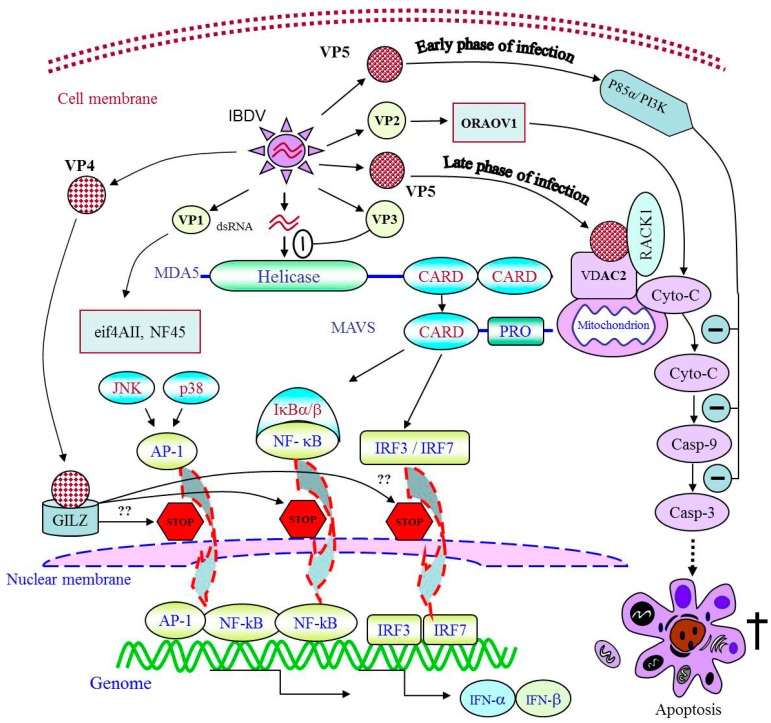
Infectious bursal disease (IBD) is an acute, highly contagious and immunosuppressive poultry disease caused by IBD virus (IBDV). The consequent immunosuppression increases susceptibility to other infectious diseases and the risk of subsequent vaccination failure as well. Since the genome of IBDV is relatively small, it has a limited number of proteins inhibiting the cellular antiviral responses and acting as destroyers to the host defense system. Thus, these virulence factors must be multifunctional in order to complete the viral replication cycle in a host cell. Insights into the roles of these viral proteins along with their multiple cellular targets in different pathways will give rise to a rational design for safer and effective vaccines. Here we summarize the recent findings that focus on the virus-cell interactions during IBDV infection at the protein level.
传染性法氏囊病(IBD)是由传染性法氏囊病病毒(IBDV)引起的一种急性、高度传染性和免疫抑制性家禽疾病。由此导致的免疫抑制会增加家禽对其他传染病的易感性以及后续疫苗接种失败的风险。由于IBDV的基因组相对较小,其抑制细胞抗病毒反应并作为宿主防御系统破坏者的蛋白质数量有限。因此,这些毒力因子必须具有多功能性,以便在宿主细胞中完成病毒复制周期。深入了解这些病毒蛋白的作用及其在不同途径中的多个细胞靶点,将有助于合理设计更安全有效的疫苗。在此,我们总结了最近在蛋白质水平上聚焦于IBDV感染期间病毒与细胞相互作用的研究发现。