Beberashvili Ilia, Sinuani Inna, Azar Ada, Shapiro Gregory, Feldman Leonid, Doenyas-Barak Keren, Stav Kobi, Efrati Shai
Nephrology Division, Assaf Harofeh Medical Center, Zerifin. Affiliated with the Sackler Faculty of Medicine, Tel Aviv University, Tel Aviv, Israel.
Department of pathology, Assaf Harofeh Medical Center, Zerifin. Affiliated with the Sackler Faculty of Medicine, Tel Aviv University, Tel Aviv, Israel.
BMC Nephrol. 2017 Jan 18;18(1):29. doi: 10.1186/s12882-017-0442-8.
Ghrelin, a gastric orexigenic peptide, and body mass index (BMI) are known as inversely associated to each other and are both linked to cardiovascular (CV) risk and mortality in maintenance hemodialysis (MHD) patients. However, it is unclear whether the interaction between ghrelin and BMI is associated with a risk of all-cause and CV death in this population.
A prospective observational study was performed on 261 MHD outpatients (39% women, mean age 68.6 ± 13.6 years) recruited from October 2010 through April 2012, and were followed until November 2014 (median follow-up-28 months, interquartile range-19-34 months). We measured acyl-ghrelin (AG) levels, appetite, nutritional and inflammatory markers, prospective all-cause and cardiovascular (CV) mortality.
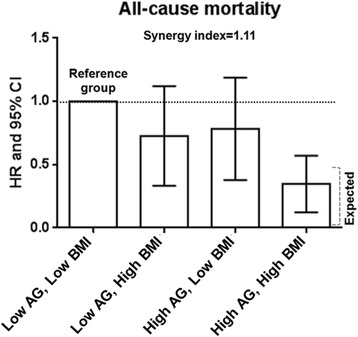
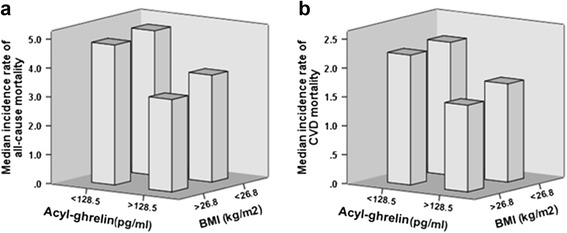
During follow-up, 109 patients died, 51 due to CV causes. A significant interaction effect of high BMI and high AG (defined as levels higher than median) on all-cause mortality was found. Crude Cox HR for the product termed BMI x AG was 0.52, with a 95% confidence interval (CI): 0.29 to 0.95 (P = 0.03). Evaluating the interaction on an additive scale revealed that the combined predictive value of BMI and AG is larger than the sum of their individual predictive values (synergy index was 1.1). Across the four BMI-AG categories, the group with high BMI and high AG exhibited better all-cause and cardiovascular mortality irrespective of appetite and nutritional status (multivariable adjusted hazard ratios were 0.31, 95% CI 0.16 to 0.62, P = 0.001, and 0.35, 95% CI 0.13 to 0.91, P = 0.03, respectively). Data analyses made by dividing patients according to fat mass-AG, but not to lean body mass-AG categories, provided similar results.
Higher AG levels enhance the favourable association between high BMI and survival in MHD patients irrespective of appetite, nutritional status and inflammation.
胃促生长素是一种胃部产生的促食欲肽,已知其与体重指数(BMI)呈负相关,且二者均与维持性血液透析(MHD)患者的心血管(CV)风险及死亡率相关。然而,胃促生长素与BMI之间的相互作用是否与该人群的全因死亡及心血管死亡风险相关尚不清楚。
对2010年10月至2012年4月招募的261例MHD门诊患者(39%为女性,平均年龄68.6±13.6岁)进行了一项前瞻性观察研究,随访至2014年11月(中位随访时间28个月,四分位间距19 - 34个月)。我们测量了酰基胃促生长素(AG)水平、食欲、营养及炎症标志物、前瞻性全因死亡率及心血管(CV)死亡率。
随访期间,109例患者死亡,51例死于心血管原因。发现高BMI与高AG(定义为高于中位数水平)对全因死亡率有显著的交互作用。BMI×AG乘积项的粗Cox风险比为0.52,95%置信区间(CI):0.29至0.95(P = 0.03)。在相加尺度上评估交互作用显示,BMI与AG的联合预测值大于其各自预测值之和(协同指数为1.1)。在四个BMI - AG类别中,高BMI且高AG组无论食欲和营养状况如何,全因死亡率和心血管死亡率均较低(多变量校正风险比分别为0.31,95%CI 0.16至0.62,P = 0.001;以及0.35,95%CI 0.13至0.91,P = 0.03)。根据脂肪量 - AG而非瘦体重 - AG类别对患者进行分组的数据分析提供了类似结果。
较高的AG水平增强了高BMI与MHD患者生存之间的有利关联,而与食欲、营养状况及炎症无关。