Huang Chi-Wei, Hsu Shih-Wei, Tsai Shih-Jen, Chen Nai-Ching, Liu Mu-En, Lee Chen-Chang, Huang Shu-Hua, Chang Weng-Neng, Chang Ya-Ting, Tsai Wan-Chen, Chang Chiung-Chih
Department of Neurology, Cognition and Aging Center, Kaohsiung Chang Gung Memorial Hospital, Chang Gung University College of Medicine, #123, Ta-Pei Road, Niaosung, Kaohsiung County, 833, Taiwan.
Department of Radiology, Kaohsiung Chang Gung Memorial Hospital, Chang Gung University College of Medicine, Niaosung, Kaohsiung, Taiwan.
J Neuroinflammation. 2017 Jan 18;14(1):12. doi: 10.1186/s12974-017-0791-z.
Inflammatory processes play a pivotal role in the degenerative process of Alzheimer's disease. In humans, a biallelic (C/T) polymorphism in the promoter region (position-511) (rs16944) of the interleukin-1 beta gene has been significantly associated with differences in the secretory capacity of interleukin-1 beta. In this study, we investigated whether this functional polymorphism mediates the brain networks in patients with Alzheimer's disease.
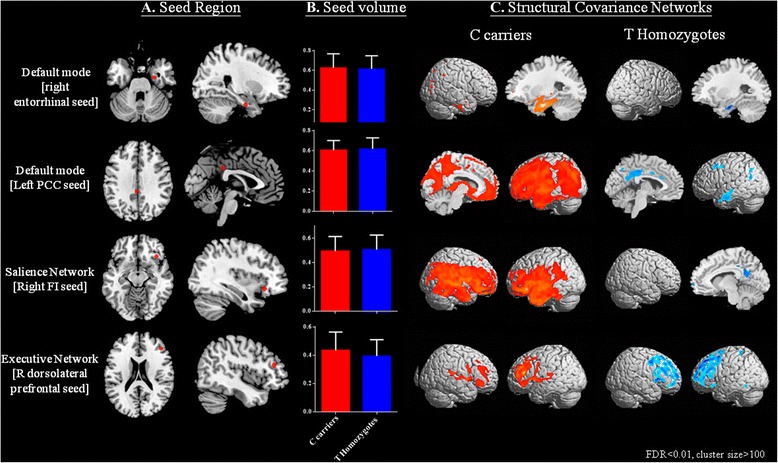
We enrolled a total of 135 patients with Alzheimer's disease (65 males, 70 females), and investigated their gray matter structural covariance networks using 3D T1 magnetic resonance imaging and their white matter macro-structural integrities using fractional anisotropy. The patients were classified into two genotype groups: C-carriers (n = 108) and TT-carriers (n = 27), and the structural covariance networks were constructed using seed-based analysis focusing on the default mode network medial temporal or dorsal medial subsystem, salience network and executive control network. Neurobehavioral scores were used as the major outcome factors for clinical correlations.
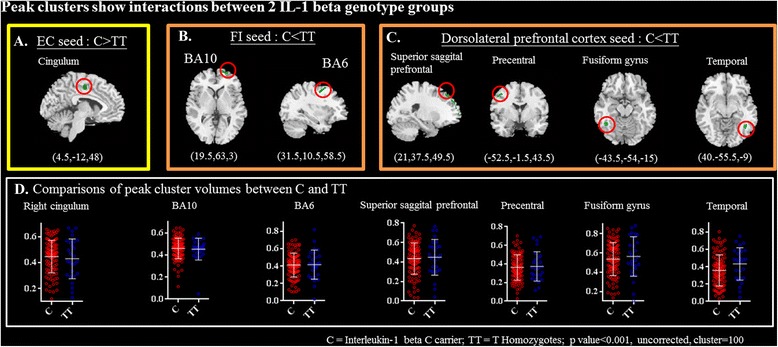
There were no differences between the two genotype groups in the cognitive test scores, seed, or peak cluster volumes and white matter fractional anisotropy. The covariance strength showing C-carriers > TT-carriers was the entorhinal-cingulum axis. There were two peak clusters (Brodmann 6 and 10) in the salience network and four peak clusters (superior prefrontal, precentral, fusiform, and temporal) in the executive control network that showed C-carriers < TT-carriers in covariance strength. The salience network and executive control network peak clusters in the TT group and the default mode network peak clusters in the C-carriers strongly predicted the cognitive test scores.
Interleukin-1 beta C-511 T polymorphism modulates the structural covariance strength on the anterior brain network and entorhinal-interconnected network which were independent of the white matter tract integrity. Depending on the specific C-511 T genotype, different network clusters could predict the cognitive tests.
炎症过程在阿尔茨海默病的退行性病变过程中起关键作用。在人类中,白细胞介素-1β基因启动子区域(位置-511)(rs16944)的双等位基因(C/T)多态性与白细胞介素-1β的分泌能力差异显著相关。在本研究中,我们调查了这种功能多态性是否介导了阿尔茨海默病患者的脑网络。
我们共纳入了135例阿尔茨海默病患者(65例男性,70例女性),使用三维T1磁共振成像研究他们的灰质结构协方差网络,并使用分数各向异性研究他们的白质宏观结构完整性。患者被分为两个基因型组:C等位基因携带者(n = 108)和TT等位基因携带者(n = 27),并使用基于种子点的分析构建结构协方差网络,重点关注默认模式网络内侧颞叶或背内侧子系统、突显网络和执行控制网络。神经行为评分用作临床相关性的主要结局因素。
两个基因型组在认知测试分数、种子点或峰值簇体积以及白质分数各向异性方面没有差异。显示C等位基因携带者>TT等位基因携带者的协方差强度是内嗅-扣带轴。在突显网络中有两个峰值簇(布罗德曼6区和10区),在执行控制网络中有四个峰值簇(额上回、中央前回、梭状回和颞叶),其协方差强度显示C等位基因携带者<TT等位基因携带者。TT组的突显网络和执行控制网络峰值簇以及C等位基因携带者的默认模式网络峰值簇强烈预测了认知测试分数。
白细胞介素-1β C-511 T多态性调节前脑网络和内嗅相互连接网络的结构协方差强度,这与白质束完整性无关。根据特定的C-511 T基因型,不同的网络簇可以预测认知测试。