Wu Ming-Kung, Lu Yan-Ting, Huang Chi-Wei, Lin Pin-Hsuan, Chen Nai-Ching, Lui Chun-Chung, Chang Wen-Neng, Lee Chen-Chang, Chang Ya-Ting, Chen Sz-Fan, Chang Chiung-Chih
From the Department of Psychiatry (M-KW, S-FC); Department of Neurology, Cognition and Aging Center, Kaohsiung Chang Gung Memorial Hospital, Chang Gung University College of Medicine (Y-TL, C-WH, N-CC, W-NC, Y-TC, S-FC, C-CC); Department of Health and Beauty, Shu-Zen College of Medicine and Management (P-HL, Chen-Chang Lee); and Department of Radiology, Kaohsiung Chang Gung Memorial Hospital, Chang Gung University College of Medicine, Kaohsiung, Taiwan (Chun-Chung Lui).
Medicine (Baltimore). 2015 Jul;94(28):e1192. doi: 10.1097/MD.0000000000001192.
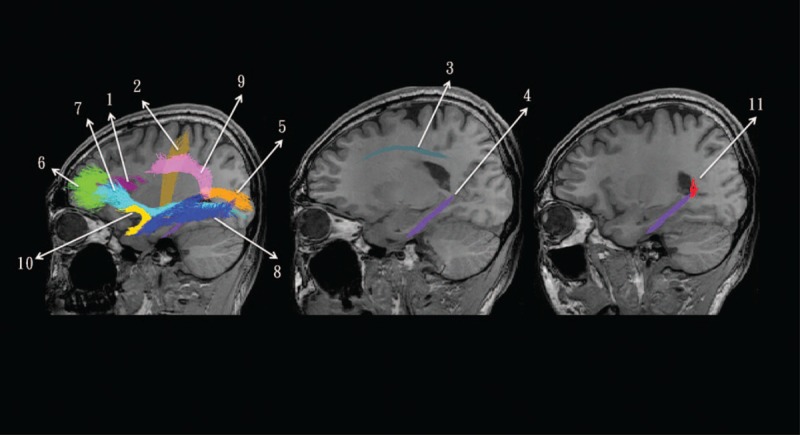
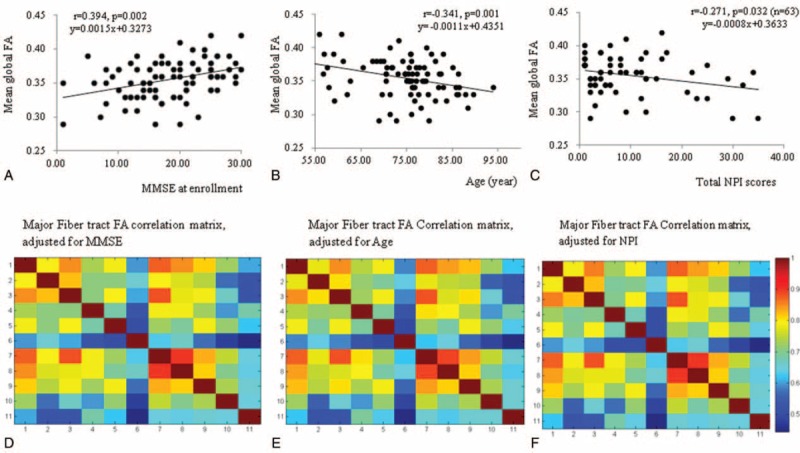
Cerebrovascular risk factors and white matter (WM) damage lead to worse cognitive performance in Alzheimer dementia (AD). This study investigated WM microstructure using diffusion tensor imaging in patients with mild to moderate AD and investigated specific fiber tract involvement with respect to predefined cerebrovascular risk factors and neurobehavioral data prediction cross-sectionally and after 18 months. To identify the primary pathoanatomic relationships of risk biomarkers to fiber tract integrity, we predefined 11 major association tracts and calculated tract specific fractional anisotropy (FA) values. Eighty-five patients with AD underwent neurobehavioral assessments including the minimental state examination (MMSE) and 12-item neuropsychiatric inventory twice with a 1.5-year interval to represent major outcome factors. In the cross-sectional data, total cholesterol, low-density lipoprotein, vitamin B12, and homocysteine levels correlated variably with WM FA values. After entering the biomarkers and WM FA into a regression model to predict neurobehavioral outcomes, only fiber tract FA or homocysteine level predicted the MMSE score, and fiber tract FA or age predicted the neuropsychiatric inventory total scores and subdomains of apathy, disinhibition, and aberrant motor behavior. In the follow-up neurobehavioral data, the mean global FA value predicted the MMSE and aberrant motor behavior subdomain, while age predicted the anxiety and elation subdomains. Cerebrovascular risk biomarkers may modify WM microstructural organization, while the association with fiber integrity showed greater clinical significance to the prediction of neurobehavioral outcomes both cross-sectionally and longitudinally.
脑血管危险因素和白质(WM)损伤会导致阿尔茨海默病(AD)患者的认知表现更差。本研究使用扩散张量成像对轻度至中度AD患者的WM微观结构进行了研究,并就预先定义的脑血管危险因素和神经行为数据预测,对特定纤维束受累情况进行了横断面研究以及18个月后的随访研究。为了确定风险生物标志物与纤维束完整性之间的主要病理解剖关系,我们预先定义了11条主要联合纤维束,并计算了纤维束特定的各向异性分数(FA)值。85名AD患者接受了神经行为评估,包括简易精神状态检查(MMSE)和12项神经精神科问卷,间隔1.5年进行两次评估,以代表主要结局因素。在横断面数据中,总胆固醇、低密度脂蛋白、维生素B12和同型半胱氨酸水平与WM FA值存在不同程度的相关性。将生物标志物和WM FA纳入回归模型以预测神经行为结局后,只有纤维束FA或同型半胱氨酸水平可预测MMSE评分,纤维束FA或年龄可预测神经精神科问卷总分以及冷漠、脱抑制和异常运动行为等子领域。在随访神经行为数据中,平均整体FA值可预测MMSE和异常运动行为子领域,而年龄可预测焦虑和欣快子领域。脑血管风险生物标志物可能会改变WM微观结构组织,而与纤维完整性的关联在横断面和纵向对神经行为结局预测均显示出更大的临床意义。