Tajima Yosuke, Shimada Yoshifumi, Kameyama Hitoshi, Yagi Ryoma, Okamura Takuma, Kobayashi Takashi, Kosugi Shin-Ichi, Wakai Toshifumi
Division of Digestive and General Surgery, Niigata University Graduate School of Medical and Dental Sciences, Niigata.
Department of Digestive and General Surgery, Uonuma Institute of Community Medicine, Niigata University Medical and Dental Hospital, Niigata, Japan.
Jpn J Clin Oncol. 2017 Apr 1;47(4):313-320. doi: 10.1093/jjco/hyw209.
Although poorly differentiated cluster has been reported to be a useful grading system for predicting prognosis in colorectal cancer, its relationship to chemotherapy efficacy has not been demonstrated. We aimed to investigate the association between poorly differentiated cluster and the efficacy of 5-fluorouracil-based adjuvant chemotherapy in stage III colorectal cancer.
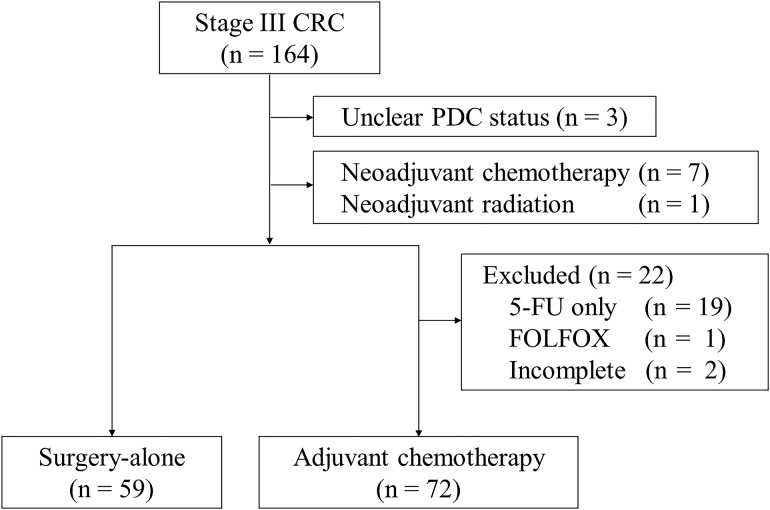
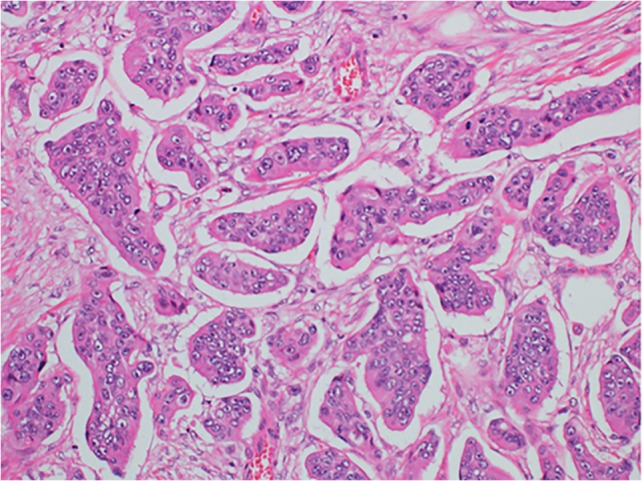
This retrospective study enrolled 131 patients with stage III colorectal cancer who underwent curative resection: 72 received 5-fluorouracil-based adjuvant chemotherapy (chemotherapy group) and 59 did not (surgery-alone group). Poorly differentiated cluster was defined as a cancer cluster of ≥5 cancer cells without gland-like structure, and was classified into poorly differentiated cluster G1, G2 and G3 according to the number of clusters. The benefit of 5-fluorouracil-based adjuvant chemotherapy was evaluated based on poorly differentiated cluster grade.
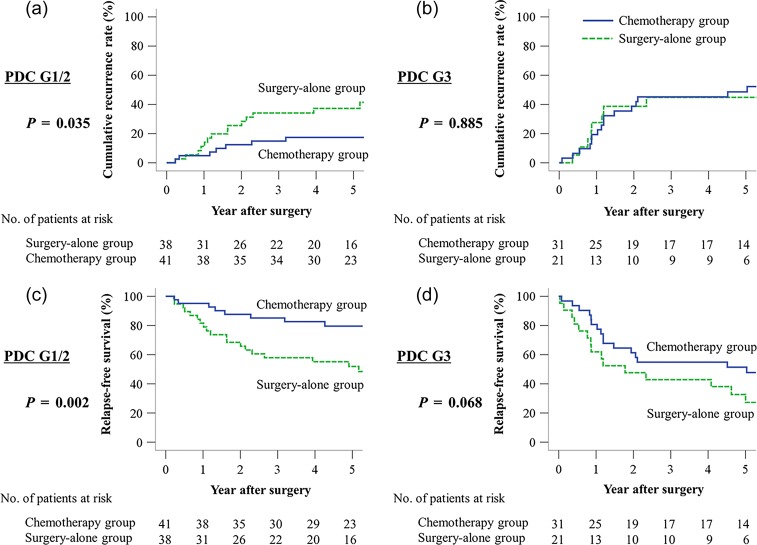
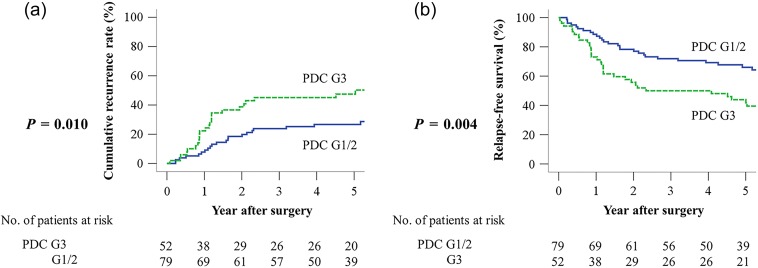
Thirty-nine, 40 and 52 patients were classified as poorly differentiated cluster G1, G2 and G3, respectively. Significant differences in the 5-year cumulative recurrence rate and relapse-free survival were observed between poorly differentiated cluster G1/G2 and G3 (26.7% vs. 47.5%, P = 0.010; 66.0% vs. 43.9%, P = 0.004). A comparison of cumulative recurrence rate and relapse-free survival between the chemotherapy and surgery-alone groups showed a significant benefit of adjuvant chemotherapy in poorly differentiated cluster G1/G2 patients (cumulative recurrence rate: 17.4% vs. 37.3%, P = 0.035; relapse-free survival: 79.5% vs. 51.9%, P = 0.002), but not in poorly differentiated cluster G3 patients (cumulative recurrence rate: 48.6% vs. 44.8%, P = 0.885; relapse-free survival: 51.4% vs. 32.7%, P = 0.068).
In stage III colorectal cancer, poorly differentiated cluster G1/G2 predicts a significant benefit from 5-fluorouracil-based adjuvant chemotherapy, whereas poorly differentiated cluster G3 predicts a poor response to it.
尽管有报道称低分化细胞簇是预测结直肠癌预后的一种有用的分级系统,但其与化疗疗效的关系尚未得到证实。我们旨在研究低分化细胞簇与Ⅲ期结直肠癌中基于5-氟尿嘧啶的辅助化疗疗效之间的关联。
这项回顾性研究纳入了131例行根治性切除术的Ⅲ期结直肠癌患者:72例接受了基于5-氟尿嘧啶的辅助化疗(化疗组),59例未接受(单纯手术组)。低分化细胞簇定义为≥5个癌细胞且无腺样结构的癌细胞簇,并根据细胞簇数量分为低分化细胞簇G1、G2和G3。基于低分化细胞簇分级评估基于5-氟尿嘧啶的辅助化疗的益处。
分别有39例、40例和52例患者被分类为低分化细胞簇G1、G2和G3。低分化细胞簇G1/G2和G3之间在5年累积复发率和无复发生存率方面存在显著差异(26.7%对47.5%,P = 0.010;66.0%对43.9%,P = 0.004)。化疗组和单纯手术组之间累积复发率和无复发生存率的比较显示,辅助化疗对低分化细胞簇G1/G2患者有显著益处(累积复发率:17.4%对37.3%,P = 0.035;无复发生存率:79.5%对51.9%,P = 0.002),但对低分化细胞簇G3患者无显著益处(累积复发率:48.6%对44.8%,P = 0.885;无复发生存率:51.4%对32.7%,P = 0.068)。
在Ⅲ期结直肠癌中,低分化细胞簇G1/G2预示基于5-氟尿嘧啶的辅助化疗有显著益处,而低分化细胞簇G3预示对其反应较差。