Kendall Debra A, Yudowski Guillermo A
Department of Pharmaceutical Sciences, University of Connecticut Storrs, CT, USA.
Department of Anatomy and Neurobiology, University of Puerto Rico, Medical Sciences CampusSan Juan, Puerto Rico; Institute of Neurobiology, University of Puerto RicoSan Juan, Puerto Rico.
Front Cell Neurosci. 2017 Jan 4;10:294. doi: 10.3389/fncel.2016.00294. eCollection 2016.
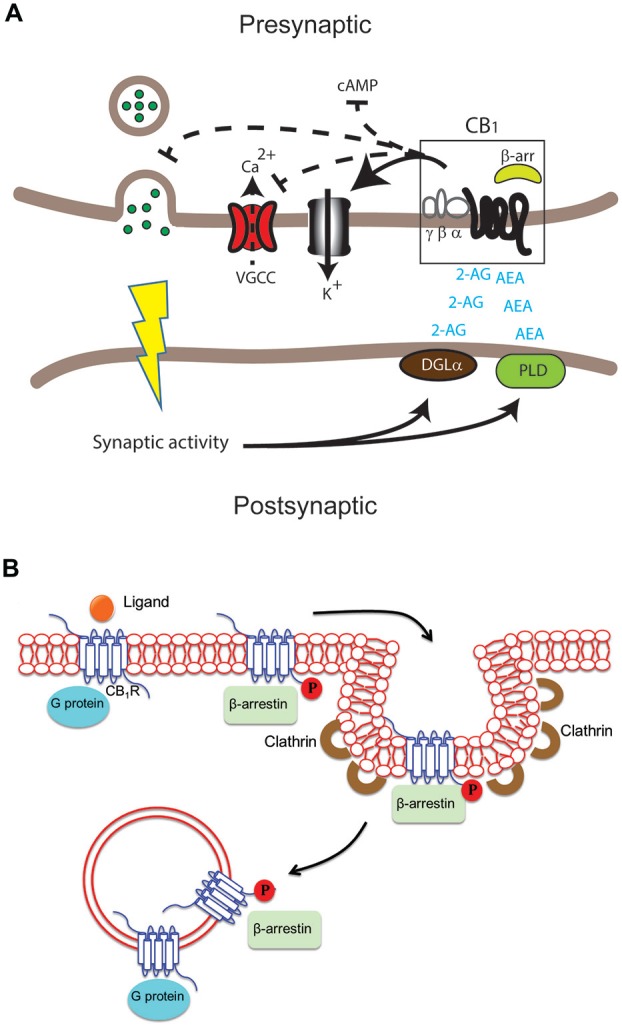
The identification and cloning of the two major cannabinoid (CB and CB) receptors together with the discovery of their endogenous ligands in the late 80s and early 90s, resulted in a major effort aimed at understanding the mechanisms and physiological roles of the endocannabinoid system (ECS). Due to its expression and localization in the central nervous system (CNS), the CB receptor together with its endogenous ligands (endocannabinoids (eCB)) and the enzymes involved in their synthesis and degradation, has been implicated in multiple pathophysiological events ranging from memory deficits to neurodegenerative disorders among others. In this review, we will provide a general overview of the ECS with emphasis on the CB receptor in health and disease. We will describe our current understanding of the complex aspects of receptor signaling and trafficking, including the non-canonical signaling pathways such as those mediated by β-arrestins within the context of functional selectivity and ligand bias. Finally, we will highlight some of the disorders in which CB receptors have been implicated. Significant knowledge has been achieved over the last 30 years. However, much more research is still needed to fully understand the complex roles of the ECS, particularly and to unlock its true potential as a source of therapeutic targets.
20世纪80年代末和90年代初,两种主要大麻素(CB1和CB2)受体的鉴定与克隆,以及它们内源性配体的发现,引发了旨在了解内源性大麻素系统(ECS)机制和生理作用的重大努力。由于CB1受体及其内源性配体(内源性大麻素(eCB))以及参与其合成和降解的酶在中枢神经系统(CNS)中的表达和定位,它们与多种病理生理事件有关,包括记忆缺陷和神经退行性疾病等。在这篇综述中,我们将对ECS进行概述,重点关注健康和疾病状态下的CB1受体。我们将描述目前对受体信号传导和转运复杂方面的理解,包括在功能选择性和配体偏向性背景下由β-抑制蛋白介导的非经典信号通路。最后,我们将强调一些与CB1受体有关的疾病。在过去30年里已经取得了重大进展。然而,仍需要更多研究来全面了解ECS的复杂作用,特别是要释放其作为治疗靶点来源的真正潜力。