van Leeuwen Roelof W F, Jansman Frank G A, Hunfeld Nicole G, Peric Robert, Reyners Anna K L, Imholz Alex L T, Brouwers Jacobus R B J, Aerts Joachim G, van Gelder Teun, Mathijssen Ron H J
Department of Medical Oncology, Erasmus MC Cancer InstituteErasmus University Medical Center, 's-Gravendijkwal 230, 3015 CE, Rotterdam, The Netherlands.
Department of Hospital Pharmacy, Erasmus University Medical Center, 's-Gravendijkwal 230, 3015 CE, Rotterdam, The Netherlands.
Clin Pharmacokinet. 2017 Jul;56(7):683-688. doi: 10.1007/s40262-016-0503-3.
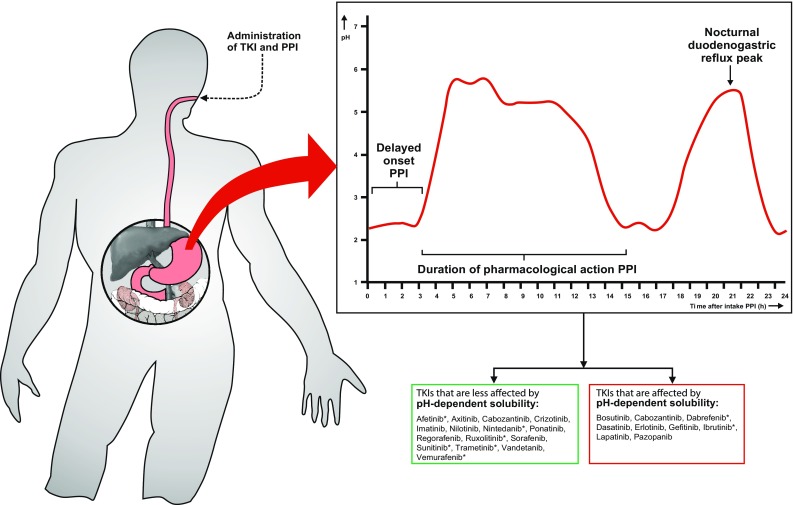
Tyrosine kinase inhibitors (TKIs) have rapidly become an established factor in oncology, and have been shown to be effective in a wide variety of solid and hematologic malignancies. Use of the oral administration route of TKIs offers flexibility and is convenient for the patient; however, despite these advantages, the oral route of administration also causes a highly relevant new problem. Acid-inhibitory drugs, such as proton pump inhibitors (PPIs), increase the intragastric pH, which may subsequently decrease TKI solubility, bioavailability, and treatment efficacy. Clear and practical advice on how to manage PPI use during TKI therapy is currently not available in the literature. Since PPIs are extensively used during TKI therapy, prescribers are presented with a big dilemma as to whether or not to continue the combined treatment, resulting in patients possibly being deprived of optimal therapy. When all pharmacological characteristics and data of either TKIs and PPIs are considered, practical and safe advice on how to manage this drug combination can be given.
酪氨酸激酶抑制剂(TKIs)已迅速成为肿瘤学领域的既定治疗手段,并已证明在多种实体瘤和血液系统恶性肿瘤中有效。TKIs采用口服给药途径具有灵活性,对患者来说也很方便;然而,尽管有这些优点,口服给药途径也引发了一个高度相关的新问题。抑酸药物,如质子泵抑制剂(PPIs),会提高胃内pH值,这可能随后降低TKI的溶解度、生物利用度和治疗效果。目前文献中尚无关于在TKI治疗期间如何管理PPI使用的明确且实用的建议。由于PPI在TKI治疗期间被广泛使用,处方医生在是否继续联合治疗方面面临巨大困境,导致患者可能无法接受最佳治疗。当综合考虑TKIs和PPIs的所有药理学特性和数据时,就可以给出关于如何管理这种药物组合的实用且安全的建议。