Department of Medical Oncology, Institut de Cancérologie de l'Ouest, Saint-Herblain, France.
Department of Medical Oncology, Institut de Cancérologie de l'Ouest, Saint-Herblain, France.
ESMO Open. 2023 Feb;8(1):100880. doi: 10.1016/j.esmoop.2023.100880. Epub 2023 Feb 8.
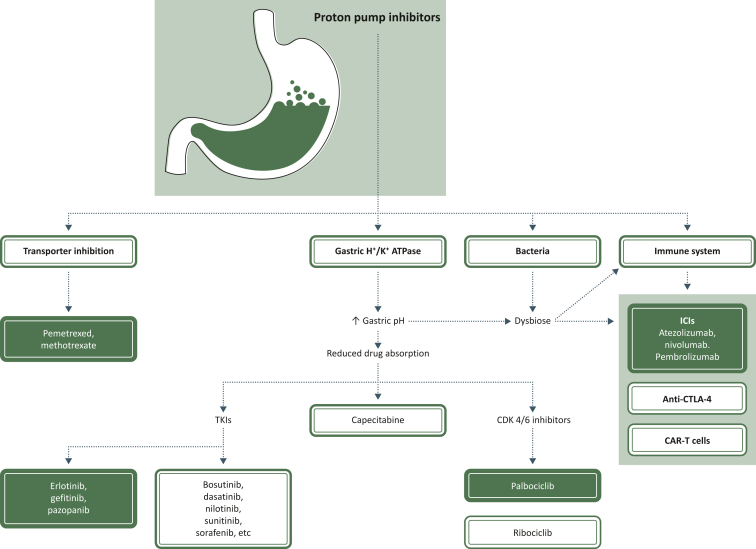
New concepts and drugs have revolutionized medical treatment for cancers. These drugs, which are very expensive and usually well tolerated, have dramatically improved cancer prognosis. We must use them wisely for patients to fully benefit. Gastric acid antisecretory drugs and particularly proton pump inhibitors (PPIs) revolutionized the treatment of gastroduodenal ulcers and severe gastroesophageal reflux, but are frequently overused for symptomatic treatment of epigastric pain or heartburn. Long-term acid suppression may alter the efficacy of many anticancer drugs, such as tyrosine kinase inhibitors (TKIs), cyclin-dependent kinase (CDK) 4/6 inhibitors and immune checkpoint inhibitors (ICIs), by either decreasing gastric acid secretion and thus drug absorption, or by modifying the gut microbiome that modulates the response to ICIs. Oncologists thus need to pay particular attention to the concomitant use of PPIs and anticancer drugs. These interactions translate into major clinical impacts, with demonstrated loss of efficacy for some TKIs (erlotinib, gefitinib, pazopanib), and conflicting results with many other oral drugs, including capecitabine and CDK 4/6 inhibitors. Furthermore, the profound changes in the gut microbiome due to using PPIs have shown that the benefit of using ICIs may be suppressed in patients treated with PPIs. As the use of PPIs is not essential, we must apply the precautionary principle. The first sentence of a recent Comment in Nature was "Every day, millions of people are taking medications that will not help them". We fear that every day millions of cancer patients are taking medications that harm them. While this may well be only association and not causation, there is enough to make us pause until we reach a clear answer. All these data should encourage medical oncologists to refrain from prescribing PPIs, explaining to patients the risks of interaction in order to prevent inappropriate prescription by another physician.
新概念和新药物彻底革新了癌症的治疗方法。这些药物非常昂贵,且通常具有良好的耐受性,它们显著改善了癌症患者的预后。为了让患者充分受益,我们必须明智地使用这些药物。胃酸分泌抑制剂,特别是质子泵抑制剂(PPIs),彻底革新了胃十二指肠溃疡和严重胃食管反流的治疗方法,但它们经常被过度用于治疗上腹痛或烧心的症状。长期的胃酸抑制可能会通过降低胃酸分泌和药物吸收,或通过改变调节免疫检查点抑制剂(ICIs)反应的肠道微生物群,从而改变许多抗癌药物(如酪氨酸激酶抑制剂(TKIs)、细胞周期蛋白依赖性激酶(CDK)4/6 抑制剂和免疫检查点抑制剂(ICIs)的疗效。因此,肿瘤学家需要特别注意 PPI 与抗癌药物的同时使用。这些相互作用带来了重大的临床影响,一些 TKI(厄洛替尼、吉非替尼、帕唑帕尼)的疗效因此降低,而许多其他口服药物(包括卡培他滨和 CDK 4/6 抑制剂)的结果则相互矛盾。此外,由于使用 PPI 导致肠道微生物群发生深刻变化,表明使用 ICIs 的获益可能会在使用 PPI 的患者中受到抑制。由于使用 PPI 并非必不可少,我们必须遵循预防原则。《自然》杂志上的一篇评论的第一句话是:“每天,数以百万计的人正在服用对他们没有帮助的药物。”我们担心每天都有数以百万计的癌症患者在服用对他们有害的药物。虽然这可能只是一种关联,而不是因果关系,但已经足以让我们停下来,直到我们得到一个明确的答案。所有这些数据都应该鼓励肿瘤内科医生避免开具 PPI,并向患者解释药物相互作用的风险,以防止其他医生开具不当处方。