Guest Olivia, Love Bradley C
Experimental Psychology, University College London, London, United Kingdom.
The Alan Turing Institute, London, United Kingdom.
Elife. 2017 Jan 19;6:e21397. doi: 10.7554/eLife.21397.
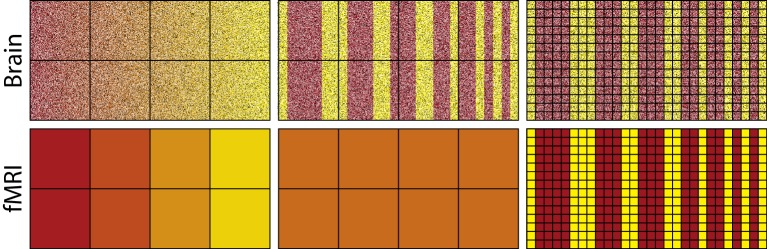
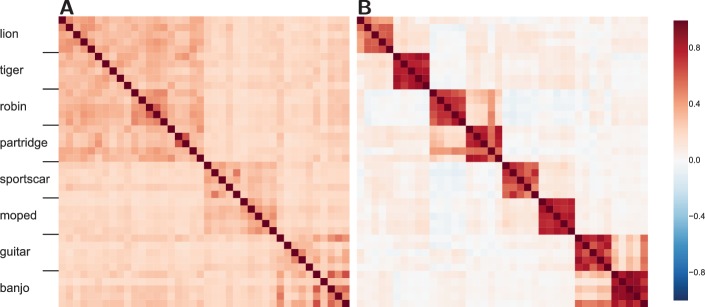
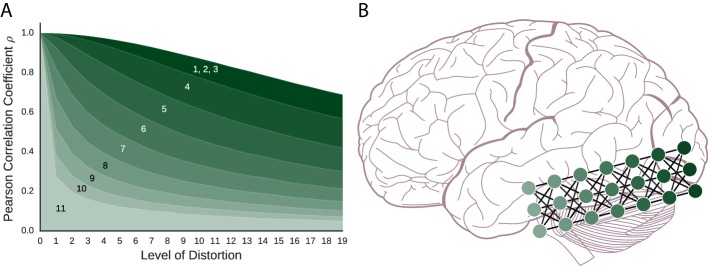
The success of fMRI places constraints on the nature of the neural code. The fact that researchers can infer similarities between neural representations, despite fMRI's limitations, implies that certain neural coding schemes are more likely than others. For fMRI to succeed given its low temporal and spatial resolution, the neural code must be smooth at the voxel and functional level such that similar stimuli engender similar internal representations. Through proof and simulation, we determine which coding schemes are plausible given both fMRI's successes and its limitations in measuring neural activity. Deep neural network approaches, which have been forwarded as computational accounts of the ventral stream, are consistent with the success of fMRI, though functional smoothness breaks down in the later network layers. These results have implications for the nature of the neural code and ventral stream, as well as what can be successfully investigated with fMRI.
功能磁共振成像(fMRI)的成功对神经编码的本质提出了限制。尽管fMRI存在局限性,但研究人员能够推断神经表征之间的相似性,这一事实意味着某些神经编码方案比其他方案更有可能。鉴于fMRI的时间和空间分辨率较低,要使其成功,神经编码在体素和功能层面必须是平滑的,以便相似的刺激产生相似的内部表征。通过论证和模拟,我们确定了哪些编码方案在fMRI测量神经活动的成功与局限两方面都是合理的。作为腹侧视觉通路计算解释而被提出的深度神经网络方法与fMRI的成功是一致的,尽管功能平滑性在网络的后期层中会失效。这些结果对神经编码和腹侧视觉通路的本质,以及使用fMRI能够成功研究的内容都具有启示意义。