Rodrigues Rafael Torres de Souza, Chizzotti Mario Luiz, Vital Camilo Elber, Baracat-Pereira Maria Cristina, Barros Edvaldo, Busato Karina Costa, Gomes Rafael Aparecido, Ladeira Márcio Machado, Martins Taiane da Silva
Department of Animal Science, Universidade Federal de Lavras, Lavras, Minas Gerais, Brazil.
Center for Analysis of Biomolecules, Nubiomol, Universidade Federal de Viçosa, Viçosa, Minas Gerais, Brazil.
PLoS One. 2017 Jan 19;12(1):e0170294. doi: 10.1371/journal.pone.0170294. eCollection 2017.
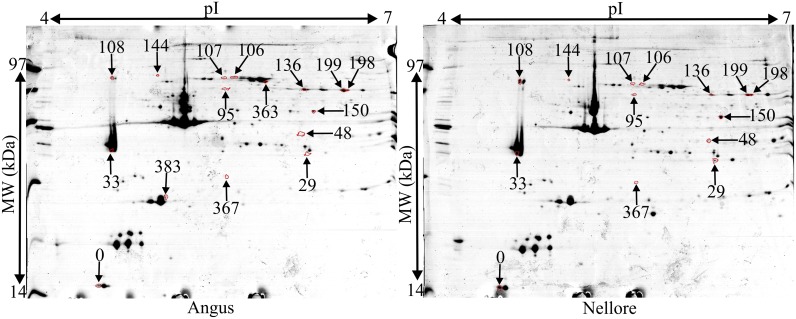
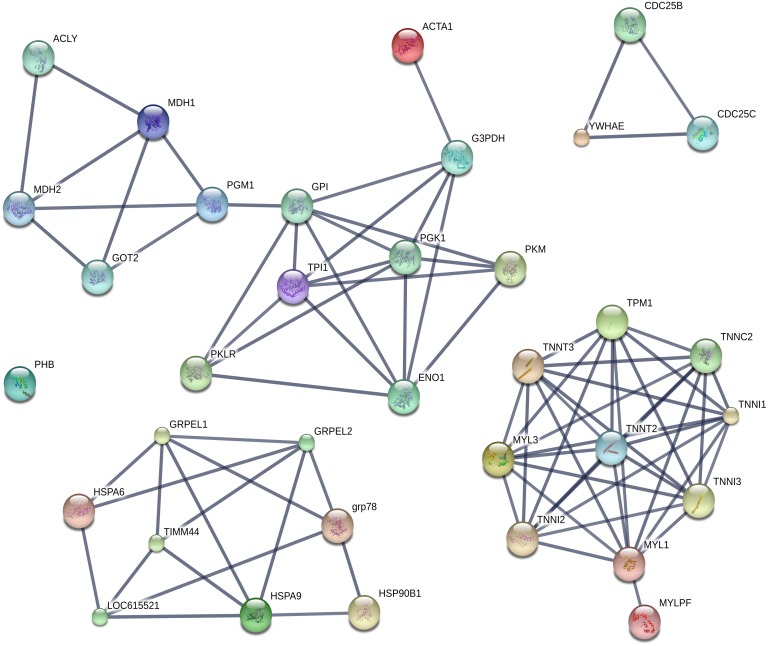
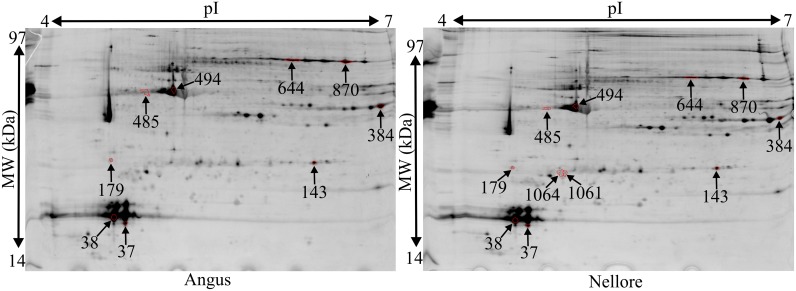
Proteins are the major constituents of muscle and are key molecules regulating the metabolic changes during conversion of muscle to meat. Brazil is one of the largest exporters of beef and most Brazilian cattle are composed by zebu (Nellore) genotype. Bos indicus beef is generally leaner and tougher than Bos taurus such as Angus. The aim of this study was to compare the muscle proteomic and phosphoproteomic profile of Angus and Nellore. Seven animals of each breed previously subjected the same growth management were confined for 84 days. Proteins were extracted from Longissimus lumborum samples collected immediately after slaughter and separated by two-dimensional electrophoresis. Pro-Q Diamond stain was used in phosphoproteomics. Proteins identification was performed using matrix assisted laser desorption/ionization time-of-flight mass spectrometry. Tropomyosin alpha-1 chain, troponin-T, myosin light chain-1 fragment, cytoplasmic malate dehydrogenase, alpha-enolase and 78 kDa glucose-regulated protein were more abundant in Nellore, while myosin light chain 3, prohibitin, mitochondrial stress-70 protein and heat shock 70 kDa protein 6 were more abundant in Angus (P<0.05). Nellore had higher phosphorylation of myosin regulatory light chain-2, alpha actin-1, triosephosphate isomerase and 14-3-3 protein epsilon. However, Angus had greater phosphorylation of phosphoglucomutase-1 and troponin-T (P<0.05). Therefore, proteins involved in contraction and muscle organization, myofilaments expressed in fast or slow-twitch fibers and heat shock proteins localized in mitochondria or sarcoplasmic reticulum and involved in cell flux of calcium and apoptosis might be associated with differences in beef quality between Angus and Nellore. Furthermore, prohibitin appears to be a potential biomarker of intramuscular fat in cattle. Additionally, differences in phosphorylation of myofilaments and glycolytic enzymes could be involved with differences in muscle contraction force, susceptibility to calpain, apoptosis and postmortem glycolysis, which might also be related to differences in beef quality among Angus and Nellore.
蛋白质是肌肉的主要成分,是调节肌肉转化为肉过程中代谢变化的关键分子。巴西是最大的牛肉出口国之一,大多数巴西牛是瘤牛(内罗尔牛)基因型。印度瘤牛的牛肉通常比安格斯等欧洲牛种更瘦、更硬。本研究的目的是比较安格斯牛和内罗尔牛的肌肉蛋白质组和磷酸化蛋白质组图谱。每个品种的7只动物先前接受相同的生长管理,圈养84天。屠宰后立即从腰大肌样本中提取蛋白质,通过二维电泳进行分离。磷酸化蛋白质组学使用Pro-Q Diamond染色。使用基质辅助激光解吸/电离飞行时间质谱进行蛋白质鉴定。原肌球蛋白α-1链、肌钙蛋白-T、肌球蛋白轻链-1片段、细胞质苹果酸脱氢酶、α-烯醇化酶和78 kDa葡萄糖调节蛋白在内罗尔牛中含量更高,而肌球蛋白轻链3、抑制素、线粒体应激-70蛋白和热休克70 kDa蛋白6在安格斯牛中含量更高(P<0.05)。内罗尔牛的肌球蛋白调节轻链-2、α-肌动蛋白-1、磷酸丙糖异构酶和14-3-3蛋白ε的磷酸化水平较高。然而,安格斯牛的磷酸葡萄糖变位酶-1和肌钙蛋白-T的磷酸化水平更高(P<0.05)。因此,参与收缩和肌肉组织的蛋白质、在快肌或慢肌纤维中表达的肌丝以及位于线粒体或肌浆网中且参与钙细胞通量和细胞凋亡的热休克蛋白可能与安格斯牛和内罗尔牛牛肉品质的差异有关。此外,抑制素似乎是牛肌内脂肪的潜在生物标志物。此外,肌丝和糖酵解酶磷酸化的差异可能与肌肉收缩力、对钙蛋白酶的敏感性、细胞凋亡和宰后糖酵解的差异有关,这也可能与安格斯牛和内罗尔牛之间牛肉品质的差异有关。