Kaizik Cassandra, Caga Jashelle, Camino Julieta, O'Connor Claire M, McKinnon Colleen, Oyebode Jan R, Piguet Olivier, Hodges John R, Mioshi Eneida
Neuroscience Research Australia, Sydney, Australia.
Sydney Medical School, Brain and Mind Research Institute, University of Sydney, Camperdown, Australia.
J Alzheimers Dis. 2017;56(3):1109-1117. doi: 10.3233/JAD-160852.
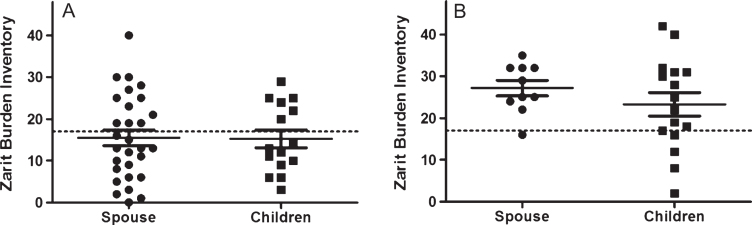
The objectives of this observational study were to (1) compare spousal and child caregiver burden; (2) compare co-resident and live-out child caregiver burden; and (3) investigate factors influencing spousal and child caregiver burden. Data was collected from 90 caregivers of people with frontotemporal degeneration (FTD) recruited from the Frontotemporal Dementia Research Group (Frontier) at Neuroscience Research, Australia. Of this caregiver group, 43 were spousal caregivers and 47 were child caregivers. Caregiver burden and emotional state were evaluated using the short Zarit Burden Interview and the short version of the Depression, Anxiety and Stress Scale-21. The Social Network Index was applied to ascertain the social network of the caregiver, while the Intimate Bond Measure was used to evaluate the current quality of the relationship between the caregiver and the person with dementia. The Frontotemporal Dementia Rating Scale was used to assess severity of dementia. Spousal and child caregivers experienced similar levels of burden, depression, anxiety, and stress, regardless of disease severity. Co-resident child caregivers had smaller social networks and greater burden than live-out caregivers. Dementia severity was key in spousal caregiver burden, whereas caregiver depression was most important in child caregiver burden. Child and spousal caregivers of individuals with FTD share similar levels of burden, influenced by different factors. Future interventions need to account for these differences.
(1)比较配偶和子女照顾者的负担;(2)比较同住和不住在一起的子女照顾者的负担;(3)调查影响配偶和子女照顾者负担的因素。数据收集自澳大利亚神经科学研究所额颞叶痴呆研究小组(Frontier)招募的90名额颞叶变性(FTD)患者的照顾者。在这个照顾者群体中,43名是配偶照顾者,47名是子女照顾者。使用简短版的扎里特负担访谈量表以及抑郁、焦虑和压力量表-21简版评估照顾者的负担和情绪状态。应用社会网络指数来确定照顾者的社会网络,同时使用亲密关系量表来评估照顾者与痴呆症患者之间当前的关系质量。使用额颞叶痴呆评定量表评估痴呆症的严重程度。无论疾病严重程度如何,配偶和子女照顾者在负担、抑郁、焦虑和压力水平上相似。同住的子女照顾者比不住在一起的照顾者社会网络更小且负担更重。痴呆症严重程度是配偶照顾者负担的关键因素,而照顾者的抑郁对子女照顾者负担最为重要。FTD患者的子女和配偶照顾者负担水平相似,但受不同因素影响。未来的干预措施需要考虑这些差异。